 Article Overview
This article explores the core resources of DFRobot’s AI main control board and showcases the rich application potential of DFRobot AI sensor technology in the field of perception through detailed case studies and hardware introductions. It also demonstrates how DFRobot reduces the threshold for AI innovation through its open-source hardware products, promoting the popularization of AI technology.
Hey, tech enthusiasts, we meet again! Pay attention—2025 is a new opportunity for DFRobot, and the series of videos titled 【AI Co-creation, Intelligence Surpassing the Present】 has been launched!
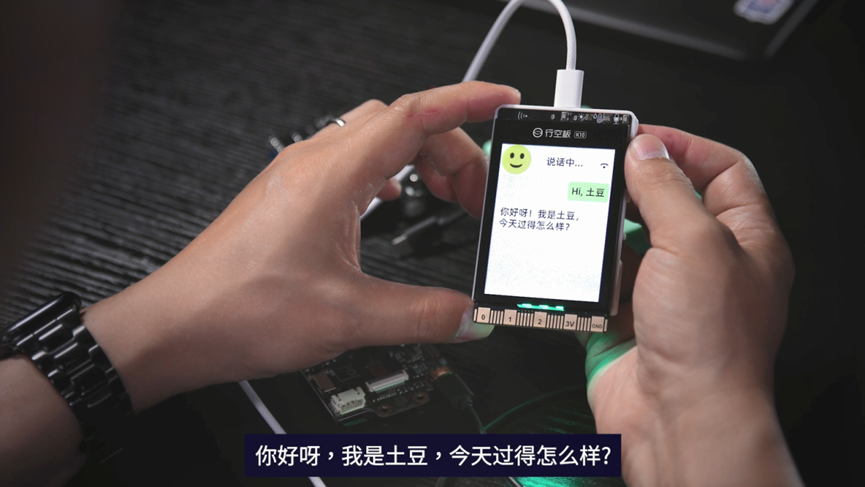
“Hello, Xiao Zhi.”
“Hello, I am Potato, how’s your day?”
“Activate work mode.”
“Okay, work mode is activated, volume is increased!”
This conversation, resembling a chat between friends, does not occur between people but rather between a person and a palm-sized circuit board. When an AI camera can call your name in real-time, when sensors can predict whether an elderly person is about to fall, and when a development board can achieve voice control as easily as building blocks— we are experiencing a “machine perception revolution,” and leading this revolution into the hands of ordinary people are open-source hardware players like DFRobot.
Guest Speaker Introduction
The first episode of the series will be presented by DFRobot Senior Engineer Xia Qing (Rockets Xia), who will guide us on how AI reshapes human perception and why DFRobot’s hardware makes AI innovation no longer exclusive to experts.

Xia Qing (Rockets Xia)
Senior Engineer at DFRobot, Co-founder of Mushroom Cloud Maker Space
Xia Qing is often active in domestic and international maker communities. Since 2008, he has been dedicated to promoting maker culture and facilitating the development of the maker movement in China. In 2010, he co-created the first maker space in China, the New Workshop, with the “father of Chinese makers” Li Dawei. In 2013, with the support of DFRobot and Puru Group, he established the Mushroom Cloud Maker Space. As a co-founder of the Mushroom Cloud Maker Space, he frequently encourages and promotes community maker projects. As a Senior Engineer at DFRobot, he actively works to promote the implementation and dissemination of advanced technologies such as artificial intelligence and the Internet of Things in the maker and maker education fields.
Live Demonstration of Machine “Superpowers”
Click here to see the live demonstration of machine “superpowers”
What Makes the AI Main Control Board Special
From “executing commands” to “active thinking”: what makes the AI main control board special?
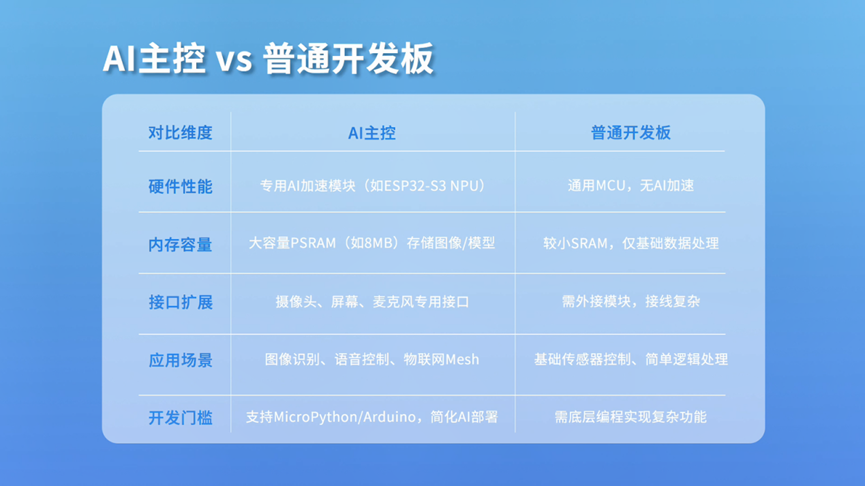
Those who have used traditional development boards know that a regular Arduino board is like a “obedient little assistant”: you tell it to turn on a light, and it powers the circuit; you tell it to turn a motor, and it drives the motor. But if you want it to “understand” whether there is a cat in a photo or “understand” a dialect command, it becomes completely confused—this is the core difference between traditional development boards and AI main control boards.
DFRobot engineers define the “AI main control board” as a “super brain” optimized for artificial intelligence tasks. Its secrets lie in three areas:
-
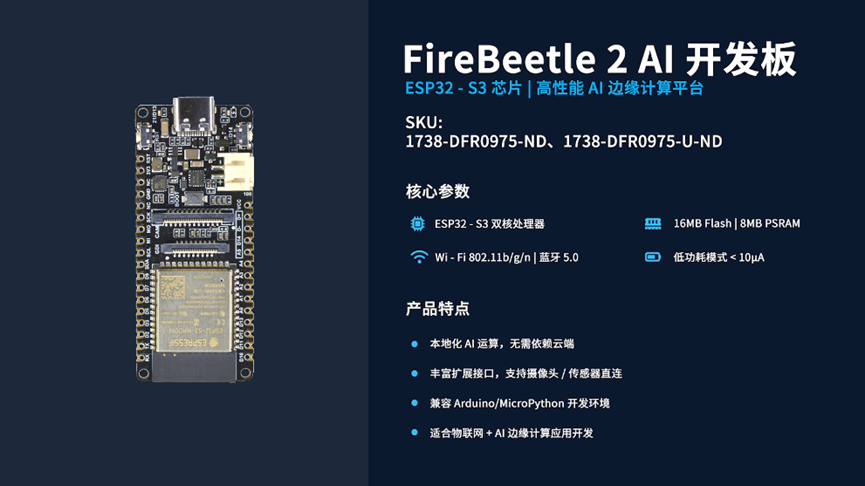
Built-in “AI accelerator”: for example, the ESP32-S3 chip on the FireBeetle 2 has a built-in vector computation extension module that allows complex neural network models to run at high speed locally. It’s like installing a dedicated graphics card in a computer, making image and voice processing speeds over 10 times faster than a regular MCU.
-
“Super large memory” to accommodate intelligence: the 8MB PSRAM equipped on the Xingkong board K10 can easily store image frames and AI models. In contrast, the SRAM on traditional development boards is so small that it can only handle simple data, like trying to store a movie on a USB drive that simply can’t fit.
-
“Plug-and-play” smart interfaces: cameras, microphones, and screens can be connected directly without complex wiring. For example, the Xingkong board M10 comes with a 2.8-inch screen that can display recognition results as soon as it’s plugged in, while a regular development board might require soldering wires and adjusting power, which can easily discourage beginners.
The most crucial point is that these “super brains” can achieve localized AI computation. When using the FireBeetle 2 with the OV2640 camera for face detection, the model runs directly on the board without relying on the cloud, resulting in response times in the millisecond range and eliminating concerns about privacy data leakage—this is essential for scenarios like smart homes and elderly monitoring.
The “Evolution of Sensors”: From “Reporting Data” to “Thinking”
If the AI main control board is the “brain,” then AI sensors are the “smart five senses.” Traditional sensors act like dull messengers: temperature 26°C, humidity 87%, VOC 300—once the data is reported, that’s it; they have no idea whether it’s the aroma of coffee or the sweetness of mango.
However, DFRobot’s AI sensors have evolved into “interpreters”:
-
The SEN0305 HuskyLens visual module not only takes photos but can also directly tell you “this is a cat” or “that is a human face,” and even distinguish between different people;
-
The SEN0609 millimeter-wave radar can not only sense the presence of a person but also use point cloud algorithms to determine “is this person about to fall?” Even if the person is motionless, it can monitor subtle changes in breathing and heartbeat;
-
The BME688 smart gas sensor even incorporates AI models into the hardware, allowing it to identify whether the smell is “coffee” or “alcohol” just by sniffing.
Behind these “smart five senses” is the deep integration of hardware and algorithms. They come with processors and pre-trained models, enabling the entire process from “data collection” to “making judgments” to be completed locally. For example, the offline voice module can understand “turn on the lights” without needing to connect to the internet and can respond with “lights are on,” forming a complete interactive loop—this is essential in areas or factories without network access.
Choosing the Right Tools, AI Innovation Threshold Drops by 80%
Choosing the right tools can reduce the AI innovation threshold by 80%. Many people feel that AI development is out of reach, but DFRobot’s open-source hardware is breaking it down into “building blocks”:
-
Zero-based entry? Start with the Arduino kit: 35 components + 30 illustrated tutorials, from lighting an LED to controlling a servo, step by step understanding how sensors work. Although it is not an AI device, it serves as a foundational “scaffold.”
-
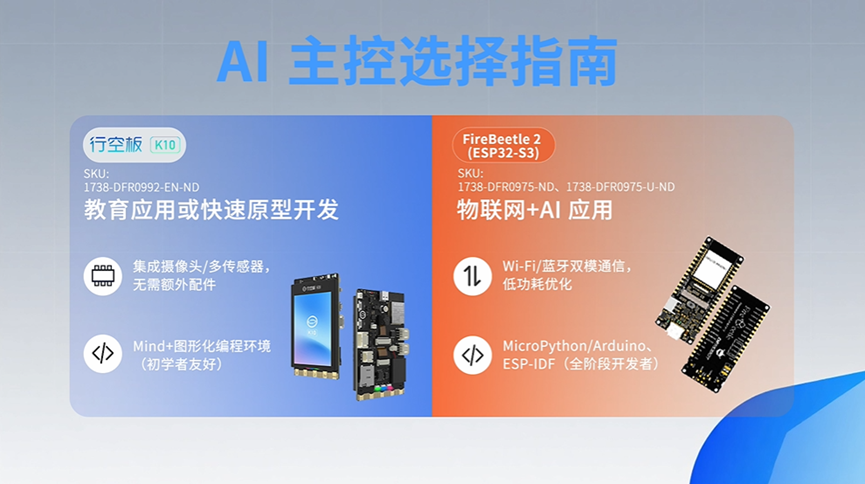
Want to quickly create smart projects? Choose the Xingkong board K10: The graphical programming platform Mind+ allows you to write code like building blocks, enabling students to easily create voice-controlled cars; the onboard camera and screen mean no additional accessories are needed.
-
Looking to do IoT + AI? FireBeetle 2 is the first choice: Wi-Fi + Bluetooth dual-mode communication, low-power design allows the battery to last for six months, making it particularly suitable for devices like smart locks and environmental monitoring that require long-term operation.
Moreover, from beginner-friendly MicroPython to advanced ESP-IDF low-level development, DFRobot’s ecosystem covers all bases. Even if you want to customize a neural network model, you can implement it on these hardware platforms—this means that whether it’s AI experiments in primary and secondary school classrooms, creative ideas from makers, or prototype development in enterprises, suitable tools can be found.
The future is here: when “intelligence” becomes standard
Today’s AI hardware is no longer a rarity in laboratories: in nursing homes, millimeter-wave radars monitor whether the elderly fall 24/7; in fields, AI sensors can distinguish “this is a weed or a crop”; at home, smart lights with voice interaction understand your habits better than switches.
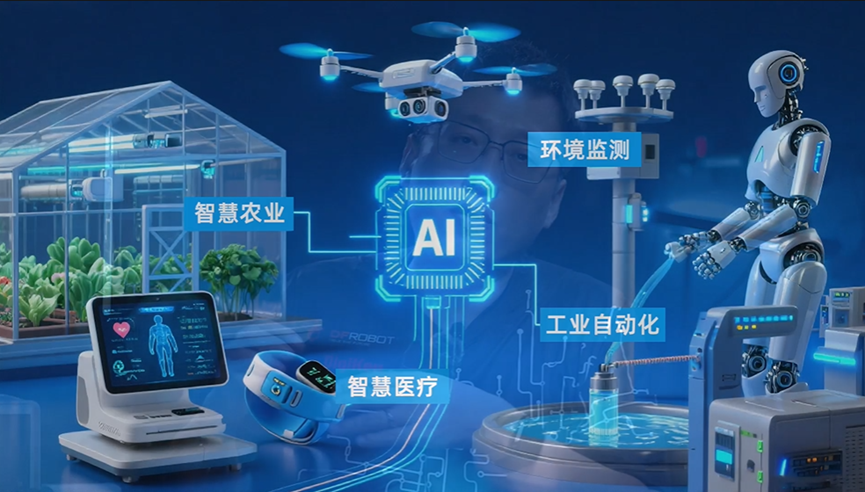
What DFRobot is doing is making this kind of “intelligence” as simple as buying a screwdriver—no need to understand complex algorithms, no need to solder dense circuits, and even without writing code, ordinary people can participate in AI innovation.
Next Episode Preview
This is just the first episode of the series. In the upcoming episodes, we will also reveal:
-
From “centralized intelligence” to “distributed intelligence”: TinyML and local offline AI
-
The interactive experience of multimodal perception: exploring AI applications such as speech synthesis/speech recognition/image recognition
-
Expanding the spatiotemporal boundaries of human perception: AI + environmental detection projects
If you also want to create a “thinking” device, why not start with a development board and a sensor—after all, the innovations that change the world are often hidden in these accessible tools.
Join DFRobot in playing with AI, and you might be the next to change the world! See you next time, don’t miss it!
Related Product Information

DFR0992-EN Xingkong Board-K10
The Xingkong Board K10 is a learning board developed specifically for programming learning, IoT, and AI project teaching needs in information technology courses. It integrates a camera, LCD color screen, microphone, speaker, Wi-Fi and Bluetooth modules, RGB indicator lights, and various sensors and expansion interfaces, enabling sensor control, IoT applications, image detection, voice recognition, voice synthesis, and other AI projects without additional equipment.
DigiKey Part Number: 1738-DFR0992-EN-ND
DFR0706-EN Xingkong Board-M10
The Xingkong (UNIHIKER) M10 is a highly integrated domestic teaching open-source hardware (with independent intellectual property rights) designed for K12 teachers and students, adapting to the new curriculum standards for interdisciplinary teaching in information technology, physics, biology, and other subjects. It integrates a single-board computer (4-core CPU/512MB memory/16GB storage), Linux system, complete Python environment, and comes pre-installed with commonly used Python libraries, along with a 2.8-inch color touchscreen and rich sensors, allowing you to start a Python teaching platform in just two steps.
DigiKey Part Number: 1738-DFR0706-EN-ND
DFR0975-U High-performance main control based on ESP32-S3, suitable for AIOT, image acquisition, and image recognition projects
The FireBeetle 2 ESP32-S3-U is a main control board designed based on the ESP32-S3-WROOM-1U-N16R8 module. The ESP32-S3-WROOM-1U-N16R8 module has 16MB Flash and 8MB PSRAM, allowing for more code and data storage. The ESP32-S3 chip on the module has powerful neural network computing and signal processing capabilities, making it suitable for image recognition, voice recognition, and other projects.
DigiKey Part Number: 1738-DFR0975-U-ND
DFR0100 Maker education introductory learning kit, suitable for Arduino UNO R3 development board and electronics beginners
The Arduino introductory kit is a set of tools designed for beginners in electronic circuit building and programming logic. It covers course content from basic LED control to complex environmental sensing, monitoring, and actuator applications.
DigiKey Part Number: DFR0100-ND
SEN0609 24GHz millimeter-wave presence sensor (25m, UART) long-distance, high-precision motion and static detection and distance speed measurement sensor
The C4001 (25m) millimeter-wave presence sensor uses a 24GHz wavelength signal, has a horizontal detection range of 100°, a presence detection range of 16 meters, and a motion detection range and distance measurement range of 25 meters.
DigiKey Part Number: 1738-SEN0609-ND
SEN0539-EN Gravity: Offline Voice Recognition Module (I2C & UART)
This module uses a brand new offline voice recognition chip. It has 135 built-in common fixed command phrases and a new command self-learning function. The self-learned command phrases can be anything from a segment of speech to a whistle, a clap, or a cat meow, supporting 17 self-learning command phrases. It uses dual microphones for better noise resistance and longer recognition distance. The module comes with a speaker and an external speaker interface, allowing real-time voice feedback of recognition results. The module supports both I2C and UART communication methods, Gravity interface, and is compatible with Arduino Uno, Arduino Leonardo, Arduino MEGA, FireBeetle series controllers, Raspberry Pi, ESP32, and other main controls.
DigiKey Part Number: 1738-SEN0539-EN-ND
SEN0305 Gravity: HuskyLens AI Vision sensor
The HuskyLens is a simple-to-use AI vision sensor that has six built-in functions: face recognition, object tracking, object recognition, line tracking, color recognition, and label recognition. AI training can be completed with just one button, eliminating the need for cumbersome training and complex visual algorithms, allowing you to focus more on project conception and implementation.
DigiKey Part Number: 1738-SEN0305-ND
SEN0617 Gravity: I2C BME688 Environmental sensor
The Gravity BME688 environmental sensor is a highly integrated MEMS environmental sensor capable of measuring temperature, humidity, pressure, and VOC gases (volatile organic compounds) comprehensively. Its software protocol and hardware dimensions are fully compatible with the BME680, allowing for direct replacement in existing systems without any adjustments. Additionally, the BME688 improves temperature measurement accuracy and has been designed with cutouts around the chip on the circuit board to reduce the impact of external component heat on measurements.
DigiKey Part Number: 1738-SEN0617-ND
DFR0760 Gravity: Chinese and English Speech Synthesis Module V2.0
Add a touch of character to your project with sound! Connect the speech synthesis module, and with just a few lines of simple code, your project can start talking. Whether in Chinese or English, the speech synthesis module makes it “so easy” to announce the current time or environmental data. When combined with the voice recognition module, it can even achieve voice dialogue! The module supports both I2C and UART communication methods, Gravity interface, and is compatible with most main controls. The module already comes with a speaker, so you don’t need to add an extra one.
DigiKey Part Number: 1738-DFR0760-ND
Welcome to click the end of the article “Read the full text” to explore the products you need on the DigiKey website~
Editor’s Note
As introduced in the article and video, DFRobot’s open-source hardware effectively breaks down the professional barriers of AI development through three core advantages: technical simplification, cost optimization, and a complete ecosystem, enabling individual makers, educational institutions, and enterprises to participate in AI innovation in a cost-effective and efficient manner. At the same time, it deeply integrates the “open-source spirit” with “AI engineering,” accelerating the landing and commercialization of AI creativity. Have you used DFRobot’s open-source hardware to develop AI projects? What experiences or questions do you have regarding related development? Feel free to leave a message and share with friends from DigiKey!



“Star” us, and don’t miss fresh cases and industry insights