Universal GPU: The Key to the Next Decade

Universal GPU: The Key to the Next Decade

Source: Xingneng Assets

Editor | Eva
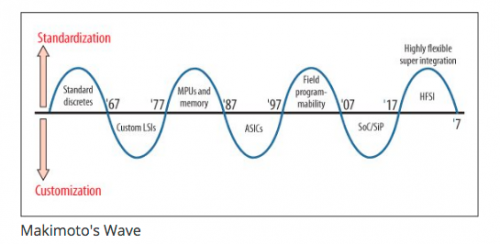
In 1987, Tsugio Makimoto, the former chief engineer of Hitachi, proposed that semiconductor products might advance along a path of alternating “standardization” and “customization,” oscillating every ten years. He published this idea in Electronics Weekly in 1991, referring to it as “Makimoto’s Wave.”
Universal GPU: The Key to the Next Decade
In recent years, the rapid development of programmable chips has validated the correctness of “Makimoto’s Wave,” receiving responses from programmable chip manufacturers like Xilinx and Altera. A professor in Germany even referred to “Makimoto’s Wave” as “Makimoto’s Law,” suggesting that in the context of semiconductor technology approaching its limits, “Makimoto’s Law” will surpass Moore’s Law, and future semiconductor technology will rely on “Makimoto’s Law” to sustain its high growth innovation speed.
For the past few years, we have been calling for AI chips and high-performance computing chips. If “Makimoto’s Wave” still holds, the next peak will be chips with ultra-high flexibility integration. In today’s AI era, this refers to GPGPU.

What is GPGPU?

Universal GPU: The Key to the Next Decade
To clarify GPGPU, we must start with GPU. Initially, GPUs were also dedicated chips—compared to CPUs, early GPUs were specialized for graphics computation acceleration and were introduced as ASIC chips. However, through continuous development and evolution, GPUs have gradually evolved to possess more and more general-purpose attributes, namely programmability.
Especially since NVIDIA introduced CUDA around 2006. CUDA was a significant innovation for programming in the field of high-performance heterogeneous computing using GPUs, undoubtedly a highly correct strategic move—CUDA allows direct application development based on C, C++, Fortran, Python, and other languages, establishing a vast developer user base, laying the technological foundation and ecological strength for the widespread application of GPUs.
Of course, this is also due to the era of big data, where various industries require stronger computing power. The introduction of CUDA initiated NVIDIA’s GPGPU (General Purpose GPU) strategy—at a time when most people still perceived GPUs as merely game graphics accelerators, the era of GPGPU began.
GPGPU, sometimes referred to as GP2U (GP squared U), indicates different meanings: the latter GP represents graphic processing (Graphic Process), combining with U to form the familiar GPU (Graphics Processing Unit); the former GP represents “General Purpose.”
GPGPU is not a specific chip but a concept, which utilizes graphic processors for high-performance computing that is not related to graphic rendering.
Narrowly speaking, GPGPU optimizes the design based on GPUs to make them more suitable for high-performance parallel computing and capable of using higher-level programming languages, thus enhancing performance, usability, and generality.
In terms of application fields, GPGPU has expanded applications beyond graphics, widely utilized in scientific computing, blockchain, big data processing, engineering computing, finance, and genetics, with numerous research results and new application models emerging.
Universal GPU: The Key to the Next Decade
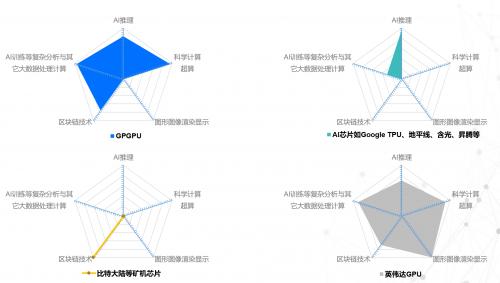
As shown in the figure above, the application of GPUs in AI computing, whether for cloud training or edge inference, is essentially a direction of the general-purpose attribute of GPUs. In other words, AI computing in the GPGPU world is just one component. However, due to the immense potential of AI computing, GPU manufacturers focus on developing and promoting this direction.
If we compare a CPU to a mathematician and a GPU to an artist, then GPGPU might be… Leonardo da Vinci.

The Battlefield of Competition

Universal GPU: The Key to the Next Decade
Currently, NVIDIA seems to dominate the GPGPU field globally.
In fact, as early as around 2006, AMD released a “stream processor,” considered AMD’s first attempt at GPGPU. However, that “stream processor” was merely a “prototype” of GPGPU, far from demonstrating its true power.
After that, AMD did not make many moves in GPGPU, and even the subsequently developed OpenCL was launched by Apple. This caused AMD to miss the opportunity to compete with NVIDIA in the GPGPU space, relegating it to the role of a follower.
Intel is also accelerating its layout in general-purpose GPUs. Intel’s desire for GPUs is well-known, stemming from a history of frustration—from initial disdain for GPUs to developing independent graphics cards based on its x86 architecture. After a decade of effort, Intel still has not produced a decent GPU. Recently, it has been rumored that Intel will launch its first independent GPU in 2020, likely due to its heavy investment in talent acquisition—several key figures from AMD’s RTG graphics department, including Raja, the Zen architecture leader Jim Keller, and graphics technology market director Damien Triolet, were recruited by Intel in 2018.

It is easy to imagine that for Intel, by 2020, the significance of developing traditional graphics cards is evidently minimal. In the era of heterogeneous computing, Intel has only decided to focus on data centers to trigger its GPU ambitions.

From relevant industry technical personnel, the challenges of developing GPGPU lie in several aspects.
From a hardware perspective, the core issue is the instruction set.The coverage, granularity, and efficiency of the instruction set determine whether a chip can cover a sufficiently wide application market and be friendly to software development and product iteration. Both NVIDIA and AMD’s GPGPU instruction sets are at the level of thousands, while most domestic AI chip instruction sets are under a hundred. The differences in type and quantity reflect the complexity of efficiently implementing hardware, and the gap is significant; domestic teams still have a certain distance to cover in this regard. Another important aspect is task management and intelligent scheduling based on the hardware layer, which can improve the utilization of computing power from the hardware level, commonly referred to as actual computing power. Most AI chips rely entirely on software layer scheduling, which complicates software development, reduces hardware computing power utilization, and slows down the iteration and updating speed of the software stack—this undoubtedly increases the difficulty of product landing and engineering in the AI field, given the fast-paced updates required for algorithm models, development environments, and application scenarios.
On the software side, undoubtedly, the most critical aspect is the development ecosystem.Through more than a decade of cultivation, GPGPU has established a large and mature ecosystem—CUDA—with over 1.6 million developers. AI chips need to build a brand new ecosystem, which brings significant issues in two dimensions: the first dimension is the client side, where clients need a lengthy adaptation period to switch from the original development environment to the new software ecosystem, which not only requires resource investment but also delays the business deployment time window and increases business uncertainty. More seriously, it hinders the protection of existing software investments, as many parts of the software need to be rewritten and adapted, which is a very sensitive and cautious matter for enterprise users. The second dimension concerns product development; skipping the CUDA layer to directly support development frameworks from the bottom chip and system software inevitably requires massive software investment, constantly chasing new versions of existing frameworks and the new frameworks of ecosystem giants, which becomes particularly pronounced in the context of a shortage of underlying software personnel.
Both of the above points ultimately require people to solve, and precisely in this area, talent is currently the most lacking in Chinese enterprises. Currently, only NVIDIA and AMD have rich teams, which indirectly explains why Intel has struggled for several years and still ended up hiring several key figures from AMD.
Regarding GPGPU, there are very few chip manufacturers in China that can discern development opportunities and take action. Many companies choose to take a roundabout approach or attempt to leapfrog, but often this means switching tracks. Other manufacturers, including Cambrian, Yitu, Bitmain, and Suiruan Technology, are currently focusing on AI chips and have developed their unique styles and levels based on their advantages.

Chinese Enterprises: Challenges and Opportunities Coexist
Universal GPU: The Key to the Next Decade
Upon reflection, it is easy to understand why general-purpose GPUs have become a battleground for competition, driven by at least two clear and hidden factors. On the surface, we are in the era of heterogeneous computing; in recent years, the traditional CPU-centric server market has seen relatively slow growth, while GPU servers have been growing rapidly, with an annual growth rate reportedly exceeding 60%.
The potential factor lies in the arrival of the 5G era, which has accelerated the development of the Internet of Things, leading to a richer and more diverse range of application scenarios. This requires cloud computing resources to meet the demands of various complex scenarios, and engineers are certainly more inclined to use chips that can “handle everything” in servers.
There is no doubt that in the era of computing power economy, the world is facing a surge in the semiconductor market, with various semiconductor companies emerging, whether established, mature, or startups, all competing fiercely. NVIDIA has early on leveraged its powerful GPU + CUDA solution to penetrate various fields, building an impregnable ecological wall with substantial R&D investment and time; this is precisely the weak link for other players both domestically and internationally.
Domestic chip companies, especially those in the startup phase, know that “correct choices outweigh a hundred times of effort.” It can be said that general-purpose GPUs are indeed a direction worth investing in. GPGPU has only been around for a little over a decade, and its “moat” is not insurmountable.
However, at the current stage, domestic alternatives still need to promote their chip products based on the CUDA ecosystem while building a new ecosystem compatible with CUDA. Every step in this process is crucial and filled with challenges.

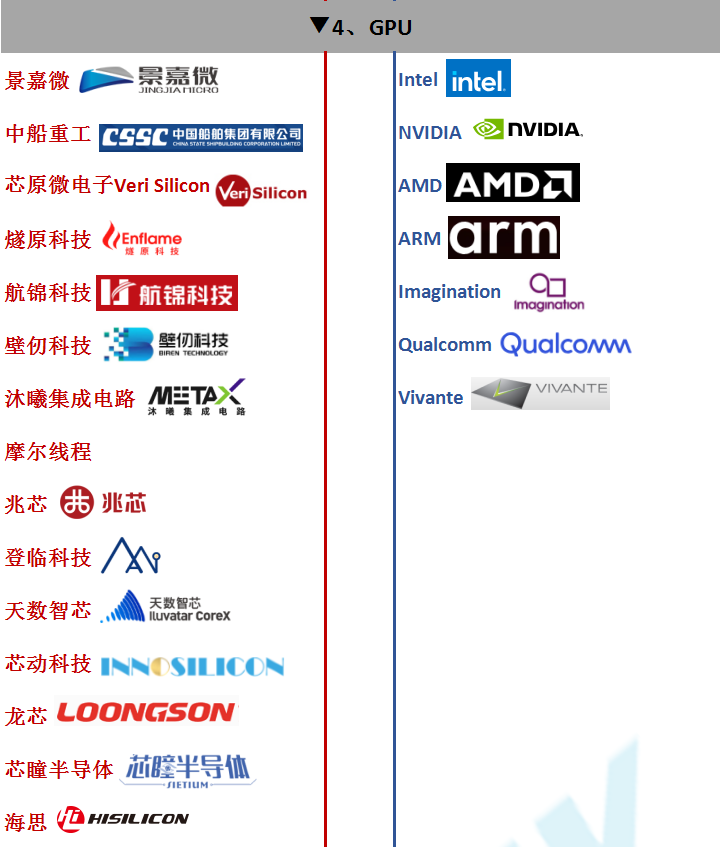
Introduction to Some Domestic GPU Chip Enterprises
Universal GPU: The Key to the Next Decade

1.Jingjia Micro

Founded in April 2006, Changsha Jingjia Microelectronics Co., Ltd. focuses on technology and comprehensive applications in information detection, processing, and transmission, providing customers with highly reliable and high-quality solutions, products, and supporting services. In March 2016, the company was successfully listed on the Shenzhen Stock Exchange’s Growth Enterprise Market, stock code: 300474.

The company possesses complete research and production qualifications and certifications, establishing strategic partnerships with many research institutes and universities, forming joint laboratories and engineering centers. Its products cover integrated circuit design, graphics and image processing, computing and storage products, small radar systems, wireless communication systems, and electromagnetic spectrum application systems, widely used in professional fields with high reliability requirements such as aviation, aerospace, navigation, and automotive.

Over the years, Jingjia Micro has focused on customer needs, continuously enhanced its innovation capabilities, and worked to improve product quality and shorten delivery times. The company always adheres to the core values of “customer-centric, based on the efforts of the diligent, pragmatic and efficient, continuous improvement,” providing competitive solutions and services to create maximum value for customers, continually striving towards the vision of “focusing on information detection, processing, and transmission, facilitating the perception of the world.”

2. China Shipbuilding Industry Corporation

The GP101 is a graphics processor chip developed by the 709th Research Institute of China Shipbuilding Industry Corporation, possessing complete independent intellectual property rights. GP101 supports 2D/3D graphics acceleration, 2D vector graphics acceleration, 4K resolution, video decoding, and hardware layer processing functions. GP101 supports general operating systems such as VxWorks, Linux, and Windows, as well as domestic operating systems such as Kylin and Dao, and supports domestic processors such as Loongson, Feiteng, and Shenwei. GP101 has achieved a breakthrough in China’s general-purpose 3D graphics card, ensuring information security and supply capacity, and can be widely applied in both military and civilian fields.

3. Suiruan Technology

Suiruan Technology focuses on cloud computing platforms for artificial intelligence, committed to providing inclusive infrastructure solutions for the development of the AI industry, adhering to a route of original innovation in technology research and development, and offering high computing power and high energy efficiency general-purpose AI training and inference products. Its innovative architecture, interconnection schemes, and distributed computing and programming platforms can be widely applied in various AI scenarios such as cloud data centers, supercomputing centers, the Internet, traditional industries, and smart cities.

4. Birun Technology

Founded in 2019, Birun Technology consists of core professionals and researchers from the domestic and international chip and cloud computing fields, possessing rich technical accumulation and unique industry insights in GPU, DSA (Dedicated Accelerator), and computer architecture.

Birun Technology is committed to developing original general computing systems, establishing efficient hardware and software platforms, and providing integrated solutions in the field of intelligent computing. From a developmental perspective, Birun Technology will first focus on cloud-based general intelligent computing, gradually surpassing existing solutions in areas such as AI training and inference, graphics rendering, achieving breakthroughs in domestic high-end general intelligent computing chips.

Birun Technology aims to become a high-tech company with an international vision, leading technology, and participating in setting future industry standards, providing strong, flexible, and efficient general computing power for various industries.

5. Muxi Integrated Circuit

Muxi Integrated Circuit (Shanghai) Co., Ltd. (abbreviated as Muxi) is dedicated to providing high-performance GPU chips and solutions for heterogeneous computing. The company was established in September 2020 in the Lingang New Area of Shanghai and has established wholly-owned subsidiaries and R&D centers in cities including Beijing, Nanjing, Chengdu, Hangzhou, Shenzhen, and Wuhan.

The core team of Muxi has an average of nearly 20 years of end-to-end R&D experience in high-performance GPU products, having led the development of over ten mainstream high-performance GPU products globally, covering the entire process from GPU architecture definition, GPU IP design, GPU SoC design to mass production delivery of GPU system solutions. This is a technically complete team with rich design and industrialization experience.

Muxi’s high-performance GPU chips and solutions feature a completely independently developed new patented architecture, with a complete software stack compatible with international mainstream ecosystems, showing broad application prospects in numerous cutting-edge fields such as AI inference, AI training, high-performance data analysis, scientific computing, data centers, cloud gaming, and the metaverse, providing strong computing power support for the development of the digital economy.

6. Moore Threads

Moore Threads focuses on the research and design of fully functional GPU chips and related products, supporting various combined workloads including 3D high-speed graphics rendering, AI training and inference acceleration, ultra-high-definition video coding and decoding, and high-performance scientific computing, providing computational acceleration capabilities for China’s technology ecosystem partners and widely empowering multiple fields of the digital economy.

In GPU product research and design, Moore Threads adheres to green innovation, utilizing advanced manufacturing processes and innovative energy-saving computing architectures to achieve better GPU energy consumption ratios, enabling enterprise customers to reduce computing power costs and energy consumption, realizing the deployment of “effective computing power.”

Moore Threads has a complete team for designing a modern, fully functional GPU architecture, deeply understanding the application needs and product definition strategies in the fields of graphics and general computing, having proposed numerous leading-edge GPU software and hardware technical standards, with a solid technical foundation and strong innovative capabilities. Moreover, the main members of the team have rich experience in the mass production of multiple generations of GPU chips and in building key GPU software and industry partner ecosystems.

7. Denglin Technology

Denglin Technology is the first domestic company to build a cloud-based AI computing platform centered on GPU+ through independent innovation. The GPU+ series products of Denglin Technology pioneered a new generation of AI general processors/accelerators, successfully filling the technological and product gaps in the domestic high-performance GPU field and achieving commercial landing in multiple industry application scenarios. The company’s independently innovated GPU+ (software-defined heterogeneous artificial intelligence computing platform) perfectly solves the dual challenges of generality and high efficiency, fully supporting various popular AI network frameworks and underlying operators while providing CUDA/OpenCL hardware acceleration capabilities.

Denglin Technology was founded in 2017, with core team members from global renowned chip design companies such as Zhaoxin, S3, NVIDIA, AMD, and Alibaba, each with over 20 years of experience in GPU R&D and commercialization. The company’s headquarters is located in Shanghai, with R&D centers in Chengdu, Hangzhou, Beijing, Suzhou, Shenzhen, and Xi’an.

8. Xi’an Xintong Semiconductor

Xi’an Xintong Semiconductor Technology Co., Ltd. (abbreviated as Xintong) was established in 2019 and is a GPU chip design enterprise engaged in graphics rendering and high-performance computing.

Information technology plays a crucial strategic role in the development of technological undertakings and industrial manufacturing, greatly enhancing the competitiveness of national industries. As a core device of basic hardware, GPUs significantly influence this. The core R&D team of Xintong focuses on graphics rendering and high-performance computing for over 12 years, continuously optimizing product performance and functionality with a pioneering vision, exploring forward-looking technologies in GPU chip architecture, instruction set architecture, chip logic design, and GPU software systems based on independent intellectual property rights, empowering the evolution of the next generation of products to create efficient and high-quality domestic software and hardware integrated solutions. Notably, the GenBu01 series GPU products have currently achieved compatibility certification with domestic mainstream operating systems, domestic basic software and hardware, and software applications, and complete machine compatibility.

Xintong is committed to providing high-quality domestic GPUs as its corporate mission, driven by market demand to innovate technology, focusing on the independent R&D of GPU chips, and aiming to create a new generation of domestic GPU integrated solutions for artificial intelligence applications. In addition, Xintong has established R&D centers in cities such as Xi’an, Yantai, and Shenzhen to facilitate technical communication and innovative development in R&D design, ecosystem alliances, and technical support, jointly promoting high-quality industrial development and achieving core technology independence and lean management for greater economic benefits, thus creating more value for customers.

(End of text)

Previous Highlights

Universal GPU: The Key to the Next Decade
1. IPOverview of Domestic IP Companies
2. Overview of Domestic EDA Companies
3. Insights | Linux Operation Demonstration
4. The Difference Between Engineers from “Formal” and “Non-Formal” Backgrounds
5. A Live Stream Almost Ignited the IC Circle! Netizens Commented “Even University Professors Are Getting Involved”
6. This Summer, the Mee Talent Cloud Training Base Officially Opened in Zhangjiang!
7. Major Chip Design Companies (Fabless) in Beijing, Shanghai, Shenzhen, Hangzhou, Chengdu, Wuhan, Hefei, and Chongqing
8. Why You Should Definitely Learn the Course on Low Power Design Practices for Digital IC Front-End Based on UPF?
Universal GPU: The Key to the Next Decade

Leave a Comment