Previously, I introduced the core raw materials upstream of PCB and CCL, such as electronic fiberglass, electronic resin, copper foil, etc. I also discussed the industry situation of PCBs. I believe everyone has a certain understanding of this industry. If interested, you can refer back to the previous articles~~

Trends in Core PCB Equipment Development
After discussing raw materials, there is another crucial aspect that has not been covered, which is the production process of PCBs. This requires specific PCB equipment (akin to a scalpel). The precision and craftsmanship of this ‘scalpel’ are also critical for producing high-end PCBs (multi-layer PCBs or HDI).
Mainstream PCB manufacturers in China are accelerating capacity expansion around high-end HDI and high-layer multi-layer boards, focusing on high-performance application scenarios such as AI servers and intelligent computing centers. Companies like Dongshan Precision, Shenghong Technology, Shenzhen Circuit, Huadian Co., Shenyin Electronics, and Jingwang Electronics are all advancing high-end PCB investment projects aimed at AI, indicating a clear trend towards high-end development in the industry.
Compared to ordinary through-hole boards, HDI boards have higher wiring density and interconnection precision, significantly increasing manufacturing difficulty. 1) More layers: High-end HDI boards require structures such as blind holes, buried holes, and multi-stage laser stacked holes, which impose extremely high precision requirements on laser drilling, electroplating filling, and inter-layer alignment. Equipment precision and material compatibility become key limiting factors;
2) More holes and smaller diameters: As the wiring density per unit area increases, the number of holes that need to be processed per board significantly increases, and the hole diameters become smaller, raising the requirements for the capacity and efficiency of laser drilling machines, automated electroplating lines, and lamination equipment.
 Analysis of Core PCB Equipment Value
The global PCB equipment market exceeds 50 billion yuan, with drilling/exposure/testing equipment having the highest value. By 2024, the global PCB equipment market is expected to reach 51 billion yuan, a year-on-year increase of 9.0%, with a CAGR of 4.9% from 2020 to 2024. The current wave of AI computing power construction has increased the demand for PCB equipment, and it is expected to reach 77.5 billion yuan by 2029, with a projected CAGR of 8.7% from 2024 to 2029, significantly higher than previous levels.China’s PCB equipment market is nearly 30 billion yuan. The PCB production process is complex and involves multiple steps, including exposure, lamination, drilling, electroplating, forming, and testing.
1) Exposure (value share 17%), with a relatively high equipment value.
2) Lamination (value share 6%)
3) Drilling (value share 21%), with a relatively high equipment value.
4) Electroplating (value share 7%)
5) Forming (value share 9%)
6) Testing (value share 15%), with a relatively high equipment value.
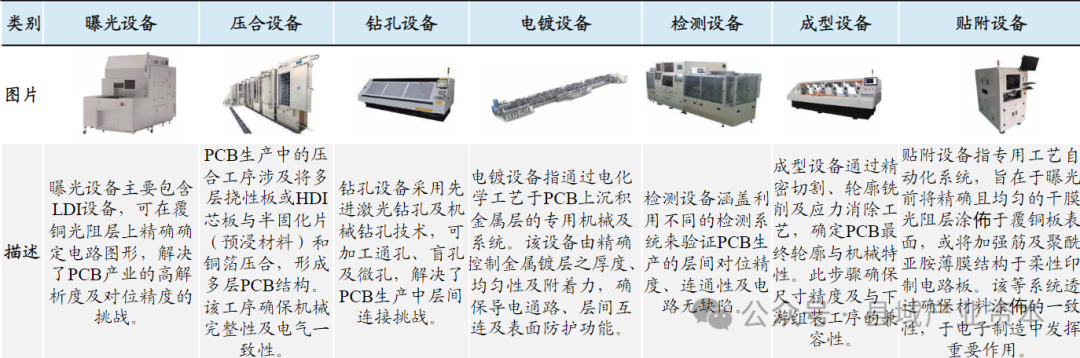

Introduction to Drilling Processes and Methods
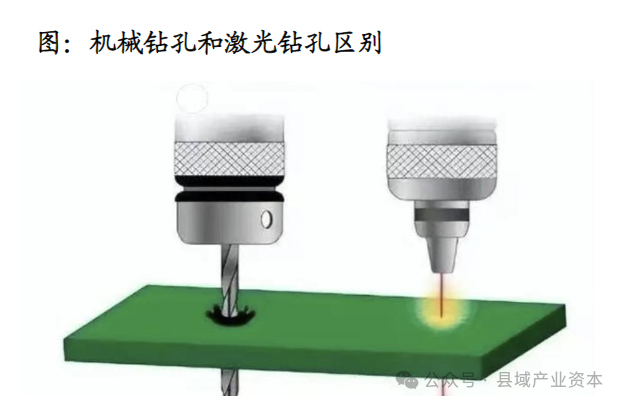
Drilling/exposure/testing equipment has the highest value, and in this issue, we mainly discuss drilling equipment. Mechanical and laser drilling are suitable for different hole diameters and are not interchangeable.
(1) Mechanical Drilling: Used when hole diameter ≥ 0.15mm.
◆Core Principle: High-speed rotating carbide drill bits physically cut the material, mainly suitable for through holes, buried holes (which have high equipment requirements), and standard hole processing in multi-layer boards.
◆Advantages: This is a mature and stable process with low costs.
◆Disadvantages: Precision limitations prevent it from meeting the needs for HDI micro-holes, etc.
In terms of materials: Traditional mechanical drilling has good adaptability to common materials like FR-4 and aluminum substrates, but when processing ceramic substrates, high-frequency materials (like PTFE), or hybrid medium laminates, it is prone to tool breakage or rough hole walls due to uneven material hardness.
(2) Laser Drilling: Used when hole diameter ≤ 0.15mm.
◆Core Principle: Uses high-energy lasers (CO₂/UV/picosecond lasers) to ablate materials, achieving non-contact precision processing for drilling purposes. Its main applicable scenarios include micro-holes in HDI boards, blind buried holes, and flexible boards.
◆Advantages: Offers ultra-high precision and micro-hole capabilities.
◆Disadvantages: Higher costs and cannot perform multi-layer stacked board operations simultaneously like mechanical drilling.
◆Material Aspects: Laser drilling can adapt to different materials by adjusting wavelength and pulse parameters. For example, UV lasers (wavelength 355nm) have high ablation efficiency for copper and resin, while CO₂ lasers (wavelength 10.6μm) are better suited for processing organic materials. The combination of both can efficiently remove different medium layers, which is particularly important when processing blind buried holes in high-frequency and high-speed boards.
The global scale of drilling equipment exceeds 10 billion yuan, with China’s scale nearing 6 billion yuan.
(1) Mechanical Drilling:
◆Competitive Landscape: There are few players, and the landscape is excellent. The mechanical drilling equipment industry mainly consists of two tiers: one is Germany’s Schmoll, and the other includes Dazhu CNC, Weijia, and Hitachi. Currently, compared to overseas manufacturers, domestic manufacturers can basically replace mid-to-low-end mechanical drilling equipment, but they still face issues with maintaining high precision over the long term, as precision drift may occur after three years of use.
◆ Equipment Prices: Domestic equipment prices are only half of those overseas. For example, Schmoll’s mainstream mechanical drilling equipment is around 1 million yuan, while Dazhu CNC’s is 500,000 to 600,000 yuan, showing a clear price advantage.
◆ Delivery Times: Overseas manufacturers have long delivery times and no plans for expansion. For a long time, overseas manufacturers like Schmoll have faced tight capacity, and delivery times have always been longer than domestic ones. Coupled with the recent surge in demand and no plans for expansion from overseas manufacturers, delivery times have further extended, with Schmoll’s products now taking over 10 months. In contrast, domestic manufacturers like Dazhu have ample capacity and can deliver in just three months to meet customer needs..
(2) Laser Drilling:
◆Competitive Landscape: Similar to mechanical drilling, the laser drilling equipment landscape is also excellent, with major players including Mitsubishi, Dazhu CNC, and Xinqi Microelectronics. Currently, domestic equipment still has some quality gaps compared to overseas, for example, in CO2 laser equipment, Mitsubishi supports ventilation, while domestic designs are closed, leading to precision degradation issues with prolonged use.
◆ Equipment Prices: Domestic equipment prices are less than 70% of those overseas. For example, Mitsubishi’s mainstream laser drilling equipment is around 4.5 million yuan, while Dazhu CNC’s is 3 million yuan, showing a clear price advantage.
◆ Delivery Times: Overseas manufacturers have long delivery times and no plans for expansion. Mitsubishi’s laser drilling annual capacity is about 600 units, and there are no short-term expansion plans. Coupled with the current demand increase, delivery times have significantly lengthened compared to domestic manufacturers. Currently, overseas manufacturers’ delivery times have been extended to June 2026.

Conclusion
Today, we only introduced the core drilling equipment. You can consciously pay attention to related leading companies like Dazhu CNC and Xinqi Microelectronics. However, for specific analysis and comparison, we will wait until we have introduced exposure and testing equipment, and then provide a systematic overview. We will analyze comprehensively from dimensions such as products, channels, customers, market share, gross margin, risks, etc. If you are interested, you can follow me, and we can exchange and learn at any time!
Follow me to focus on the development of the technology industry and explore the technology industry in China!