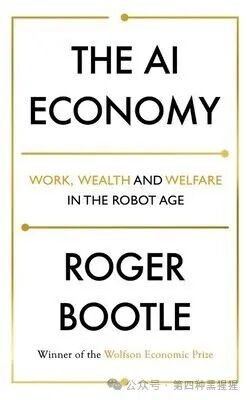
If you come across news like “AI will replace 50% of jobs” or “robots will make humans unemployed,” it is natural to feel anxious: Will there be no jobs in the future? Will wealth be concentrated in the hands of a few? Roger Bootle’s “The AI Economy: Work, Wealth and Welfare in the Robot Age” tells us: Don’t be swayed by extreme views—AI is not a “magic” that either destroys humanity or allows everyone to lie flat; rather, it is a “new tool” like steam and electricity that will reshape the economy, but if managed properly, most people can benefit from it.
The core of this book is to analyze the real impact of AI from an economic perspective: AI will eliminate some jobs but also create new ones; it will complicate wealth distribution but does not necessarily lead to the rich getting richer and the poor getting poorer; the key is that individuals, businesses, and governments must make the right choices. Below, we will clarify the core content of this book step by step in simple language.
1. Introduction: Don’t be deceived by “extreme narratives”—AI is neither a “savior” nor a “destroyer”.
The author begins by pointing out a phenomenon: current discussions about AI are either “tech fantasies” (AI allows us to stop working and just collect money) or “apocalyptic anxiety” (robots take all jobs, and humans become poor). For example, some say “AI is more important than climate change,” while others claim “this is hype, just like the Y2K bug was exaggerated.”
However, the author’s own experience is quite interesting: he was previously a “technophobe,” and even his children thought he didn’t understand technology. After spending a year studying AI, he found that everyone was “running off course”—either only discussing how powerful the technology is or only talking about emotions, with no one calculating the “economic account” properly. As an economist, he is most concerned about: How will AI affect our job opportunities? Will income increase or decrease? Can ordinary people share in the dividends?
The author makes his position clear: he does not discuss the technical details of AI (such as how algorithms are written or how robots are made), but only talks about the “economic consequences”—after all, for most people, “Will AI make it hard for me to find a job?” is much more important than “Can AI play Go?”
2. Part One: How is AI and machines different from past technological revolutions?
To understand the impact of AI, we must first look back at history—past technological revolutions (steam, electricity, computers) have also caused anxiety, but in the end, they did not lead to human unemployment; instead, they made everyone richer. Is AI really “different”?
1. Looking at history: The Industrial Revolution tells us that technology will “eliminate jobs,” but it will also “create jobs”.
The author first takes us back to the Industrial Revolution: Before the 18th century, there was almost no economic progress, and per capita GDP remained unchanged for thousands of years; after the Industrial Revolution, per capita GDP began to “take off”—in 1900 it was 3.5 times that of 1800, and in 2000 it was 30 times that of 1800.
However, every technological advancement has its “growing pains”:
• For example, when the steam engine appeared, handloom weavers feared unemployment and smashed machines (the Luddites), but later textile factories needed workers to operate machines, and new industries such as railways and steel emerged;
• Similarly in agriculture: In 1900, 40% of Americans worked in agriculture, but now only 2% do, yet these people did not become unemployed; they transitioned to factory and service jobs.
The author states that past technological revolutions have followed the principle of “creative destruction”—eliminating old jobs but creating more new ones. Now some say “AI is different and will eliminate all jobs,” but history tells us that humans always find things that machines cannot do.
2. Is this time really different? The “special” and “not special” aspects of AI.
Many people say “AI is the fourth industrial revolution and is different from the past,” and the author acknowledges that AI has two “special points”:
• General technology: Unlike the steam engine, which only transformed manufacturing, AI can transform all industries—healthcare (AI diagnosis), education (personalized learning), and services (robotic care) can all utilize it.
• Exponential growth: Computer processing power doubles every 18 months (Moore’s Law), and AI’s learning ability is also accelerating; for example, AlphaGo went from not knowing how to play chess to winning the world championship in just a few years.
However, AI also has aspects that are “overstated”:
• Robots are not that powerful: For instance, in autonomous driving, Google claimed in 2012 that it would be popular in 6 years, but it still has accidents—unable to recognize pedestrians in the rain or respond to emergencies; robots folding towels or tying shoelaces are still not as flexible as humans (this is called the “Moravec’s Paradox”: machines excel at complex calculations but struggle with tasks that a one-year-old can do);
• AI replaces “tasks,” not “jobs”: For example, doctors will not be replaced by AI, but AI can help doctors analyze CT scans (saving time), allowing doctors to spend more time communicating with patients; accountants will not disappear, but AI can calculate reports, enabling accountants to focus more on strategic analysis.
The author’s conclusion is that AI will have a broader impact than previous technologies, but its essence remains that of a “tool”—it will not make humans unemployed but will change the “content” of work.
3. Macroeconomics: AI will improve the economy, but we must guard against “distribution traps”.
Many people worry that “AI will lead to economic recession and soaring unemployment,” but the author believes:
• The economy will grow: AI can improve productivity—for example, factories using robots can double efficiency; nurses using AI assistance can care for more elderly people. Productivity growth has been slow over the past 20 years, but AI may accelerate it again; for instance, global GDP could increase by $15 trillion (more than the combined GDP of China, the US, India, and Canada);
• Unemployment will not explode on a large scale: As long as policies are appropriate (for example, government stimulating demand, businesses creating new jobs), unemployment will be “temporary” as it has been in the past—drivers may decrease, but new jobs such as “AI trainers” and “robot maintenance workers” will emerge;
• We must guard against “inflation” and “inequality”: AI may lower prices (for example, robots making things cheaper), but if wealth is concentrated in the hands of a few (for example, AI company owners), ordinary people will have no money to consume, which could drag down the economy.
4. Part Two: What will our work, leisure, and income look like in the AI era?
This part is of most concern to ordinary people: What jobs will be available in the future? Will we have more leisure time? Will we have enough money?
1. Work and leisure: Will we choose “less work, more play”?
Keynes predicted that “100 years from now, humans will work 15 hours a day,” but many people are still working 996. The author analyzes the reasons:
• Competitive psychology: For example, some people earn 1 million but want to earn 2 million, not out of need for money, but to be better than others (for example, buying a better house, sending children to better schools);
• Work has meaning: Many people work not for money—doctors want to save patients, teachers want to educate students; unemployment can lead to a lack of fulfillment.
However, the author believes that the situation will change in the future:
• The rich will choose “more leisure” first: For example, Europeans currently take 4-6 weeks of vacation each year, much more than Americans; in the future, as income rises, more people will choose to work “6 hours a day” or adopt a “four-day workweek”;
• Ordinary people may want to “work more”: For example, low-income individuals may find their jobs (such as caregiving, manual labor) more valuable due to AI and may want to earn more money;
• Leisure requires “knowing how to enjoy”: Future education should teach “how to enjoy leisure”—for example, in arts, sports, and socializing; otherwise, people may feel bored when they have free time.
2. Future jobs: Which will disappear, and which will increase?
The author breaks down the “job map in the AI era”:
• Jobs that will disappear: “routine types”—jobs that do not require creativity or emotional intelligence, only repetitive tasks, such as:
◦ Drivers (after autonomous driving matures), cashiers (in unmanned supermarkets);
◦ Ordinary clerks (AI handling reports, typing), basic lawyers (AI drafting contracts).
• Jobs that will remain/increase: Jobs requiring “unique human abilities,” such as:
◦ Emotional roles: Elderly care (robots cannot comfort lonely elderly people), psychological counseling (AI does not understand the complexities of human emotions);
◦ Creative roles: Artists (AI can paint, but cannot express human emotions), designers (who need to understand human aesthetics and needs);
◦ Manual skill roles: Plumbers (who must handle various emergencies that robots cannot), chefs (who create dishes with “soul”).
• New jobs that will emerge: “AI-assisted” and “leisure service” roles, such as:
◦ AI trainers (teaching AI to recognize errors), robot maintenance workers;
◦ Personal fitness trainers, travel planners (as people have more leisure time, they are more willing to spend money on “experiences”).
For example: Amazon is currently developing “unmanned warehouses,” but it requires people to do “robot scheduling”; hospitals use AI to analyze CT scans, but doctors need to communicate treatment plans with patients—AI does not “replace humans” but rather allows humans to do more valuable work.
3. Winners and losers: Who will profit, and who will suffer?
AI will not benefit everyone, and the author outlines three categories of winners and losers:
• Individual level:
◦ Winners: Those who can collaborate with AI (for example, doctors using AI for diagnosis, programmers optimizing AI algorithms), and those with creativity/emotional intelligence (such as teachers, artists);
◦ Losers: Those who only perform repetitive tasks (such as assembly line workers, ordinary drivers)—if they do not learn new skills, they may find it hard to get good jobs.
• Regional level:
◦ Winners: Large cities (such as London and Shanghai, which have more AI companies and new job opportunities);
◦ Losers: Remote areas (such as small counties, which struggle to attract AI companies and have fewer job opportunities).
• National level:
◦ Winners: Countries that invest heavily and dare to innovate (China and the US currently invest the most in AI and may lead);
◦ Losers: Developing countries (such as those in Africa, which previously relied on “low-cost labor” to attract factories, but now AI allows factories to operate without human labor, making development more difficult).
The author warns: Do not think that “losers will always lose”—for example, past textile workers who became unemployed could find new jobs by learning to operate machines; now drivers can also find new jobs by learning “autonomous driving maintenance”.
4. Part Three: What should be done? An “AI response guide” for individuals, businesses, and governments.
Knowing the impact of AI, the key is “what to do”. The author provides suggestions from three perspectives:
1. Government: Don’t impose a “robot tax”; instead, implement “reasonable regulation”.
Many people say “we should tax robots to subsidize the unemployed,” but the author disagrees:
• Robots are “capital equipment” and are no different from factory machines—taxing them will deter businesses from using AI, slowing down the economy and ultimately making everyone poorer;
• What the government should do is “regulate,” for example:
◦ Data privacy: AI requires a lot of data, and we must prevent companies from abusing it (such as leaking personal information);
◦ Safety: For example, legal responsibility for autonomous driving (who is liable in case of an accident—the driver, the company, or the AI?);
◦ Antitrust: Prevent a few AI companies from monopolizing (such as Google and Amazon, ensuring small companies also have opportunities).
2. Education: Don’t just teach “programming”; teach “human advantages”.
The author believes that education in the AI era needs to “change tracks”:
• Don’t just focus on STEM (science, technology, engineering, mathematics); we also need to learn “humanities and soft skills”—for example, history (to cultivate critical thinking), arts (to foster creativity), and communication (to learn how to interact with people);
• Educational methods need to change: Use AI for “personalized learning”—for example, AI helps students address weak areas, while teachers focus more on “interaction and guidance” rather than just lecturing;
• Lifelong learning is crucial: In the past, “learn once and use for a lifetime”; now we need to “learn while working”—for example, drivers learning autonomous driving maintenance, clerks learning AI office software.
For example: Finland is currently piloting “AI-assisted teaching,” where students use AI for exercises, and teachers focus on teaching “how to solve complex problems,” which has proven much more effective than traditional teaching.
3. Universal welfare: Should we implement “Universal Basic Income (UBI)?”
Many people argue that “AI will leave everyone unemployed, and the government should give everyone money (UBI),” and the author analyzes the pros and cons:
• Benefits of UBI:
◦ Simplifies the welfare system: Current welfare is too complex (unemployment benefits, minimum living allowances, pensions), UBI allows everyone to receive money without filling out applications;
◦ Provides “security”: For example, someone wants to start a business or learn new skills without worrying about “not having income and starving.”
• Problems with UBI:
◦ Where does the money come from? It requires higher taxes—if taxes are too high, businesses and wealthy individuals will be reluctant to invest, which could slow down the economy;
◦ Will it make people “not work”? If UBI is high enough, some may choose to “lie flat” and not want to learn new skills (for example, young people not working and living off UBI).
The author’s conclusion is that UBI has potential, but it should not be implemented “all at once”—we can first reform existing welfare (for example, merging unemployment benefits and minimum living allowances), then pilot UBI while ensuring education enables everyone to earn money rather than relying solely on government handouts.
5. Conclusion: AI is not “destiny”; it is a “choice”.
At the end of the book, the author does not say whether “AI will make the world better or worse” but emphasizes that the impact of AI depends on the choices we make.
For individuals: Do not fear AI; learn “skills to collaborate with AI”—for example, if you are a teacher, learn to use AI to create teaching materials; if you are a nurse, learn to use AI to monitor patient data; for businesses: Do not only think about “using AI to cut jobs”; think about “using AI to enable employees to do more valuable work”—for example, factories using robots should train employees to manage robots; for governments: Do not implement “one-size-fits-all” policies; balance “innovation” and “fairness”—ensuring that AI companies are encouraged to develop while helping unemployed individuals learn new skills.
In the postscript, the author mentions the “singularity” (AI surpassing human intelligence), but he believes that this is still far off—there is no need to worry about “AI ruling humanity”; the focus should be on “how to let AI help humans earn money and live well”.
The final sentence is very practical: “AI is not magic; it will not automatically make the world better—but as long as we make the right choices, it can become a ‘new tool’ for humanity, allowing most people to earn money and enjoy welfare in this era.”