Analysis of Anti-Interference Technologies in Drone Self-Organizing Network Systems
A MESH self-organizing network system composed of multiple drones and ground stations is a decentralized wireless communication network. The system consists of multiple airborne and ground communication terminals, with the core feature being “no fixed center,” adopting a decentralized architecture where all nodes are equal.
In this mesh structure, all communication nodes can communicate directly with each other, forming a dynamic and flexible network. When a node cannot communicate directly due to damage, excessive distance, or obstruction, the system’s built-in dynamic routing mechanism automatically senses link changes and quickly plans a new optimal data transmission path, thereby bypassing the fault point and ensuring the stability of the entire communication link.
However, in complex electromagnetic environments, the communication links of drone self-organizing networks are constantly facing various intentional or unintentional interferences. These interferences affect the normal operation of the communication link, leading to increased bit error rates and communication interruptions. The interferences in drone communication systems can be classified into the following categories based on their spectral characteristics:
- • Out-of-Band Interference: Interference signals have frequencies outside the normal operating band of the communication system, but if the interference power is too strong, it can still “overwhelm” the RF front end of the receiver, causing communication interruptions.
- • In-Band Interference: Interference signals overlap with the frequency of useful signals, making it the most destructive type of interference.
- • Narrowband Interference: Interference signals occupy a very narrow spectral width, affecting only a small portion of the communication band.
- • Wideband Interference: Interference signals cover the entire or most of the operating frequency band of the communication system, contaminating all channels, and are the nemesis of “avoidance-type” anti-interference technologies.
To resist these ubiquitous interferences, communication systems must employ various anti-interference technologies to adapt to different interference scenarios.
This article mainly introduces several commonly used anti-interference technologies in drone communication systems, including:
- • OFDM technology for anti-interference
- • Cavity filters to suppress out-of-band interference
- • Intelligent frequency selection
- • Adaptive frequency hopping
- • Dynamic adaptive anti-interference
Anti-Interference Capability of OFDM
Introduction to OFDM in Simple Terms
Orthogonal Frequency Division Multiplexing (OFDM) is an efficient digital modulation technology that is an indispensable core technology in Wi-Fi, 4G/5G mobile networks, and high-definition digital television broadcasting.
Traditional communication methods transmit a high-speed data stream all at once over a wide channel (a single carrier), akin to a large convoy traveling on a single highway. If there is an obstacle or congestion on this highway (such as multipath fading or interference), the entire convoy’s progress will be severely affected.
OFDM adopts a completely different strategy by dividing the entire broadband channel into dozens to hundreds of closely spaced, narrow-bandwidth subchannels (also known as subcarriers). At the same time, it decomposes the original high-speed data stream into many parallel low-speed data streams, each modulated and transmitted by an independent subcarrier. This is similar to splitting a large convoy into individual cars, allowing them to travel simultaneously on hundreds or thousands of parallel country roads.
Anti-Interference Capability of OFDM System
Fixed-frequency narrowband interference present in wireless channels, or severe signal fading at specific frequency points due to multipath effects, can severely impact traditional single-carrier systems if the interference falls within their operating frequency band, potentially rendering the entire communication link inoperable.
In contrast, the OFDM system disperses data information across hundreds or thousands of subcarriers for transmission, meaning that a narrowband interference will only affect a few of those subcarriers, while the majority of the data on other subcarriers can still be correctly received.
Even for the damaged data, the system typically combines channel coding (such as Turbo codes, LDPC codes) technology, introducing redundant information through Forward Error Correction (FEC) to allow the decoder at the receiving end to recover the interfered data, thus ensuring the overall reliability of the communication.
Cavity Filters to Suppress Out-of-Band Interference
Although OFDM can effectively combat in-band narrowband interference, when there is a very strong interference source outside the operating frequency band, this strong interference signal, despite having a different frequency, directly saturates the RF front end of the receiver.
For example, if two people are talking in a room, they can normally hear each other. However, if there is a loudspeaker playing noise in the room, even if the noise is unrelated to the target speech, the strong interference will mask the useful signal, preventing both individuals from hearing each other’s voices.
To address this issue, engineers have introduced a purely physical solution—cavity filters. Cavity filters are typically installed between the antenna and the backend RF circuit, acting as a “gatekeeper”.
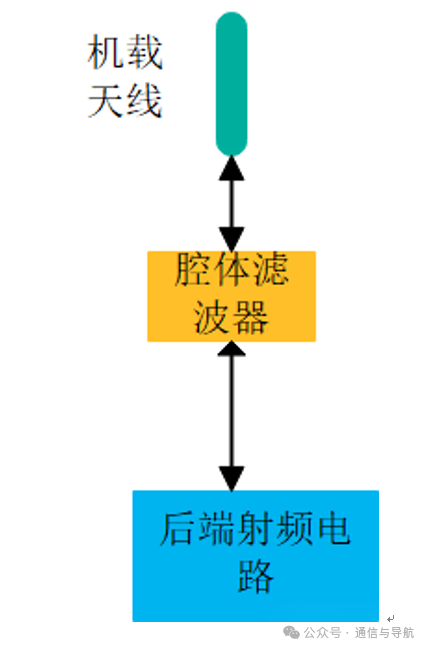
The efficiency of cavity filters stems from three core characteristics:
- • Extremely Low In-Band Insertion Loss:
Cavity filters produce almost no attenuation for the useful signals we need (within the passband), with losses typically below 2dB, or even as low as 1dB. This can improve transmission efficiency for the transmitting link and protect weak useful signals from excessive attenuation in the receiving link, thus ensuring receiving sensitivity.
- • Extremely High Out-of-Band Suppression:
Cavity filters utilize high-quality factor (Q value) resonant cavities to produce significant attenuation for out-of-band interference signals deviating from the operating frequency. A typical cavity filter can provide over 30dB of out-of-band suppression, while high-performance ones can achieve over 60dB.
- • Steep Roll-Off Factor:
Cavity filters transition very quickly between the passband and stopband, allowing for precise delineation of which signals should pass and which should be blocked, even if the interference signal is very close to the frequency of the useful signal, it can be effectively filtered out.
Below are the specifications of a cavity filter used in a drone:
| Operating Frequency | 1490–1530MHz |
| Insertion Loss | ≤1.2dB |
| In-Band Ripple | ≤0.7dB |
| VSWR | ≤1.5 |
| Out-of-Band Suppression | ≥25dB@Fo±30MHz≥40dB@Fo±50MHz |
| Power Handling | 50W |
| Connector | SMA-K |
| Dimensions | 61×51×17mm |
| Weight | 60g |
Intelligent Frequency Selection for Anti-Interference
What is Intelligent Frequency Selection?
Intelligent frequency selection is an adaptive anti-interference technology. Each node in the network uses its receiver to continuously scan and monitor the wireless environment across a preset list of frequency points or the entire frequency band supported by the hardware. The monitored metrics may include background noise, interference signal strength, channel occupancy, etc.
Each node independently calculates which frequency point has the best signal quality (e.g., highest signal-to-noise ratio, lowest bit error rate) based on its real-time spectrum monitoring results. Subsequently, the node declares this frequency point as its current “working frequency point” (i.e., the best receiving frequency point). This means that the best frequency point chosen by node 1 may be completely different from that of node 2 due to differences in their electromagnetic environments.
When a node (the sender) needs to send data to another node (the receiver), it must adjust its transmitter to use the receiver’s currently declared “working frequency point” to transmit the signal.
For example, suppose there are nodes 1, 2, and 3 in a self-organizing network.
- 1. Step One: Frequency Selection
After environmental sensing, node 1 finds that frequency point f1 is the “cleanest” for it, providing the best reception, so node 1 selects f1; similarly, node 2 selects f2; node 3 selects f3. At this point, f1, f2, and f3 are the “working frequency points” (best receiving frequency points) for these three nodes. They may be the same or completely different.
- 2. Step Two: Communication
When node 2 wants to send data to node 1, it will find that node 1’s best receiving frequency point is f1, so node 2 will transmit data on frequency f1.
Conversely, when node 1 wants to send data to node 2, it will use node 2’s best receiving frequency point f2 to transmit.
Similarly, when node 3 sends to node 1, it uses f1, and when sending to node 2, it uses f2.
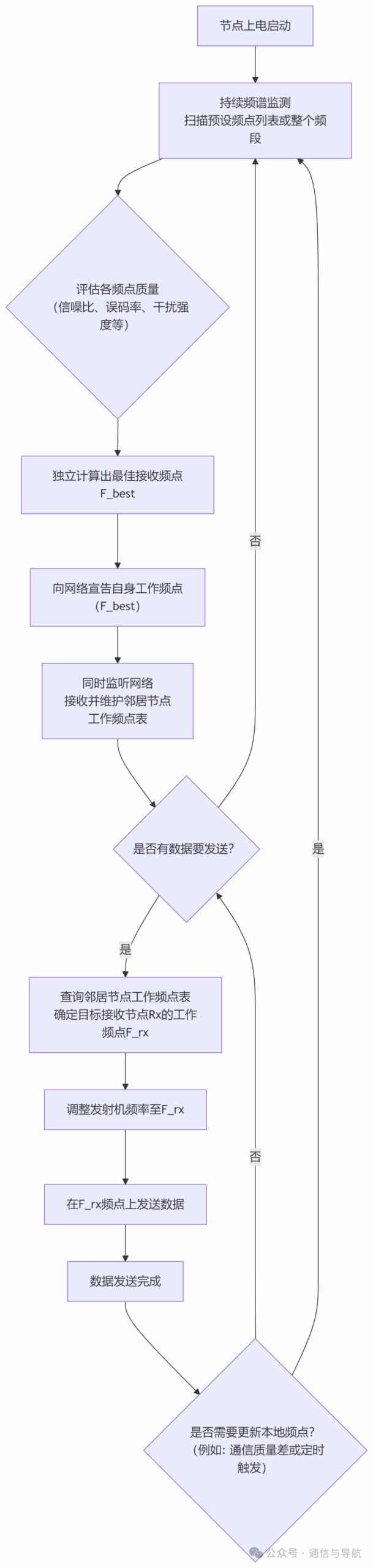
This example clearly illustrates:
- • Uplink and Downlink Can Use Different Frequencies:
The communication between node 1 and node 2 uses f2 in the 1→2 direction and f1 in the 2→1 direction. Since f1 and f2 are likely different, this allows for independent frequency selection for uplink and downlink (frequency duplex).
- • Variable Transmission Frequency:
Node 3 transmits at frequency f1 when communicating with node 1 and at frequency f2 when communicating with node 2. This demonstrates that the transmission frequency of the same node dynamically changes based on the communication partner.
Intelligent Frequency Selection for Anti-Interference
Intelligent frequency selection primarily combats frequency-selective interference, with the core principle being “avoidance of interference” rather than “suppression of interference.” Intelligent frequency selection achieves anti-interference by avoiding localized interferences that are unevenly distributed across the spectrum; essentially, it does not suppress interference but merely bypasses it.
Types of interference that intelligent frequency selection can suppress include:
- 1. Narrowband or Partial Band Interference:
This is the scenario that intelligent frequency selection is best at handling. If one or several selectable frequency points are interfered with by narrowband signals, the node’s spectrum monitoring system will detect that these frequency points have very low signal-to-noise ratios, thus automatically abandoning these points in decision-making and selecting other clean frequency points for communication.
- 2. Geographically Related Interference:
In wireless self-organizing networks, the electromagnetic environments of different nodes can vary significantly. For example, drone A near the city may find severe interference in the 2.4GHz band, so it selects a 5.8GHz frequency point as its best receiving frequency point. Meanwhile, drone B near the suburbs may find interference in the 5.8GHz band and choose a clean 2.4GHz frequency point.
Intelligent Frequency Selection Cannot Suppress In-Band Wideband Interference.
When an in-band wideband interference source appears, its energy will cover most or all of the selectable working frequency points of the system. If a standard intelligent frequency selection based on a frequency point list is used, and this wideband interference happens to cover all the points in the list, the system will have no “clean” frequency points to choose from, rendering the avoidance strategy ineffective.
At this point, the intelligent frequency selection algorithm will find that all candidate frequency points have very poor channel quality, making it impossible to establish an effective communication link.
For instance, if the hardware operating frequency of the drone networking communication system is 1350~1450MHz, and there is wideband interference within this frequency band covering the 100MHz bandwidth, no matter how frequency selection is done, the chosen working frequency band will fall within the interference bandwidth, thus making intelligent frequency selection ineffective.
Additionally, two other anti-interference modes: adaptive frequency modulation anti-interference and dynamic adaptive anti-interference technology will be detailed in the next section.
Writing is not easy; if you find the article good, please take a moment to like, share, and recommend it.Recommended Reading:What are the tracking modes of ground directional antennas for telemetry/image transmission/data links?