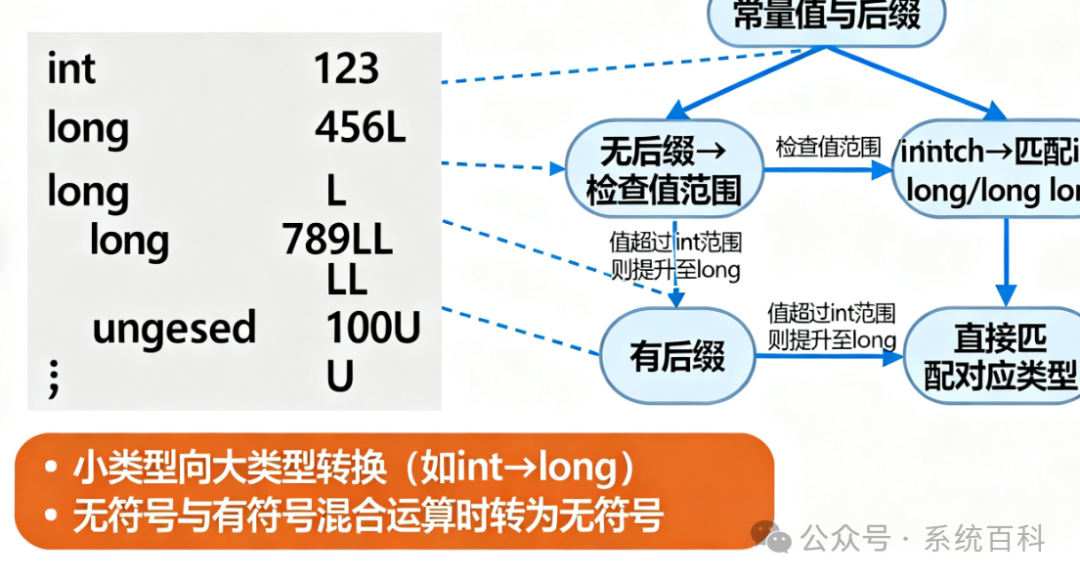
In C++, the compiler needs to determine the specific type of integer constants used in the program. This decision is based on two main factors: the suffix and the numerical size.
Basic Rules
1. Decimal Integers without Suffix
For decimal integers without a suffix, the compiler selects the smallest type that can accommodate the value in the following order:
<span>int</span><span>long</span><span>long long</span>
2. Hexadecimal/Octal Integers without Suffix
For hexadecimal or octal integers, the compiler selects the smallest type that can accommodate the value in the following order:
<span>int</span><span>unsigned int</span><span>long</span><span>unsigned long</span><span>long long</span><span>unsigned long long</span>
3. Explicitly Specifying Type with Suffix
You can explicitly specify the type of integer constants using suffixes:
<span>l</span>or<span>L</span>–<span>long</span><span>u</span>or<span>U</span>–<span>unsigned int</span><span>ll</span>or<span>LL</span>–<span>long long</span><span>ul</span>,<span>uL</span>,<span>Ul</span>,<span>UL</span>–<span>unsigned long</span><span>ull</span>,<span>uLL</span>,<span>Ull</span>,<span>ULL</span>–<span>unsigned long long</span>
Code Example
#include <iostream>
#include <type_traits>
#include <iomanip>

// Helper function to display type information
template<typename T>
void printTypeInfo(const char* description, T value) {
    std::cout << std::setw(25) << description << ": " << value;
    std::cout << " [Type: ";

    if (std::is_same<T, int>::value) std::cout << "int";
    else if (std::is_same<T, unsigned int>::value) std::cout << "unsigned int";
    else if (std::is_same<T, long>::value) std::cout << "long";
    else if (std::is_same<T, unsigned long>::value) std::cout << "unsigned long";
    else if (std::is_same<T, long long>::value) std::cout << "long long";
    else if (std::is_same<T, unsigned long long>::value) std::cout << "unsigned long long";
    else std::cout << "unknown";

    std::cout << "]" << std::endl;
}

int main() {
    std::cout << "=== Decimal Integer Example ===" << std::endl;

    // Decimal integers without suffix
    printTypeInfo("1492", 1492);
    printTypeInfo("30000", 30000);
    printTypeInfo("3000000000", 3000000000);

    std::cout << "\n=== Examples with Suffix ===" << std::endl;

    // Using suffix
    printTypeInfo("1492L", 1492L);           // long
    printTypeInfo("1492U", 1492U);           // unsigned int
    printTypeInfo("1492UL", 1492UL);         // unsigned long
    printTypeInfo("1492LL", 1492LL);         // long long
    printTypeInfo("1492ULL", 1492ULL);       // unsigned long long

    std::cout << "\n=== Hexadecimal and Octal Example ===" << std::endl;

    // Hexadecimal and octal
    printTypeInfo("0x9C40", 0x9C40);         // Hexadecimal 40000
    printTypeInfo("0x9C40U", 0x9C40U);       // unsigned int
    printTypeInfo("0123456", 0123456);       // Octal
    printTypeInfo("0123456L", 0123456L);     // Octal long

    std::cout << "\n=== Boundary Value Example ===" << std::endl;

    // Different systems may have different boundary values
    // Assuming on a 32-bit system, the range of int is -2147483648 to 2147483647
    printTypeInfo("2147483647", 2147483647);     // Max int
    printTypeInfo("2147483648", 2147483648);     // Exceeds int range, may be long

    return 0;
}
Practical Applications of Type Inference
#include <iostream>
#include <typeinfo>

// Function overloading example to demonstrate how the compiler selects types
void processNumber(int n) {
    std::cout << "Processing int: " << n << std::endl;
}

void processNumber(long n) {
    std::cout << "Processing long: " << n << std::endl;
}

void processNumber(long long n) {
    std::cout << "Processing long long: " << n << std::endl;
}

void processNumber(unsigned int n) {
    std::cout << "Processing unsigned int: " << n << std::endl;
}

int main() {
    std::cout << "=== Function Overloading Type Inference ===" << std::endl;

    // The compiler selects the correct overloaded function based on the constant type
    processNumber(100);           // int
    processNumber(100L);          // long
    processNumber(100LL);         // long long
    processNumber(100U);          // unsigned int

    std::cout << "\n=== Automatic Type Inference ===" << std::endl;

    // Using auto for type inference
    auto a = 100;                 // int
    auto b = 100L;                // long
    auto c = 100U;                // unsigned int
    auto d = 100LL;               // long long
    auto e = 0x9C40;              // Hexadecimal - type depends on the system

    std::cout << "Type of a: " << typeid(a).name() << std::endl;
    std::cout << "Type of b: " << typeid(b).name() << std::endl;
    std::cout << "Type of c: " << typeid(c).name() << std::endl;
    std::cout << "Type of d: " << typeid(d).name() << std::endl;
    std::cout << "Type of e: " << typeid(e).name() << std::endl;

    return 0;
}
Practical Programming Advice
- Prioritize Clarity: Use suffixes to explicitly specify types when specific types are needed.
- Portability: Be aware of differences in integer sizes when porting code across different platforms.
- Avoid Ambiguity: Explicitly specifying types when handling boundary values can prevent unexpected behavior.
#include <iostream>
#include <cstdint>

int main() {
    // Use standard type definitions to improve portability
    std::int32_t fixed32 = 100;           // Fixed 32-bit signed integer
    std::uint64_t fixed64 = 100ULL;       // Fixed 64-bit unsigned integer

    std::cout << "Fixed 32-bit: " << fixed32 << std::endl;
    std::cout << "Fixed 64-bit: " << fixed64 << std::endl;

    return 0;
}
Understanding the rules of type inference for integer constants in C++ is crucial for writing correct and portable code, especially in scenarios involving different platforms or requiring precise control over memory usage.