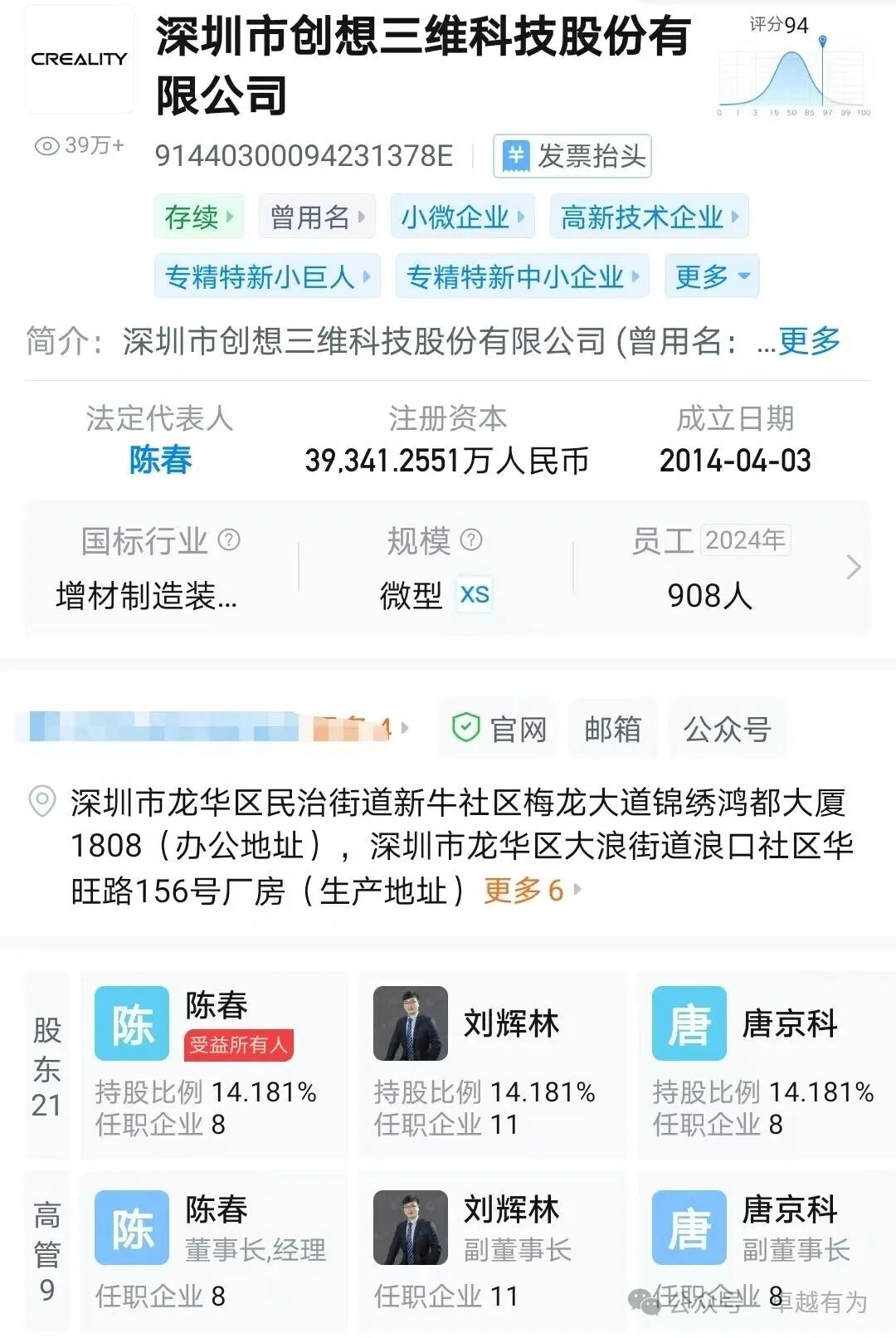
Creality 3D (H2181) is a 3D printing company driven by hardcore technological innovation. With a product matrix covering multiple scenarios, a globally coordinated channel layout, and a complete ecological chain construction, it maintains a leading position in the cross-border market. By co-creating with users, it has achieved a leap from a hardware manufacturer to a global 3D printing solution provider through technological breakthroughs, precise market positioning, and the establishment of an ecological closed loop.
01The Entrepreneurial Journey: Starting from a 20 Square Meter Office
In 2014, the consumer-grade 3D printer market was firmly controlled by imported brands from Europe and the United States, with high prices and complex operations. Four young individuals born in the 1980s—Chen Chun, Ao Danjun, Liu Huilin, and Tang Jingke—keenly sensed the business opportunity at an exhibition. With the aspiration of “bringing 3D printing into every household,” they gathered 300,000 yuan in startup capital and established the predecessor of Creality 3D, Bolingda, in a mere 20 square meter office in Longhua District, Shenzhen.
Faced with the domestic model primarily focused on parts export, they boldly adopted a differentiated strategy of selling kits. The first product, CR-i3, could be assembled by users in just 15 minutes and achieved great success in the Hong Kong market upon launch. Subsequently, leveraging Guangdong’s rich cross-border e-commerce resources, Creality 3D successfully opened the door to the European and American markets. In 2016, the CR-10, priced at $500, broke the overseas market’s price system of over $1,000, achieving sales of 20,000 units in the first month and exceeding 500,000 units in total, significantly enhancing the brand’s international influence and pushing 3D printers into the consumer era..
02Early Stability: Precise Strategies Open Up the Market
(1) Affordable Strategy to Enter the Market
In the early stages, Creality 3D drastically reduced the price of industrial-grade equipment from $4,000 to $199, quickly attracting price-sensitive customers with its affordable strategy. Hot-selling products like CR-10 and Ender-3 rapidly opened up sales channels in overseas markets due to their friendly prices and good performance, accumulating original users and reputation for the company.
(2) Smart Use of Platform Resources
Fully utilizing cross-border e-commerce platform resources, Creality 3D saved initial operating costs by leveraging new seller incentives on platforms like Amazon. Actively participating in platform promotional activities increased product exposure. For example, by optimizing product pages and using platform advertising tools, they ensured their products occupied favorable positions in search results, attracting more potential customers.
(3) User Community Supporting Growth
Creating the “Creality Cloud” online community, they gathered 4 million users globally. Users share experiences and creative works in the community, forming a good interactive atmosphere. The company collects user feedback through the community for product improvement and new product development, achieving user demand-oriented product iteration and enhancing user stickiness.
03Business Model: DTC and Distributor Dual Track
(1) Diversified Product Layout
Creality 3D has built a diversified product ecosystem centered around 3D printers. On one hand, they continuously enrich the product line of 3D printers, covering different types and price ranges to meet the needs of various users from hobbyists and designers to schools and families. On the other hand, they vigorously develop ecological products such as 3D scanners, laser engravers, and 3D printing consumables and accessories, expanding business boundaries and increasing profit points. In 2025, the company will launch Nexbie, an overseas e-commerce platform focused on 3D creative finished products, further improving the industrial chain layout.
(2) Online and Offline Integrated Sales
Online, Creality 3D has opened 74 self-operated online stores on globally renowned e-commerce platforms like Amazon and eBay, while also building independent overseas sites and promoting the brand through social media platforms, attracting nearly 4 million followers globally, with online revenue proportion increasing year by year. Offline, through 2,163 distributors, they have covered approximately 140 countries and regions worldwide, forming a sales pattern of online and offline collaborative development..
04Corporate Culture: Innovation, Pragmatism, and Responsibility
(1) Innovation-Driven Development
Always viewing innovation as the source of development, they have formed a research and development team of over 500 people and invested heavily each year to explore cutting-edge technologies like AI. Adhering to the philosophy that “user pain points are the starting point of innovation,” they continuously launch innovative products that meet user needs. For example, the K2Plus model achieves multi-color, high-speed printing and supports active chamber temperature control to meet engineering material printing needs; the HALOT-X1 resin printer is equipped with a 16K ultra-clear printing system, enhancing printing precision and continuously leading the industry’s technological development.
(2) Pragmatic Business Style
From product development, production to sales, every link emphasizes practical results. In the production phase, they optimize supply chain management and closely cooperate with suppliers to ensure stable supply of raw materials and reliable product quality. In the sales phase, they pay attention to market dynamics and changes in customer demand, adjusting sales strategies in a timely manner to promote steady company development with a pragmatic attitude.
(3) Practicing Social Responsibility
Actively engaged in educational public welfare, they launched the “Thousand Groups Action,” supporting colleges and vocational schools to establish 3D printing clubs, donating equipment and technical support. They conduct science enlightenment activities in kindergartens and primary and secondary schools, donating funds to schools in mountainous areas to provide 3D printing equipment for children, using technology to assist educational development, practicing corporate social responsibility, and enhancing brand image.
Creality 3D’s journey from the difficult exploration of its early days to its unique business model leading the cross-border e-commerce 3D printing field is filled with legendary colors and provides valuable references for many cross-border e-commerce enterprises. In the future, Creality 3D is expected to continue writing brilliance in the global market through continuous innovation and pragmatic management.
05Strategies and Mindset of Successful Entrepreneurs
5-3-2 Strategy
Looking at 5 years is to gain insight into the trend of 3D printing consumerization, anchoring the affordable and user-friendly track; thinking about 3 years is planning kit sales, cross-border layout, and user ecosystem construction; seriously working for 2 years is refining hot-selling products like CR-i3 and CR-10, deeply cultivating platform resources and the “Creality Cloud” community, laying a solid foundation with pragmatic actions.
Design Thinking: Using User Pain Points as the Starting Point for Innovation
Creality 3D adheres to the design thinking that “user pain points are the starting point of innovation,” focusing on actual user needs to refine products. To address the early complexity of 3D printer assembly and high operational thresholds, they launched the CR-i3 kit, which can be assembled in just 15 minutes, significantly reducing usage difficulty. Later, they continued to explore different scenario needs, creating the K2Plus model that supports multi-color high-speed printing and active chamber temperature control for engineering users, and the HALOT-X1 resin printer equipped with a 16K ultra-clear system for precision-demanding users, forming a product matrix covering various scenarios such as home, professional, and educational, achieving a design shift from “making products” to “solving needs.”
Reverse Thinking: Breaking Industry Inertia to Break Through the Market
Faced with the market dilemma of monopolization by European and American brands and high prices, Creality 3D reconstructed industry logic with reverse thinking. Abandoning the conventional path of “parts export” for domestic enterprises, they adopted a differentiated strategy of “whole machine kit sales”; breaking the price barrier of over $1,000 overseas, they slashed equipment prices from $4,000 to $199, quickly capturing the market with affordable hot-selling products like CR-10 and Ender-3. On the sales side, they do not rely on a single channel, but instead construct a dual-track model of “online DTC + offline distributors,” closely connecting with end users while covering a broad market, achieving a breakthrough in traditional cross-border models.
Feedback Thinking: Driving Iteration Cycles with User Communities
Creality 3D built the “Creality Cloud” community, establishing an efficient feedback closed-loop thinking. By gathering 4 million users globally, they collect usage experiences, creative works, and improvement suggestions, directly converting user feedback into R&D motivation. This cycle mechanism of “user feedback – product iteration – market validation” ensures that products always align with demand while enhancing user stickiness. From early optimization of product assembly processes to later iterations of printing precision and speed, community feedback has been an important basis, forming a development model of “user participation in co-creation.”
06Highlight Analysis
Creality 3D has achieved excellence in the 3D printing field, with its greatest highlights concentrated in three key dimensions: product innovation, market expansion, and ecological construction.
In terms of product innovation, the company boasts strong technical capabilities. They have formed a cross-disciplinary R&D team of 500 people, with a doubling annual patent growth rate, holding 800 patents. In terms of printing speed, the K1 series high-speed printers reach speeds of 600mm/s, which is 12 times that of traditional FDM 3D printers, significantly improving printing efficiency. In terms of printing quality, the HALOT-X1 resin printer achieves micron-level precision of 14×19μm with its 16K ultra-clear printing system, meeting high precision demand scenarios. The products also feature multifunctional characteristics, such as the K2PlusCombo integrating AI intelligence, closed-loop motion control, and active chamber heating technology, enabling multi-color printing and printing of engineering-grade materials, breaking through industry technical bottlenecks from multiple aspects.
In terms of market expansion, Creality 3D has a diversified and effective layout. In terms of sales channels, there are 2,163 distributors in 140 countries and regions worldwide, and online, they have opened 74 self-operated stores on platforms like Amazon and built independent overseas sites, achieving online and offline synergy, with overseas revenue proportion increasing from 50.1% in 2022 to 70.9% in 2024. Brand promotion leverages overseas social media platforms, with nearly 4 million followers, enhancing brand awareness by sharing 3D printing stories, and consolidating global market share through localized teams and overseas warehousing layouts. Product positioning is precise, with the Ender series targeting beginners and the K series for professional applications, covering different user levels while avoiding price wars and opening up B-end incremental space, such as launching the LUMINEX-400 resin printer for bulk needs of footwear companies.
Ecological construction is another prominent advantage of Creality 3D. They have built a complete ecosystem around 3D printing, covering 3D printers, scanners, laser engravers, and consumables and accessories. The Creality Cloud platform connects 5 million global users, optimizing the printing experience through user communities, model sharing, and data analysis, driving product iteration based on user needs. In 2025, they will launch the Nexbie overseas e-commerce platform, focusing on 3D creative finished products, further bridging the entire industrial chain from hardware to software, consumables, services, and finished product transactions, forming a “one-stop solution” and achieving user “co-creation,” enhancing ecological stickiness, such as improving the language style of 3D scanner manuals based on user feedback and inviting experts to participate in product revisions, transforming users from buyers to participants in brand building.
Recommended Reading
Famous Cross-Border E-commerce Companies in China and Guangdong
Outstanding and Capable
With years of experience in the capital market, having witnessed the journey from 0 to 1, I am optimistic about cross-border e-commerce. If you or your team have good performance in the products you operate, or have good pricing, or have a good ecosystem within the team, I welcome you to invite me to work together to build a great business.