GitHub Trending List | Overview of Popular C++/C#/C Projects (2025.11.29) – 15 Projects Listed
Data statistics time: 2025-11-29 16:03:34
1. Facepunch/sbox-public
 📊 Data Metrics:
⭐ stars : 2.6k | 🍴 forks : 143
🔗 https://github.com/Facepunch/sbox-public
s&box Game Engine Introduction
Overview
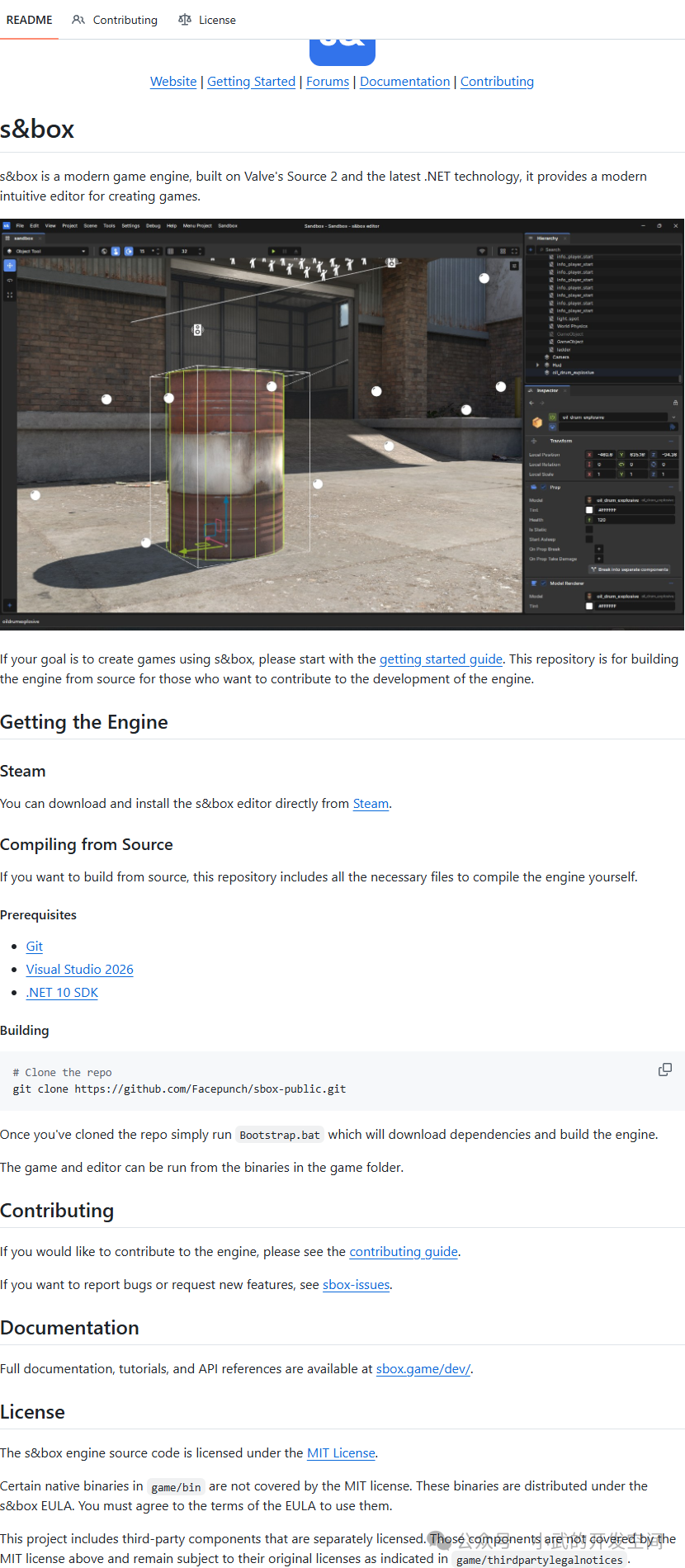
s&box is a modern game engine built on Valve’s Source 2 engine and the latest .NET technology. It provides an intuitive and modern editor to help developers efficiently create high-quality game content. With a powerful toolchain and an open development environment, s&box is suitable for both independent developers and professional teams.
Development and Usage
Users can quickly start creating by downloading the s&box editor directly from Steam or obtain the source code from GitHub for self-compilation. The project depends on Git, Visual Studio 2026, and .NET 10 SDK, and can be automatically built by running the Bootstrap script. The engine supports hot reloading and real-time preview, significantly improving development efficiency.
Community and Documentation
The official documentation, tutorials, and API references cover a wide range of topics from beginner to advanced. Developers can share experiences in forums and provide feedback or submit feature requests through the Issues platform. The project is open-source under the MIT license, encouraging community contributions.
2. kunkundi/crossdesk
 📊 Data Metrics:
⭐ stars : 1.7k | 🍴 forks : 153
🔗 https://github.com/kunkundi/crossdesk
Project Introduction
Cross-Platform Remote Desktop Solution
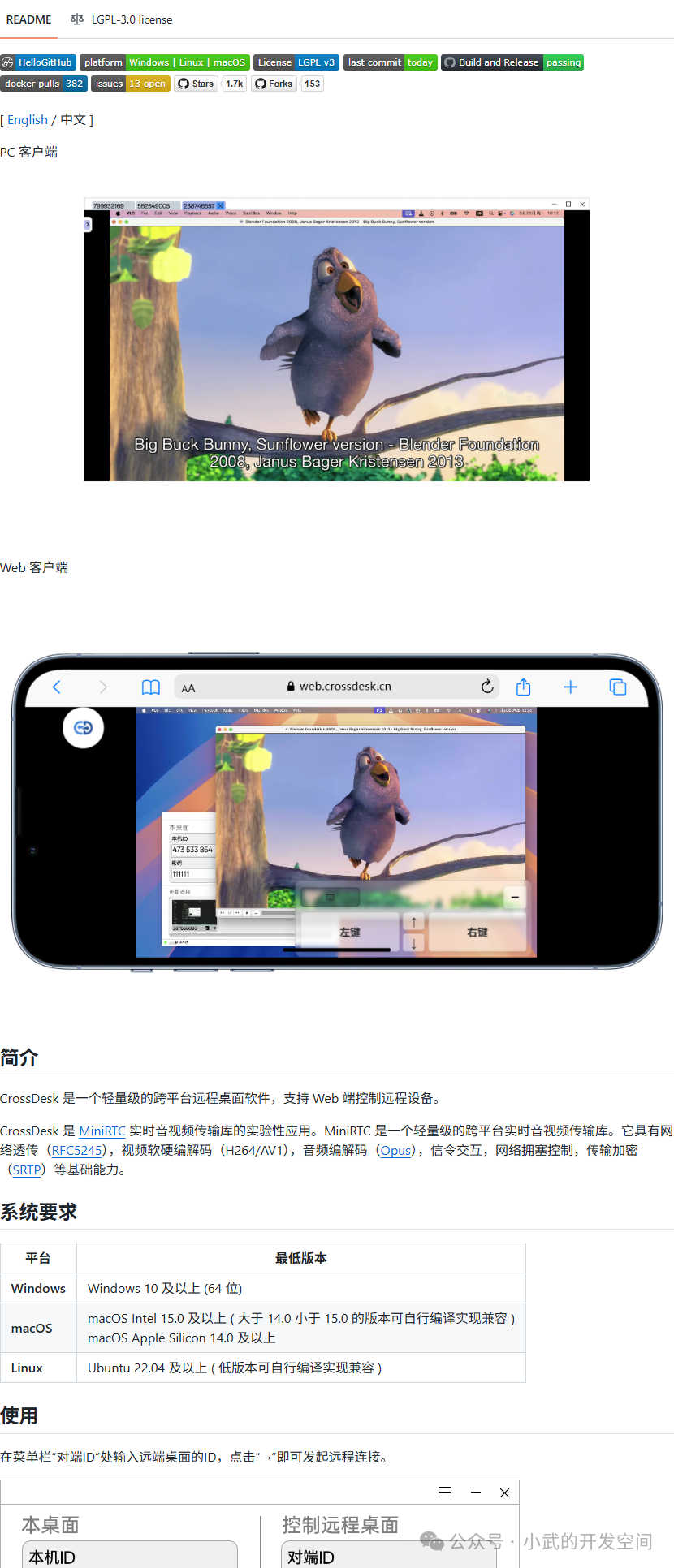
CrossDesk is a lightweight, cross-platform remote desktop software that supports efficient remote control between Windows, macOS, and Linux systems. Its biggest feature is that it not only provides a traditional PC client but also supports direct access to remote devices via a browser, greatly enhancing usability.
Real-Time Transmission Capability Based on MiniRTC
As an experimental application of the MiniRTC real-time audio and video library, CrossDesk has powerful underlying communication capabilities, including WebRTC network penetration, H264/AV1 video encoding, Opus audio encoding, SRTP encrypted transmission, and network congestion control, ensuring smooth, low-latency, and secure remote desktop visuals.
Usage and Deployment
Convenient Multi-Device Connection
Users can quickly establish a connection by entering the remote device ID and password in the client or web interface. Custom settings such as language and video encoding format are supported to enhance the personalized experience. The web client can run on mobile browsers like iOS Safari, enabling cross-platform remote control.
Support for Self-Hosted Server Deployment
The project recommends using Docker to deploy the server, integrating TURN relay and signaling services, and providing complete certificate generation scripts to facilitate the establishment of a private remote desktop system for enterprises or individuals, ensuring data security and service stability.
3. oceanbase/seekdb
 📊 Data Metrics:
⭐ stars : 902 | 🍴 forks : 70
🔗 https://github.com/oceanbase/seekdb
Project Introduction
Overview
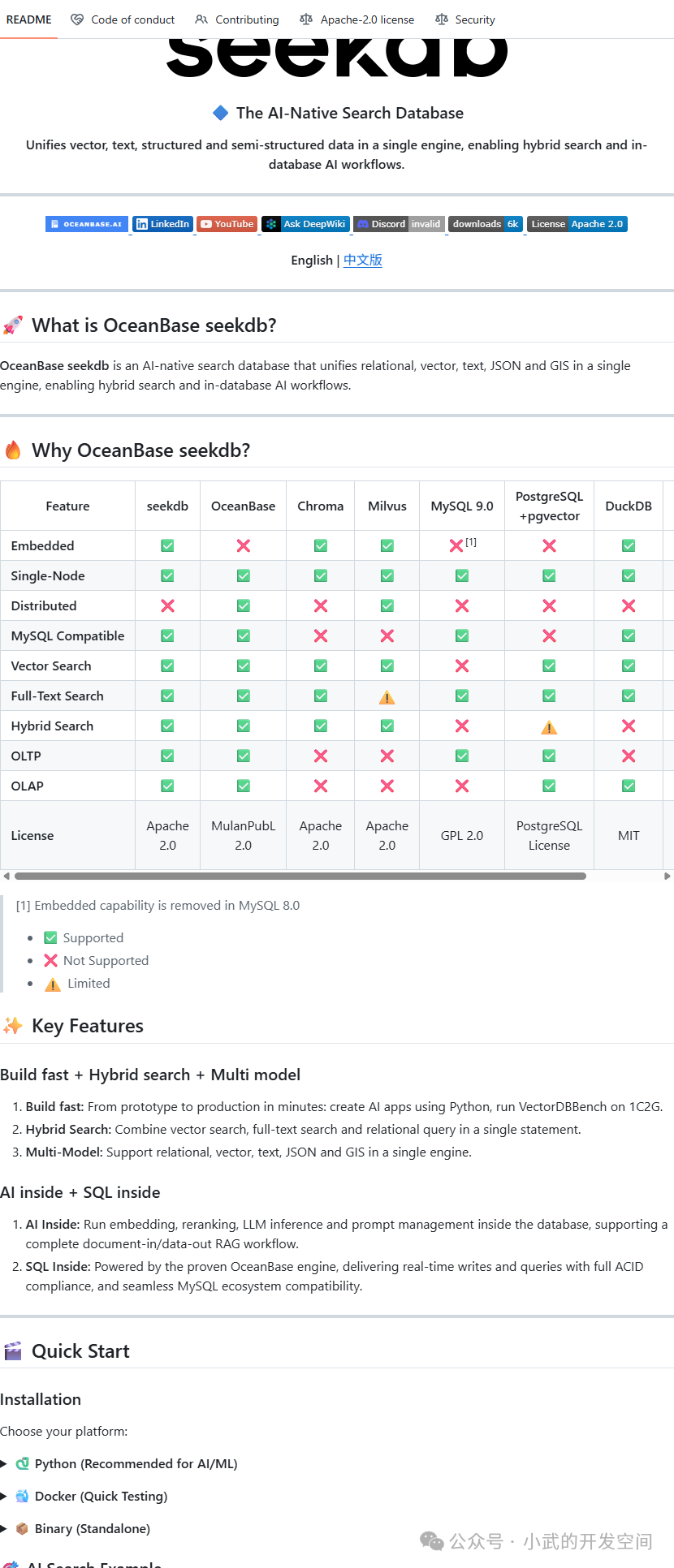
OceanBase seekdb is a search database aimed at AI-native applications, dedicated to unifying vector, text, structured, and semi-structured data within a single engine. It supports hybrid search and in-database AI workflows, providing efficient, real-time data storage and retrieval capabilities for modern AI applications.
Core Features
seekdb supports embedded deployment, single-node operation, and MySQL compatibility, with complete OLTP and OLAP capabilities. Its unique “AI Inside” design allows for embedded generation, reordering, and large model inference within the database, achieving an end-to-end RAG process. Additionally, it provides full ACID transaction guarantees through SQL interfaces, compatible with mainstream ecosystem tools.
Application Scenarios
It is suitable for RAG knowledge retrieval, semantic search engines, intelligent agent systems, AI-assisted programming, and edge computing scenarios. It supports integration with mainstream AI frameworks such as HuggingFace, LangChain, and LlamaIndex, enabling rapid construction of production-level intelligent applications, especially suitable for enterprise intelligent upgrades and localized AI deployment needs.
4. Snapchat/Valdi
 📊 Data Metrics:
⭐ stars : 14.4k | 🍴 forks : 471
🔗 https://github.com/Snapchat/Valdi
Project Introduction
Cross-Platform High-Performance UI Framework
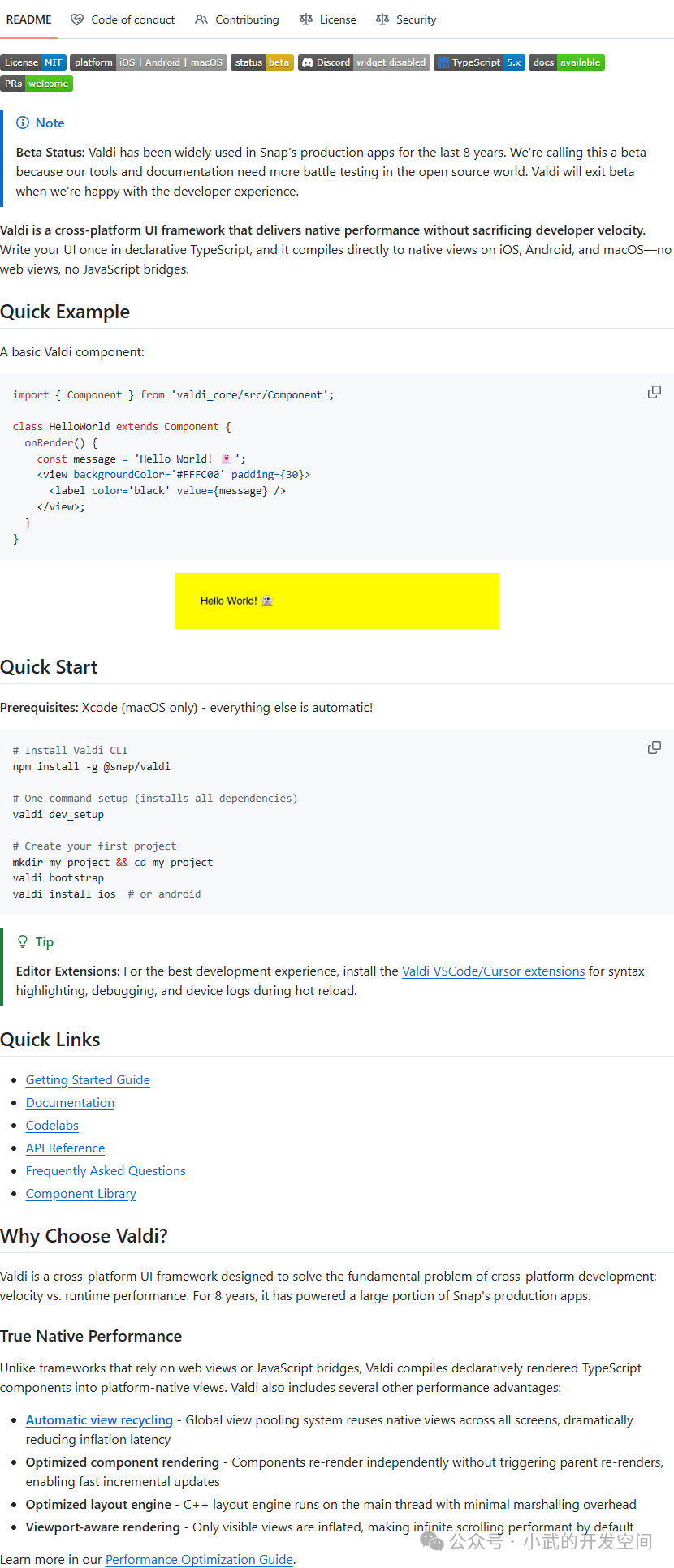
Valdi is a cross-platform UI framework designed for teams pursuing extreme performance and development efficiency. It allows developers to write declarative UI code using TypeScript, which is directly compiled into native views on iOS, Android, and macOS without relying on WebView or JavaScript bridging technology, ensuring true native performance.
Efficient Development Experience
The framework supports millisecond-level hot reloading, deep debugging integration with VSCode, and familiar TSX syntax, significantly enhancing development iteration speed. It also provides features such as automatic view recycling, optimized layout engines, and viewport rendering to ensure smooth operation of complex interfaces.
Flexible Integration and Ecosystem Support
Valdi supports progressive integration, can be embedded into existing native applications, or introduce native components, compatible with C++, Swift, Kotlin, and other multi-language modules, and provides enterprise-level features such as protobuf and Bazel builds, having been stably running in multiple production applications at Snap for eight years, with large-scale practical validation.
5. iDescriptor/iDescriptor
 📊 Data Metrics:
⭐ stars : 924 | 🍴 forks : 36
🔗 https://github.com/iDescriptor/iDescriptor
Project Introduction
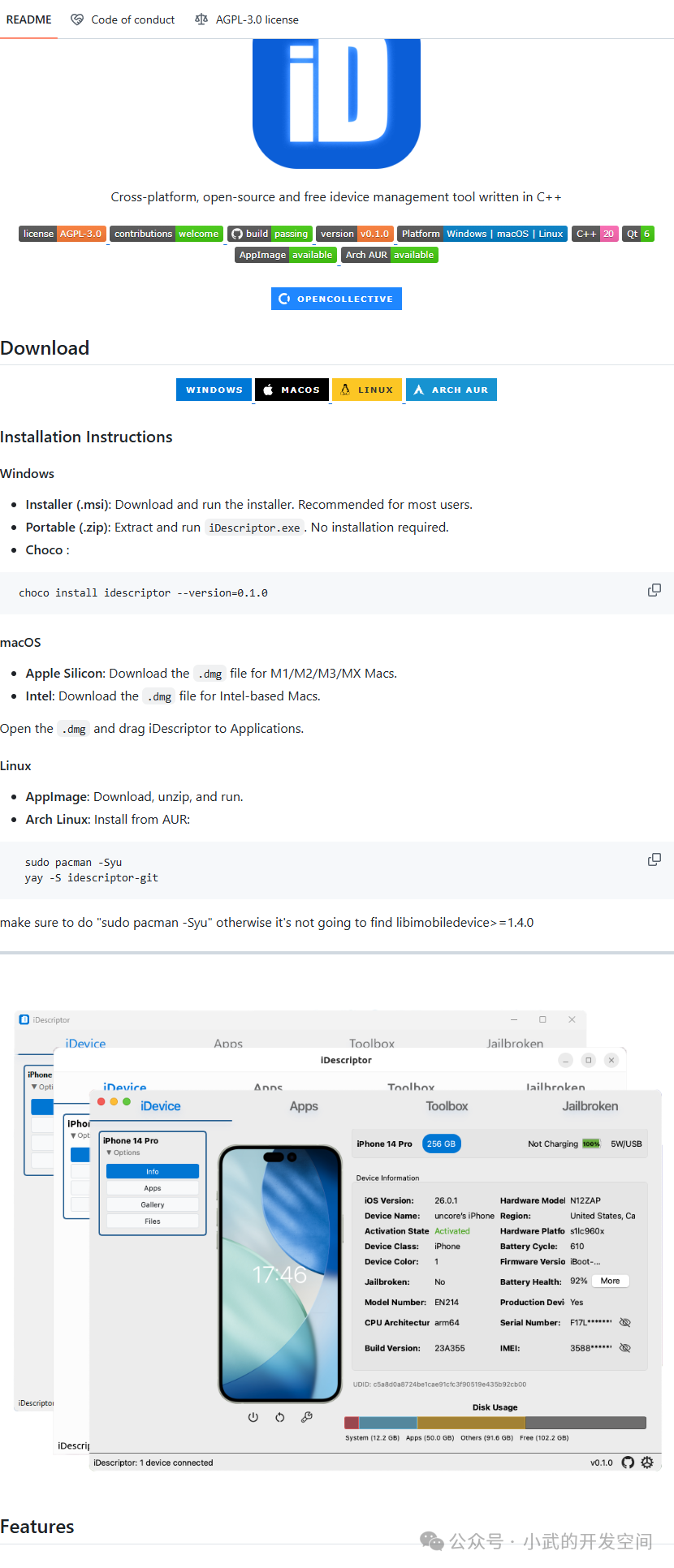
iDescriptor is a cross-platform, open-source, and free iDevice management tool written in C++, supporting Windows, macOS, and Linux systems. The project aims to provide users with a comprehensive and user-friendly device management solution, allowing efficient management of Apple devices such as iPhone and iPad without relying on iTunes or other official tools.
Core Features
The tool integrates various practical functions, including connecting devices via USB, AirPlay screen mirroring, virtual location, file system mounting (iFuse), application installation (supporting downloads from the App Store), device rebooting, and entering recovery mode. It also supports SSH terminal access for jailbroken devices and can query device hardware information (MobileGestalt), meeting the diverse needs of developers and advanced users.
Technical Architecture and Ecosystem Compatibility
iDescriptor is developed based on the Qt6 framework, featuring a modern UI and good theme adaptation capabilities, supporting automatic switching between dark/light modes. The underlying dependencies include open-source projects like libimobiledevice and ipatool, ensuring compatibility with Apple device protocols. The project provides various installation methods such as AppImage, MSI, DMG, and supports Arch Linux AUR installation, facilitating quick deployment for users on different systems.
6. DearVa/Everywhere
 📊 Data Metrics:
⭐ stars : 3.7k | 🍴 forks : 203
🔗 https://github.com/DearVa/Everywhere
Project Introduction
Everywhere: Your All-Scenario AI Assistant
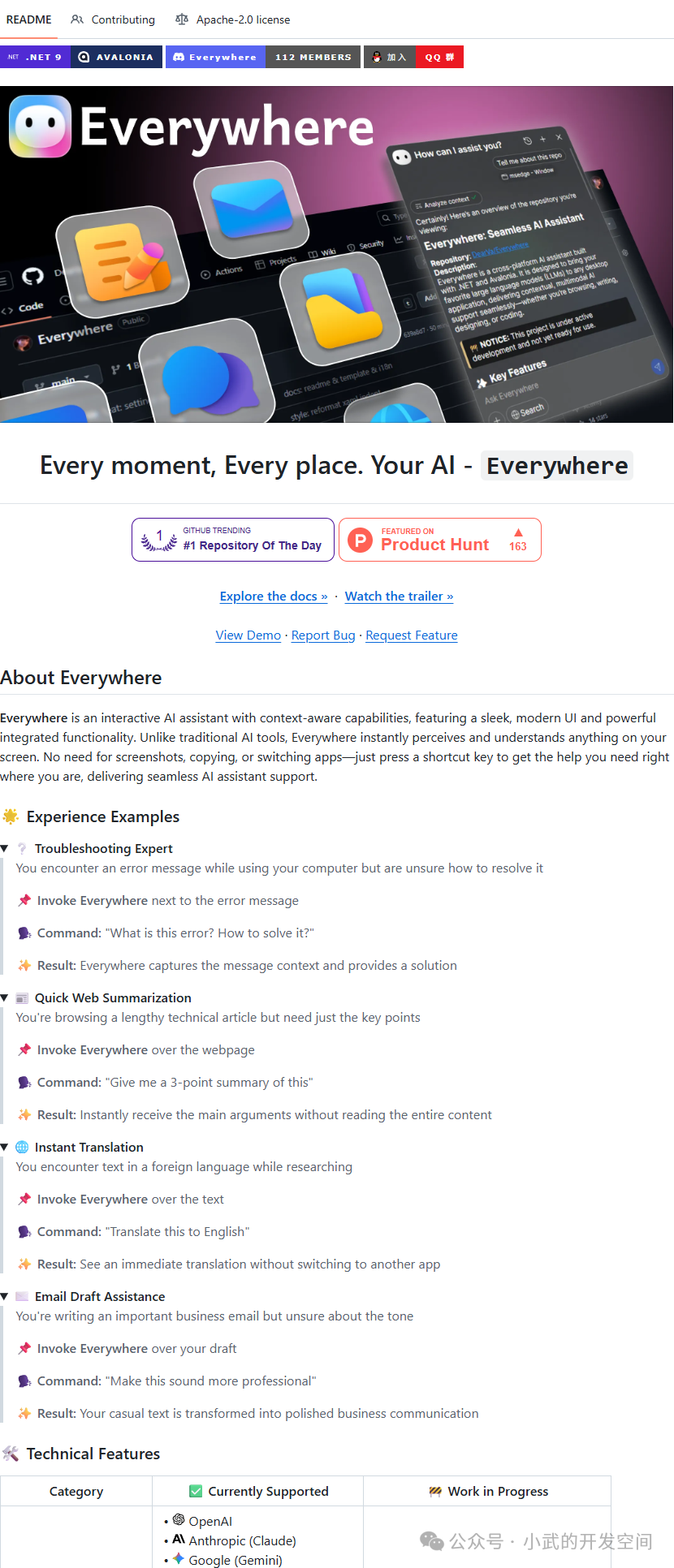
Everywhere is an innovative interactive AI assistant with context awareness, capable of real-time understanding of screen content during user operations. No need for screenshots, copying, or switching applications; just press a shortcut key to get AI support on the current interface, achieving a truly seamless intelligent assistance experience.
Core Functions and Technical Features
The tool supports various mainstream large language models, including OpenAI, Anthropic, Google Gemini, DeepSeek, and integrates the Ollama local running solution. Currently adapted for the Windows platform, it provides a modern frosted glass UI design, supporting keyboard shortcuts and Markdown rendering. Its functions cover high-frequency usage scenarios such as error diagnosis, web summarization, instant translation, and email polishing.
Multi-Language Support and Community Ecosystem
The project has achieved localization in over ten languages, including Chinese, English, German, Japanese, Korean, and Russian, with active support from Discord and QQ communities. Developed based on the Avalonia framework, it uses the .NET 9 technology stack and follows the Apache 2.0 open-source protocol, encouraging developers to participate in contributions and jointly promote the development of cross-platform versions (macOS/Linux).
7. 6rests/polyseed-monero
 📊 Data Metrics:
⭐ stars : 397 | 🍴 forks : 108
🔗 https://github.com/6rests/polyseed-monero
Project Introduction
Core Features
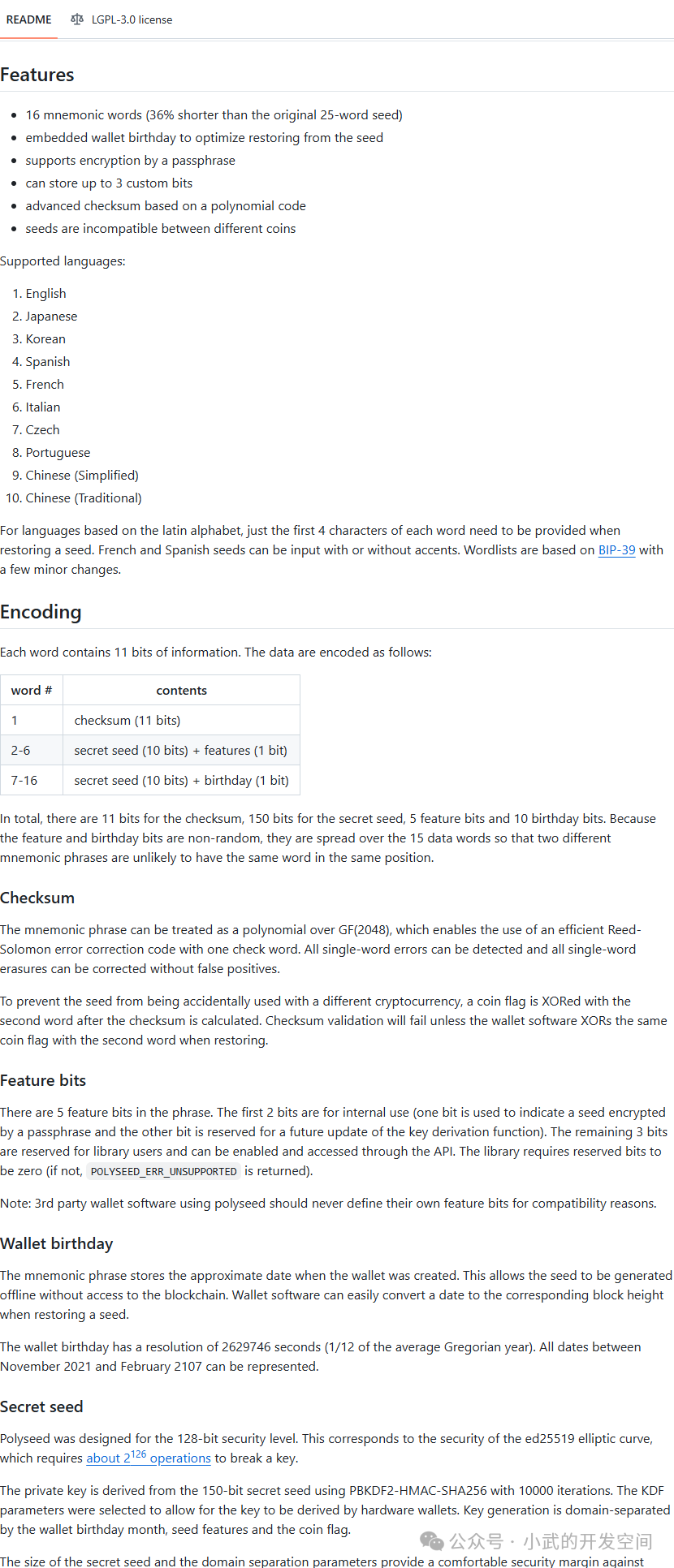
Polyseed Monero is a modern mnemonic seed scheme designed for Monero, providing a compact seed of 16 words (36% shorter than the traditional 25-word seed). It embeds the wallet creation time (birthday), supports password encryption, and can store up to 3 custom feature bits. It employs an advanced checksum mechanism based on polynomial codes, capable of detecting single-word errors and correcting single-word erasures, ensuring high security and fault tolerance.
Data Encoding and Security Design
Each word carries 11 bits of information, including 150 bits of secret seed, 11 bits of checksum, 5 bits of feature flags, and 10 bits of birthday data. The wallet birthday is covered in approximately 1/12 year units, spanning from 2021 to 2107, facilitating quick synchronization of the blockchain during offline recovery. The private key is derived using PBKDF2-HMAC-SHA256, combined with the wallet birthday, currency identifier, and feature bits to achieve domain separation, effectively resisting multi-target attacks and ensuring 128-bit security strength.
Multi-Language Support and Compatibility
Supports ten languages, including Chinese, English, Japanese, and Korean, with Latin alphabet languages requiring only the first four characters to recover the seed. The word list is fine-tuned based on BIP-39, ensuring that seeds between different currencies are incompatible for security. Mature libraries such as libsodium or OpenSSL are integrated through dependency injection mechanisms, with no built-in password algorithms, reducing security risks, suitable for hardware wallets and other resource-constrained environments.
8. Ruben2776/PicView
 📊 Data Metrics:
⭐ stars : 2.3k | 🍴 forks : 134
🔗 https://github.com/Ruben2776/PicView
Project Introduction
Project Overview
404: Not Found is a sample project used to simulate and handle “resource not found” errors in web requests. This project aims to help developers understand the triggering mechanism of HTTP status code 404 and provides design and implementation solutions for custom 404 pages. Through a simple front-end interface and back-end routing control, users can learn how to elegantly handle invalid path requests.
Functional Features
The project supports dynamic routing matching, automatically redirecting to a preset 404 page when accessing non-existent pages. The page design is user-friendly, including a return to homepage button and error explanation, enhancing user experience. Additionally, the project can be integrated into various web application frameworks, suitable for teaching, debugging, or actual deployment scenarios, with good scalability and maintainability.
9. SimonvBez/CPUSetSetter
 📊 Data Metrics:
⭐ stars : 407 | 🍴 forks : 16
🔗 https://github.com/SimonvBez/CPUSetSetter
Project Introduction
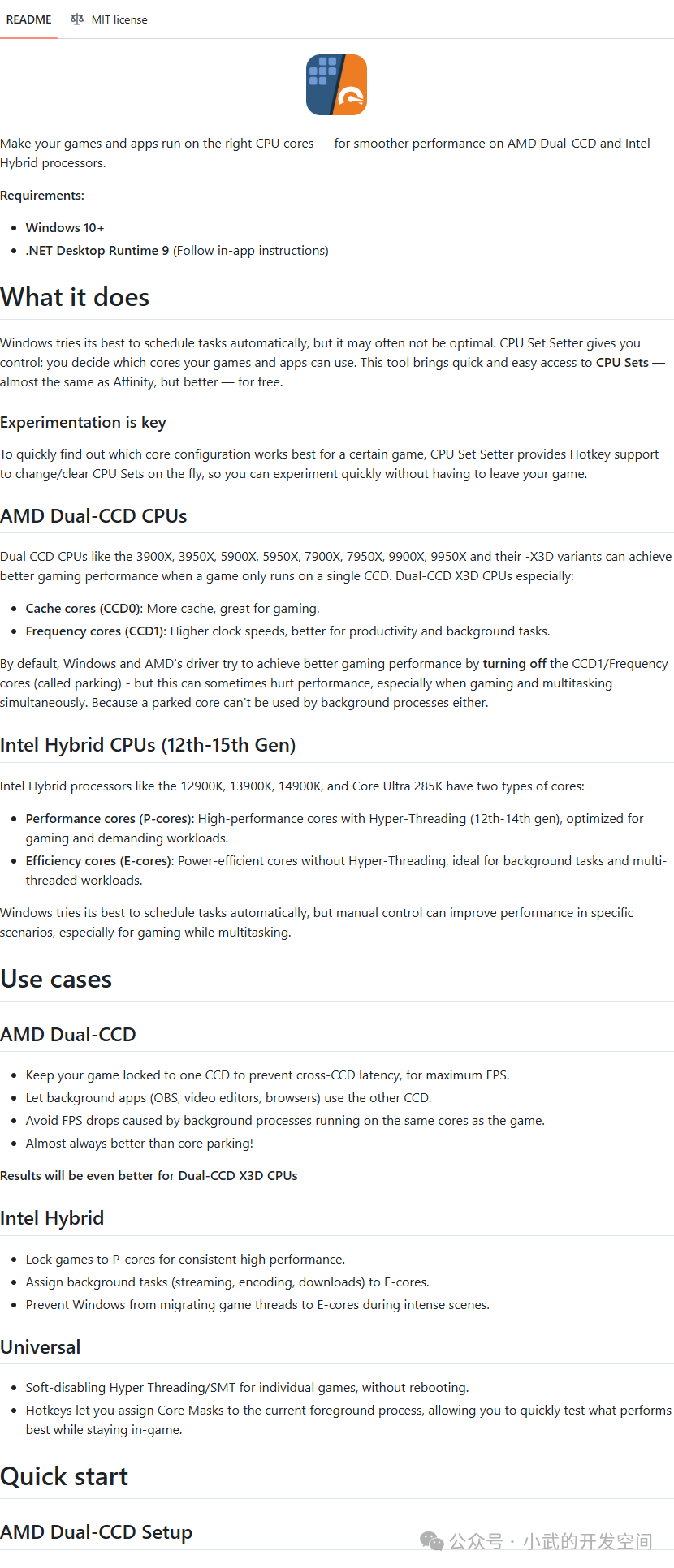
What is CPU Set Setter?
CPU Set Setter is a free tool designed to enhance the performance of games and applications, suitable for Windows 10 and above. It optimizes task scheduling by controlling the CPU cores available to processes (i.e., “CPU Sets”), specifically enhancing performance for AMD dual CCD and Intel hybrid architecture processors. Compared to traditional core affinity settings, CPU Sets provide a more stable and flexible scheduling method, avoiding game crashes caused by hard locking while remaining compatible with anti-cheat mechanisms.
Core Functions and Usage Scenarios
The tool supports hotkey instant switching of core allocation, allowing users to quickly test the best configuration during gameplay. For AMD Dual-CCD processors, it can lock games to the larger cache CCD0 to reduce cross-core latency; for Intel P-Core/E-Core architecture, it allows games to exclusively use performance cores while background tasks run on efficiency cores, achieving smooth parallel multitasking. Additionally, it supports temporarily disabling hyper-threading without needing to restart the system.
Quick Start and Automation
After installation, the program automatically recognizes the CPU type and generates preset core masks (e.g., “P-Cores”, “CCD0”, etc.). Users only need to assign the corresponding core group for games or applications in the “Processes” tab, and the settings can be saved and automatically reloaded. It supports startup on boot, along with custom rules and masks to meet advanced users’ fine-tuning needs.
10. microsoft/agent-framework
 📊 Data Metrics:
⭐ stars : 5.5k | 🍴 forks : 825
🔗 https://github.com/microsoft/agent-framework
Project Overview
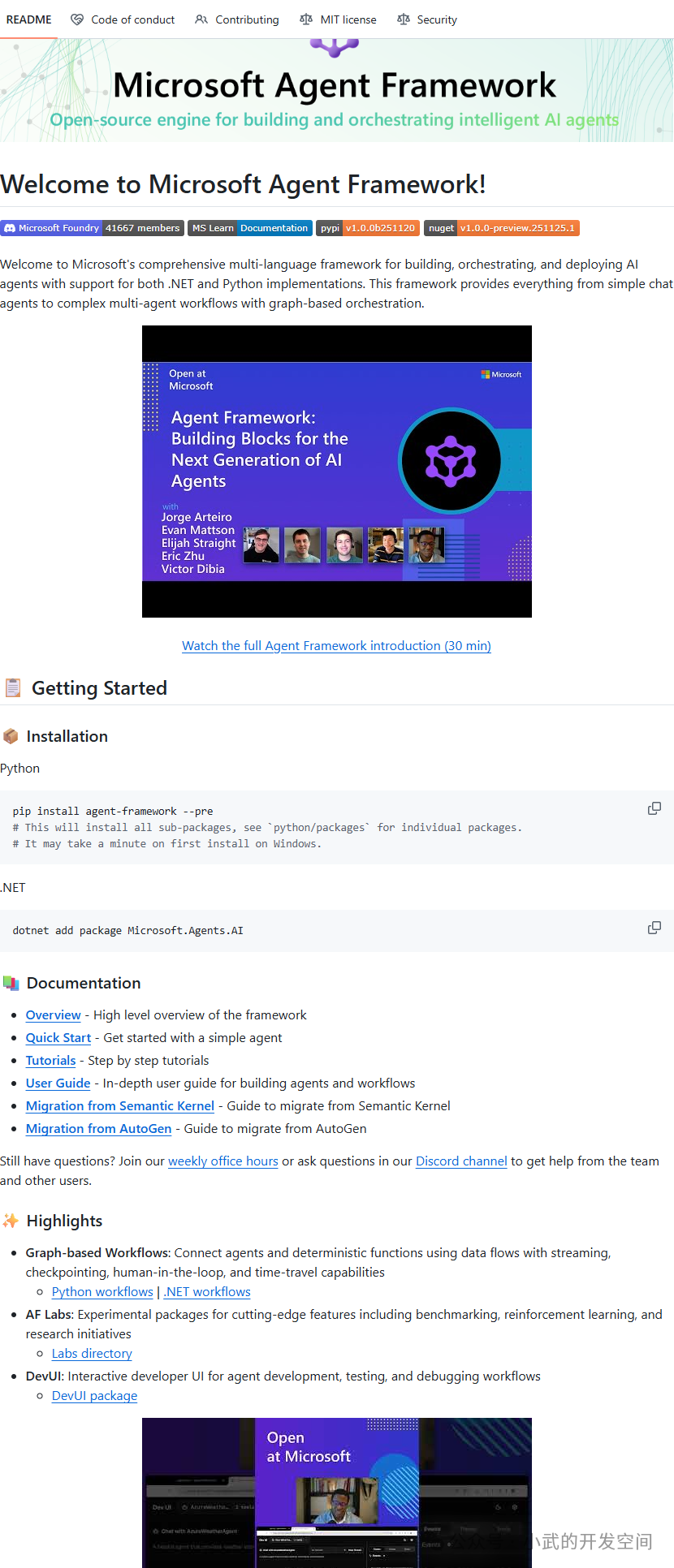
Framework Introduction
The Microsoft Agent Framework is a cross-language AI agent development framework launched by Microsoft, supporting Python and .NET platforms, aimed at simplifying the workflow construction and orchestration from simple chatbots to complex multi-agent systems. This framework provides a unified API design to help developers quickly build intelligent applications based on large models.
Core Features
Graphical Workflow and Observability
It supports data flow-based graphical workflows, with capabilities for streaming, checkpoints, human-machine collaboration, and time backtracking. Built-in OpenTelemetry integration provides distributed tracing and debugging support, enhancing system observability.
Multi-Platform Support and Tool Ecosystem
It supports both Python and C#/.NET development environments and is compatible with various LLM providers. Accompanied by a DevUI developer interface, it facilitates interactive debugging and testing, and includes a middleware system to extend request handling logic.
Quick Start and Community Support
Getting Started Examples and Documentation Resources
It provides detailed quick start guides, tutorials, and migration guides (supporting migration from Semantic Kernel and AutoGen), along with rich code examples. Real-time technical support and feedback can be obtained through the Discord community and weekly office hours.
11. game1024/Speedy
 📊 Data Metrics:
⭐ stars : 13.4k | 🍴 forks : 942
🔗 https://github.com/game1024/Speedy
Project Introduction
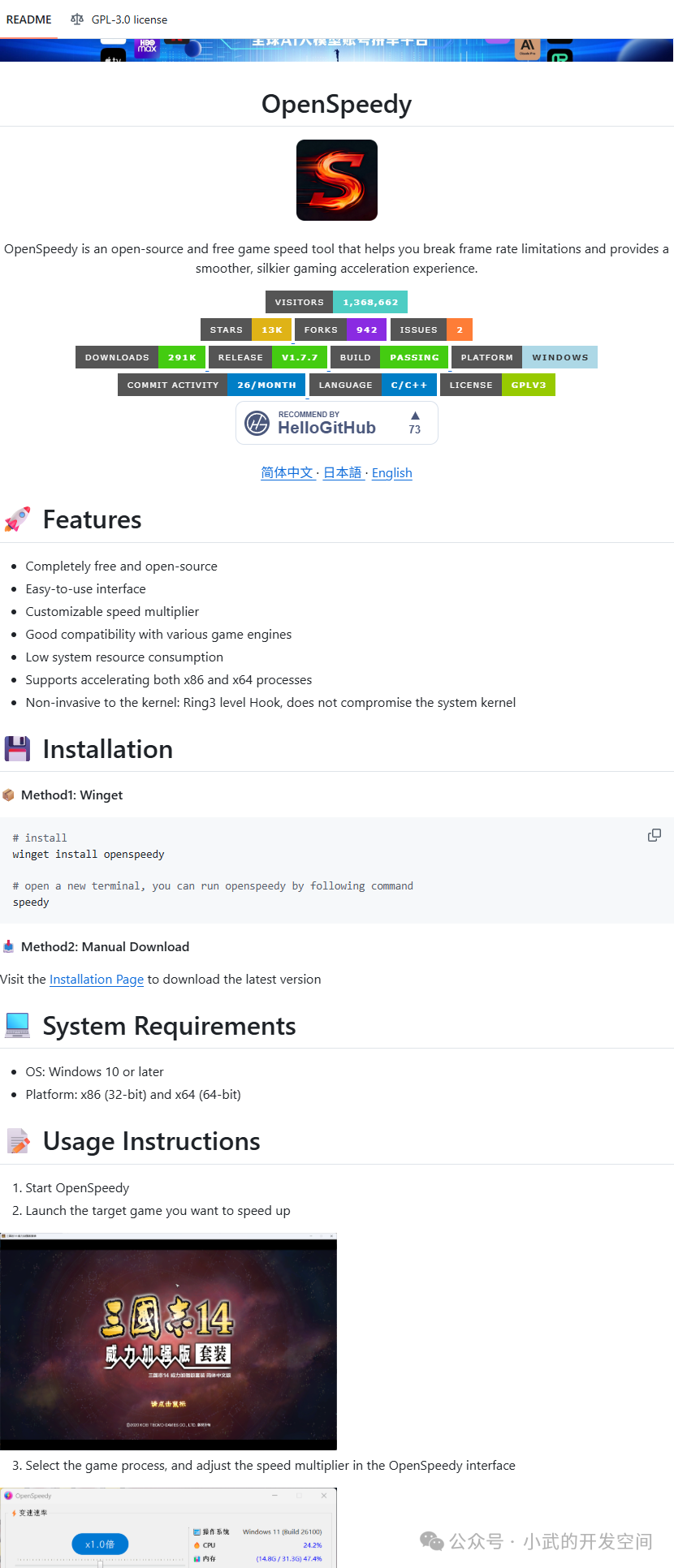
Basic Information
OpenSpeedy is an open-source free game acceleration tool designed to help users break through game frame rate limits, providing a smoother and more fluid running experience. This project is developed based on C/C++, running on Windows platforms (supporting x86 and x64 architectures), using Ring3 level API Hook technology, without intruding into the system kernel, ensuring safety and low resource usage.
Functional Features
It supports custom speed adjustment ratios, compatible with various mainstream game engines, allowing users to easily operate through a simple graphical interface. The tool achieves acceleration effects by intercepting Windows system time-related functions (such as Sleep, QueryPerformanceCounter, etc.) to control the flow of time. It also supports quick installation via Winget and provides detailed usage documentation and multi-language support.
Usage and Responsibility
The project clearly states that it is intended for learning and research purposes only, and it is not recommended for use in online competitive games to avoid triggering anti-cheat mechanisms that could lead to account bans. The software is not digitally signed and may be falsely reported by antivirus software. It follows the GNU GPLv3 license agreement, with open and transparent code maintained by the community.
12. reisxd/TizenTubeCobalt
 📊 Data Metrics:
⭐ stars : 741 | 🍴 forks : 39
🔗 https://github.com/reisxd/TizenTubeCobalt
13. browseros-ai/BrowserOS
 📊 Data Metrics:
⭐ stars : 7.9k | 🍴 forks : 760
🔗 https://github.com/browseros-ai/BrowserOS
Project Introduction
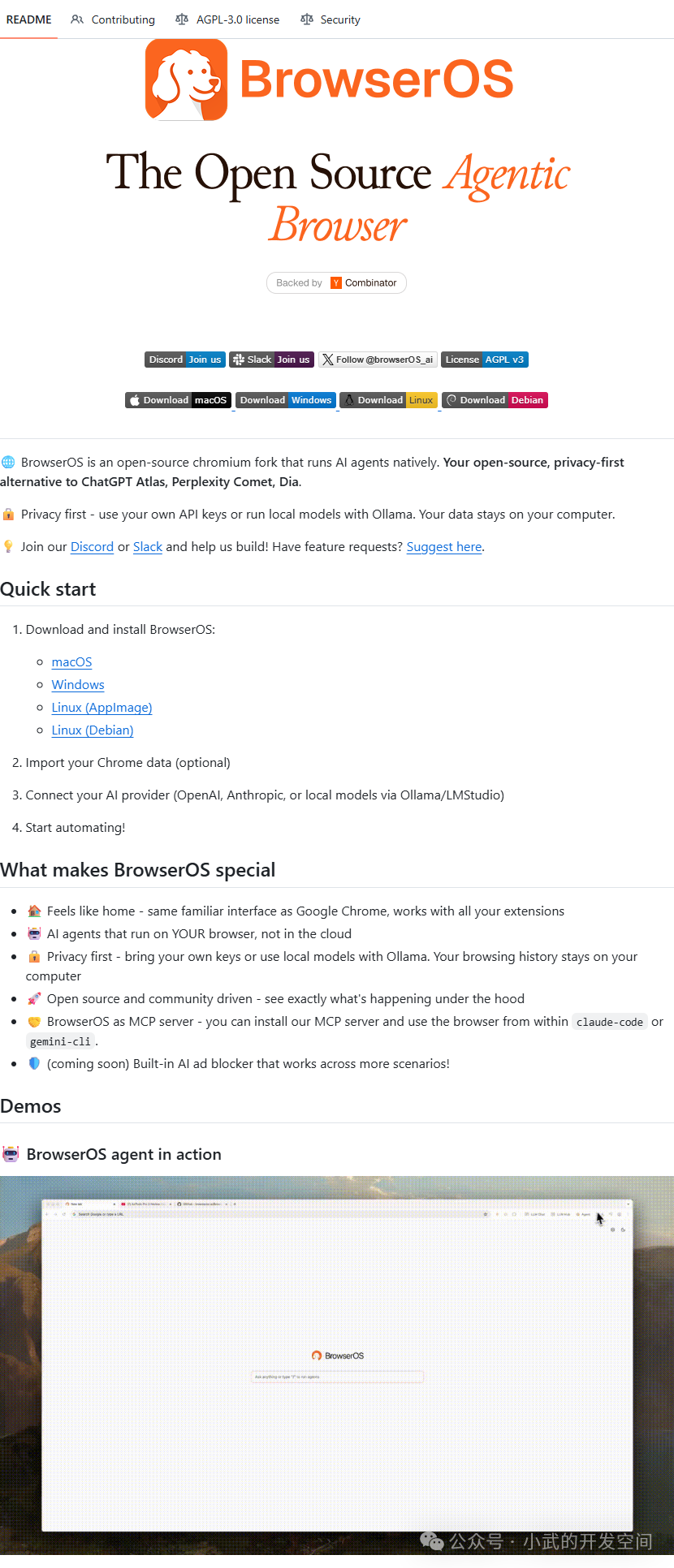
BrowserOS: An Open-Source Browser for the AI Era
BrowserOS is an open-source browser based on Chromium, designed for the AI agent era. It integrates AI capabilities directly into the browser, supporting mainstream models such as OpenAI and Anthropic, while also being compatible with Ollama and LMStudio for local model execution, ensuring that user data remains on local devices.
Privacy-First and Localized AI Automation
BrowserOS adheres to a “privacy-first” philosophy, allowing users to use their own API keys or run AI models completely offline. AI agents perform tasks within the local browser, such as auto-filling forms, scraping web data, and controlling browsing processes, without relying on cloud services, achieving a truly secure and controllable automation experience.
Open Ecosystem and Community-Driven
As a fully open-source project (AGPL-3.0 license), BrowserOS supports community contributions and secondary development. It also provides MCP server functionality, which can be called by tools like claude-code or gemini-cli to build cross-platform intelligent workflows, aiming to become the open standard for the next generation of intelligent browsers.
14. cactus-compute/cactus
 📊 Data Metrics:
⭐ stars : 3.8k | 🍴 forks : 228
🔗 https://github.com/cactus-compute/cactus
Cactus Graph
General Numerical Computing Framework
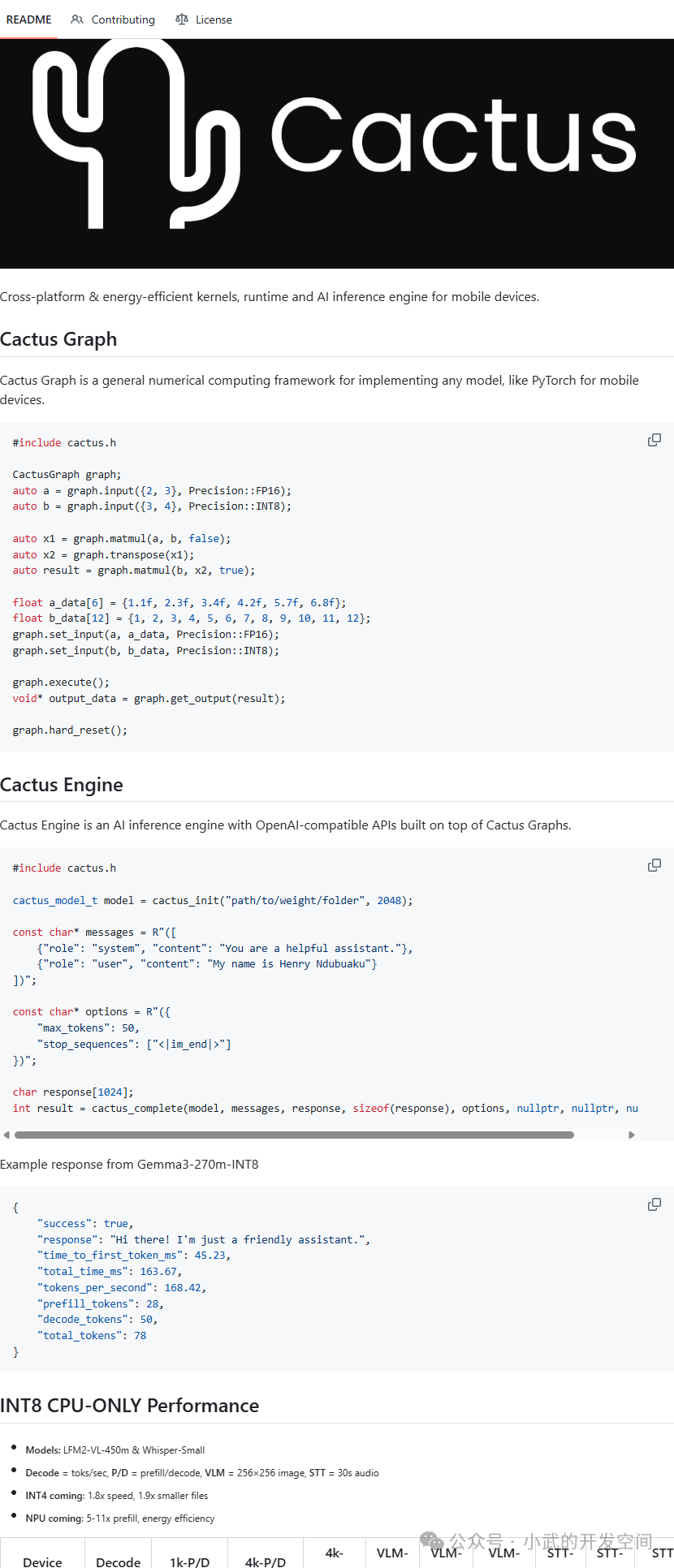
Cactus Graph is a high-performance, cross-platform numerical computing framework designed for efficiently running deep learning models on mobile devices. It supports various data precisions (such as FP16, INT8), providing a PyTorch-like programming interface for flexible tensor operations and graph construction on resource-constrained devices. Through optimized kernels and runtime scheduling, Cactus Graph can achieve low-latency and high-throughput computing performance on CPUs.
Cactus Engine
AI Inference Engine and Open API
Cactus Engine, built on Cactus Graph, is a lightweight AI inference engine compatible with OpenAI interface specifications, supporting localized deployment and edge inference. Developers can quickly integrate large language models, speech recognition, and visual understanding capabilities through a simple C/C++ API. Its response results include detailed performance metrics, facilitating monitoring of inference speed and resource consumption, suitable for real-time interactive applications on mobile devices.
Efficient Deployment and Ecosystem Support
Multi-Platform Support and Model Compression
The project supports various platforms including Android, iOS, macOS, and Windows ARM, providing automated build scripts and native SDKs (Kotlin, Swift, Flutter, React Native). It currently supports mainstream INT8 quantized models such as Gemma, Whisper, and Qwen, with advantages in small size and high inference speed, and will further introduce INT4 compression and NPU acceleration to enhance energy efficiency.
15. D4m0n/CVE-2025-50168-pwn2own-berlin-2025
 📊 Data Metrics:
⭐ stars : 124 | 🍴 forks : 16
🔗 https://github.com/D4m0n/CVE-2025-50168-pwn2own-berlin-2025
CVE-2025-50168 Vulnerability Exploitation Project Introduction
Project Background
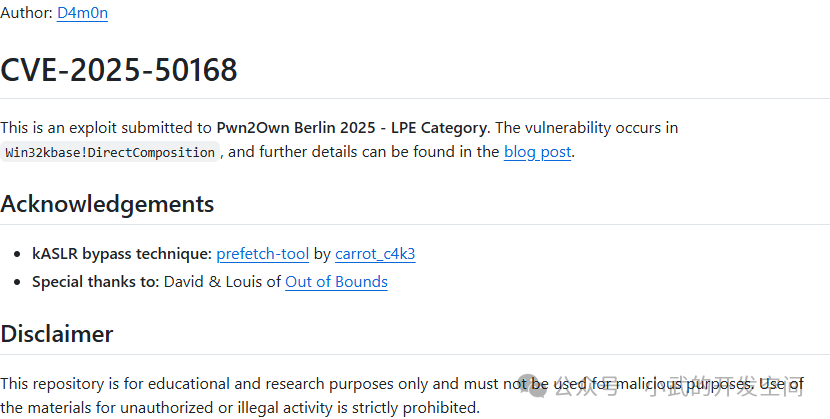
This project was submitted by security researcher D4m0n for participation in the Pwn2Own Berlin 2025 local privilege escalation (LPE) category competition. The vulnerability exists in the Windows kernel component Win32kbase!DirectComposition, belonging to a high-risk defect at the graphics subsystem level, which can be used to achieve local privilege escalation attacks.
Technical Details
The exploit combines a carefully crafted DirectComposition system call to trigger a memory corruption issue in the kernel. The project draws on advanced kASLR bypass techniques, using the prefetch-tool developed by carrot_c4k3 to achieve information leakage, thereby breaking through the kernel address space layout randomization protection mechanism.
Acknowledgments and Disclaimer
Special thanks to David and Louis from the Out of Bounds team for their support during the research process. This project is intended for security research and educational purposes only, and is strictly prohibited for illegal use; users must comply with relevant laws and regulations.