The Fraunhofer Institute for Laser Technology (ILT) in Germany, a research institution focused on laser manufacturing, has collaborated with the American engineering metal parts supplier MacLean-Fogg to produce a large die casting mold insert for Toyota using laser powder bed fusion technology (PBF-LB/M). This project marks the first successful demonstration of large-volume molds with conformal cooling, made possible by a newly developed tool steel called L-40. The hybrid mold insert for the Toyota Yaris hybrid transmission housing is manufactured by combining traditional prefabricated components with additive manufacturing structures, thereby shortening production time and enabling more complex cooling designs.
As electrification and cost competition reshape automotive platforms, manufacturers are under pressure to integrate components into fewer but larger aluminum parts. This shift places higher demands on die casting molds, which must withstand extreme thermal and mechanical stresses while quickly adapting to design changes. Traditional machining steels and tool steels (such as H11, H13, or M300) struggle to meet these requirements at scale, prompting Fraunhofer ILT and MacLean-Fogg to focus on new machine concepts and materials. Toyota has already utilized smaller additive manufacturing molds in mass production, reporting a significant increase in mold life, with a lifespan four times longer than traditional blades.
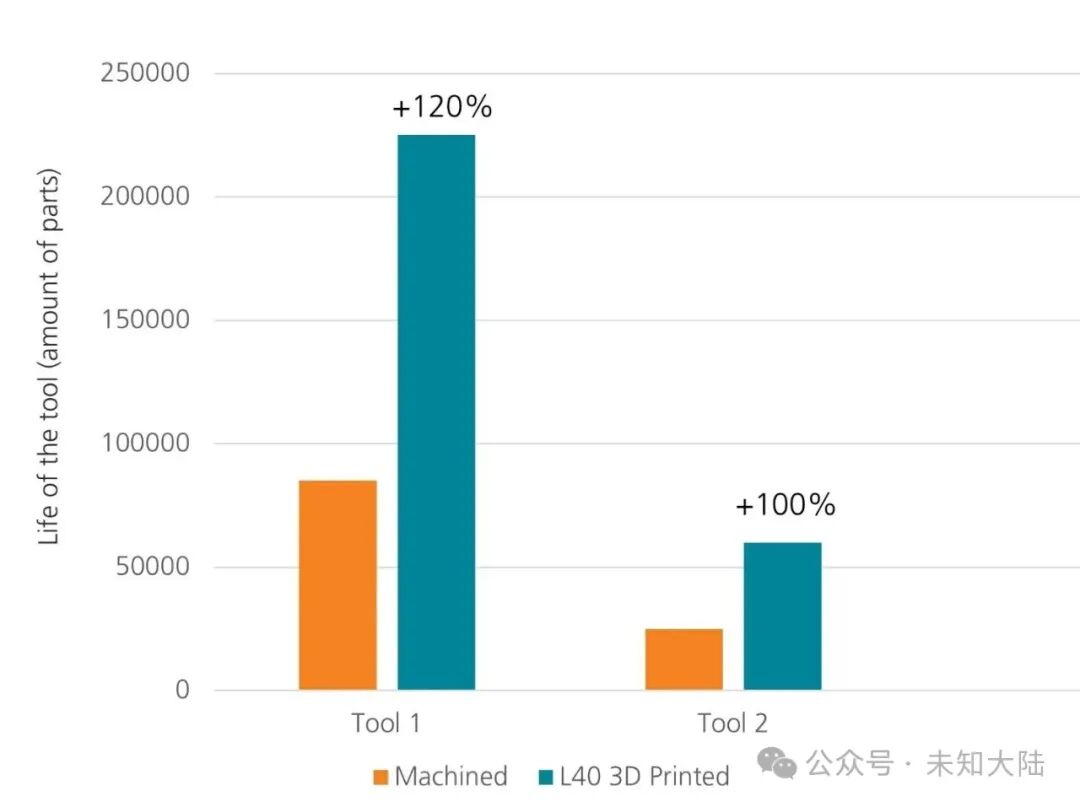
Comparison of the service life of traditional manufacturing and additive manufacturing tools made from L-40 material. Image courtesy of Fraunhofer Institute for Laser Technology.
Niklas Prätzsch, head of the LPBF process technology group at Fraunhofer ILT, explains: “To overcome these limitations, we need a new generation of machines and materials specifically tailored to the demands of large high-pressure precision stamping molds. The latest transformations we are implementing are centered around this combination.”
Fraunhofer ILT has designed a gantry-based five-laser PBF-LB/M machine with a build chamber size of 1,000 × 800 × 350 mm³. Unlike fixed bed systems, this machine features a movable processing head and is equipped with localized protective gas guidance, ensuring that parameters such as gas flow rate and laser deflection angle remain constant as the build area expands. This method can construct inserts exceeding 20,000 cm³, including a Toyota insert with boundary box dimensions of 515 × 485 × 206 mm³. A substrate heated to 200°C reduces the temperature gradient during the build process, thereby lowering the risk of residual stress and cracking that typically occurs in large geometries.
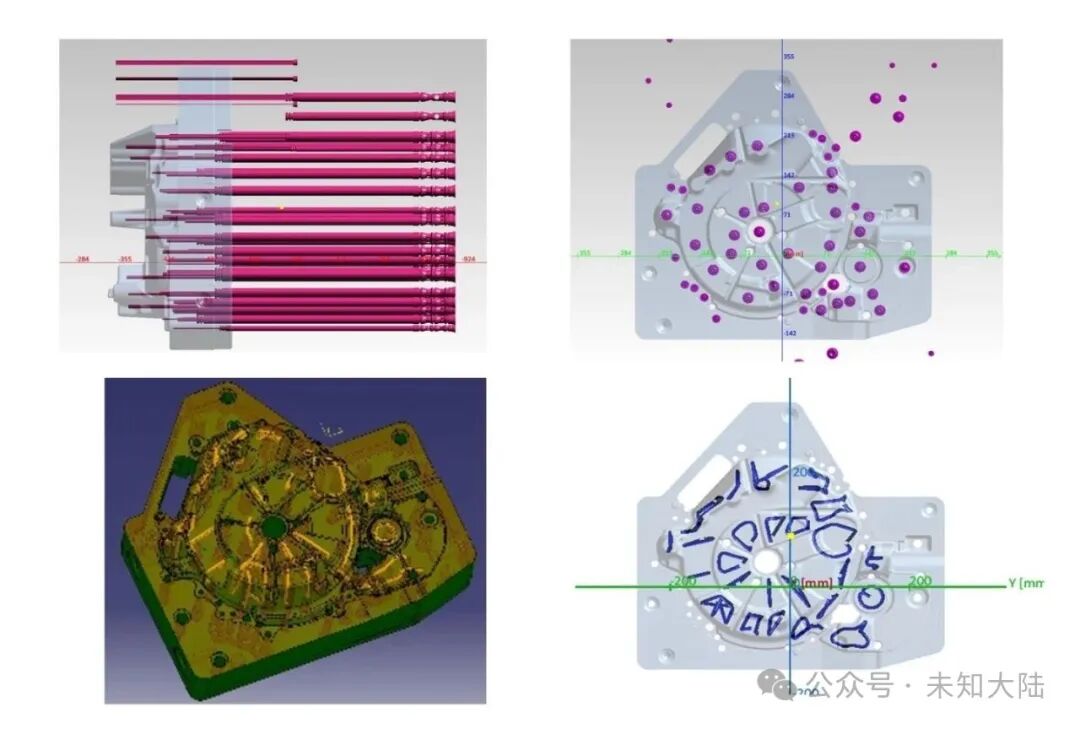
Cooling channel design: The new shape replaces traditional pin cooling (top image) with a complex network of conformal cooling channels (bottom image). Image courtesy of Fraunhofer Institute for Laser Technology.
Material development is equally crucial. MacLean-Fogg has developed L-40 steel, a material designed specifically for the additive manufacturing process of high-pressure die casting tools. Compared to existing alloys, L-40 significantly reduces the tendency to crack during printing and heat treatment processes. In its finished state, the alloy achieves a hardness of 48 HRC, a tensile strength of 1,420 MPa, and a notch impact strength exceeding 60 J. Tests have confirmed the stability of this alloy in complex geometries, including circular and suspended cooling channels, where traditional steels often fail.
For Toyota’s transmission housing, the project team employed a hybrid production method. First, a prefabricated component with vertical cooling channels was manufactured using traditional methods, followed by the construction of conformal channels using additive manufacturing technology. This required precise machine calibration to ensure accurate alignment and reliable connection between the two components. Once completed, the insert underwent stress-relief annealing and was machined on its functional surfaces using traditional methods. The high dimensional accuracy of the additive manufacturing substrate means that only minimal finishing is required, with no further material input needed.
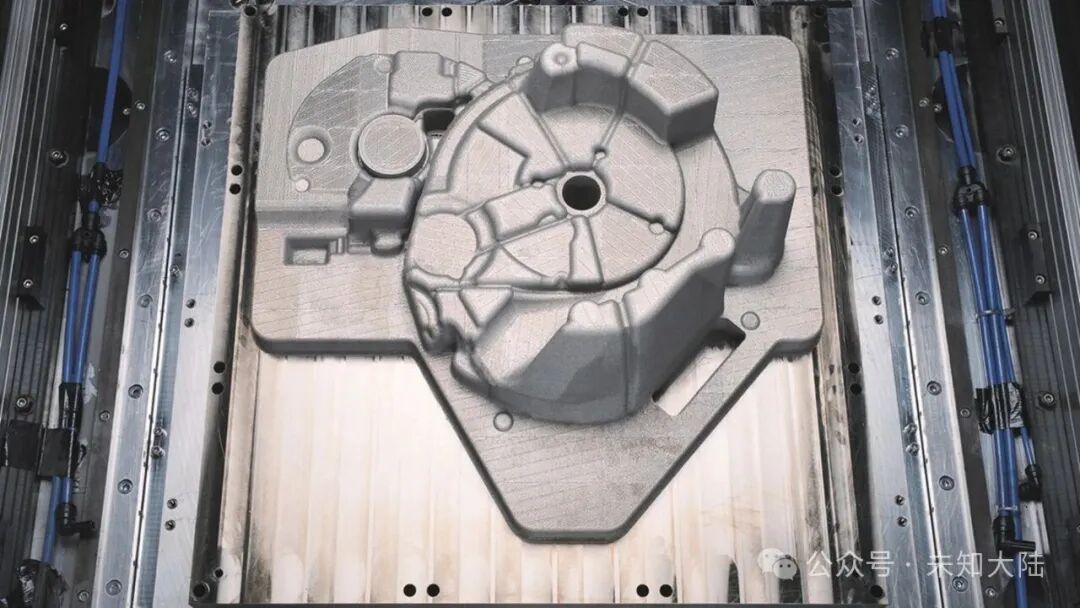
Thanks to the large-format gantry system from Fraunhofer ILT, even complex durable tools exceeding 20,000 cm³ can be printed with high repeatability. Image courtesy of Fraunhofer Institute for Laser Technology.
Harald Lemke, product management director at MacLean-Fogg Component Solutions, stated: “With L-40, we are committed to pushing the limits of additive manufacturing in hot and cold forming molds, especially die casting molds. This project demonstrates that it is technically feasible to produce large, complex, and highly durable blades, setting clear milestones for achieving economic benefits. Additive manufacturing is ready to meet the real industrial scale challenges.”
The conformal cooling network within the insert is designed to mitigate thermal stress regions in the mold. By reducing local temperature peaks, this system decreases thermal-mechanical wear and extends service life. Early studies indicate that the service life of additive manufacturing molds is four times higher than that of traditional H13 inserts, and this project extends these advantages to larger-scale applications. For manufacturers, this means fewer tool changes, lower costs, and faster responses to new design demands.
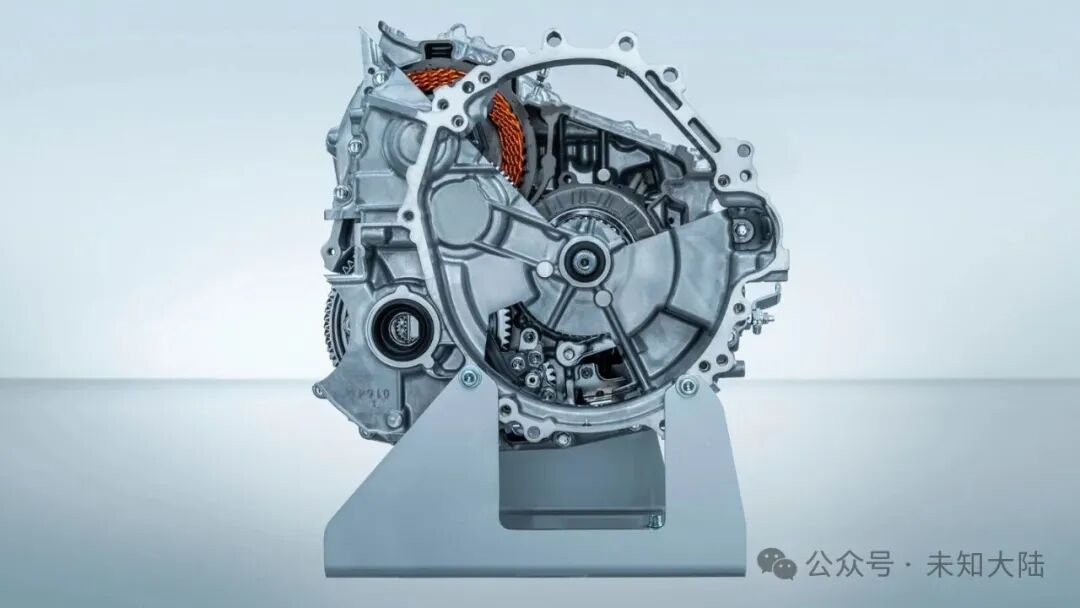
Additive manufacturing aluminum die casting molds are part of the Toyota Yaris hybrid vehicle transmission housing mold. Image courtesy of Toyota Europe.
In addition to automotive die casting, this process chain is also applicable to other fields requiring durable molds with complex cooling systems. Potential expansion areas include plastic processing and composite material molding, where limited batch sizes and high thermal loads also drive the demand for more flexible molds. As gigacasting and electric vehicle platforms further enhance mold demands, scalable additive systems provide a pathway for faster production speeds, greater adaptability, and longer-lasting production molds.