In recent years, artificial intelligence (AI) technology has rapidly developed, but its high computational resource demands often limit its application scenarios. The emergence of TinyML (Tiny Machine Learning) brings hope for AI applications on edge devices. Today, we will introduce an astonishing TinyML project—TinyML-CAM, which can achieve real-time image recognition with incredible efficiency on extremely resource-constrained micro devices!
Extreme Performance: 80FPS Real-Time Image Recognition
The core of TinyML-CAM lies in its astonishing speed and efficiency. It can achieve up to 80 FPS of real-time image recognition on the ESP32 microcontroller with only 1KB of RAM! This means it can process 80 frames of images per second and output recognition results in real-time. This is an unprecedented achievement in resource-constrained embedded systems.
Technical Principles: Clever Combination of HOG and Random Forest Algorithms
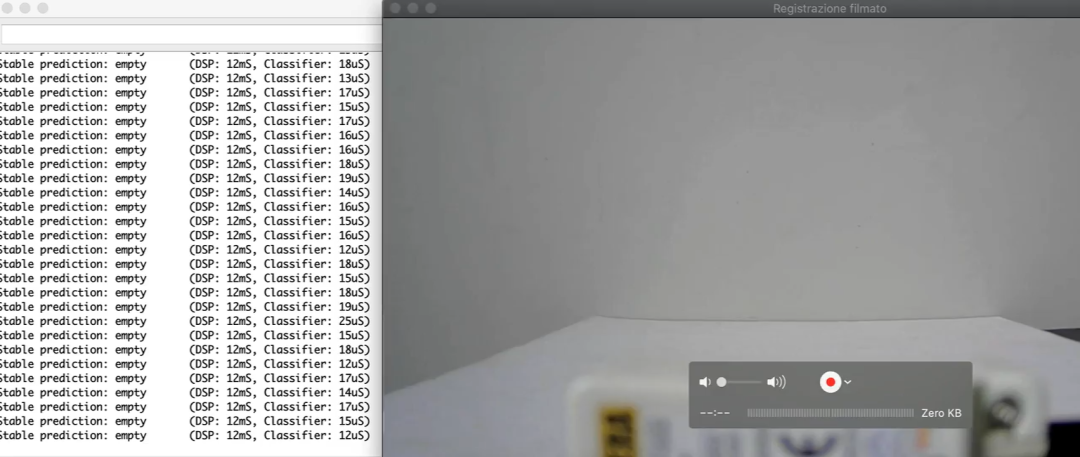
The efficiency of TinyML-CAM stems from its clever technical design. It uses the Histogram of Oriented Gradients (HOG) algorithm to extract image features, combined with a random forest classifier for image recognition. The HOG algorithm effectively captures local shape information of the images, while random forests are known for their efficiency and good generalization capabilities. More importantly, the system utilizes the digital signal processing (DSP) unit of the ESP32 to accelerate HOG feature extraction, further enhancing processing speed. Experimental results show that the DSP-based feature extraction time is about 12 milliseconds, while the classification time is less than 20 microseconds, nearly negligible.
Ultra-Low Power Consumption: 1KB RAM Memory Usage
Another remarkable feature of TinyML-CAM is its extremely low memory usage. The entire image recognition system occupies only 1KB of RAM! This allows it to run on various resource-constrained micro devices, such as the ESP32, Raspberry Pi Pico, Portenta H7, and Wio Terminal. This breaks the traditional AI dependency on high memory resources, greatly expanding the boundaries of AI applications.
Diverse Application Scenarios: Unlocking Infinite Possibilities
The high performance and low resource consumption of TinyML-CAM give it enormous potential in various application scenarios. For example:
- Smart Home: For real-time identification of family members or pets, triggering corresponding smart home devices.
- Industrial Automation: For real-time identification of product defects or anomalies, improving production efficiency.
- Robot Navigation: For real-time identification of obstacles in the environment, guiding robots to navigate safely.
- Security Monitoring: For real-time identification of intruders or abnormal behavior, enhancing security levels.
Easy to Use: Convenient Development Process
TinyML-CAM provides a clear development process and complete code examples, making it easy for users to get started quickly. It only requires the installation of the Eloquent library and the EverywhereML Python package to easily complete image data collection and model training. Users just need to upload the provided code to the ESP32 to start real-time image recognition.
Amazing Experimental Results: Real Case Demonstration
In the demonstration video, TinyML-CAM successfully performed real-time recognition on Raspberry Pi Pico, Portenta H7, and Wio Terminal. Experimental results show that the system can complete image recognition between two frames at a camera frame rate of 30FPS on the ESP32, without affecting the camera’s frame rate. Although there are some errors in object recognition due to dataset quality, its performance is already astonishing.
Conclusion
TinyML-CAM, with its astonishing performance, ultra-low resource consumption, and convenient development process, opens new possibilities for AI applications on edge devices. It is not only a technological breakthrough but also a milestone that leads the direction of AI development. It is believed that in the near future, TinyML-CAM and its derivative technologies will be widely applied in various fields, fundamentally changing the way we interact with the world.
Project Address: https://github.com/bharathsudharsan/TinyML-CAM