A company that has continuously reported net losses excluding non-recurring items has seen its stock price soar over 100% in just one month, with a market capitalization exceeding 30 billion yuan. The core of Saiwei Electronics’ capital story lies in the perfect combination of MEMS chips and computing power concepts.
“The MEMS-OCS (Optical Circuit Switching) produced by the company is involved in the construction of supercomputers and computing power infrastructure for customer data centers.” This seemingly ordinary product introduction has sparked a frenzy in the capital market.
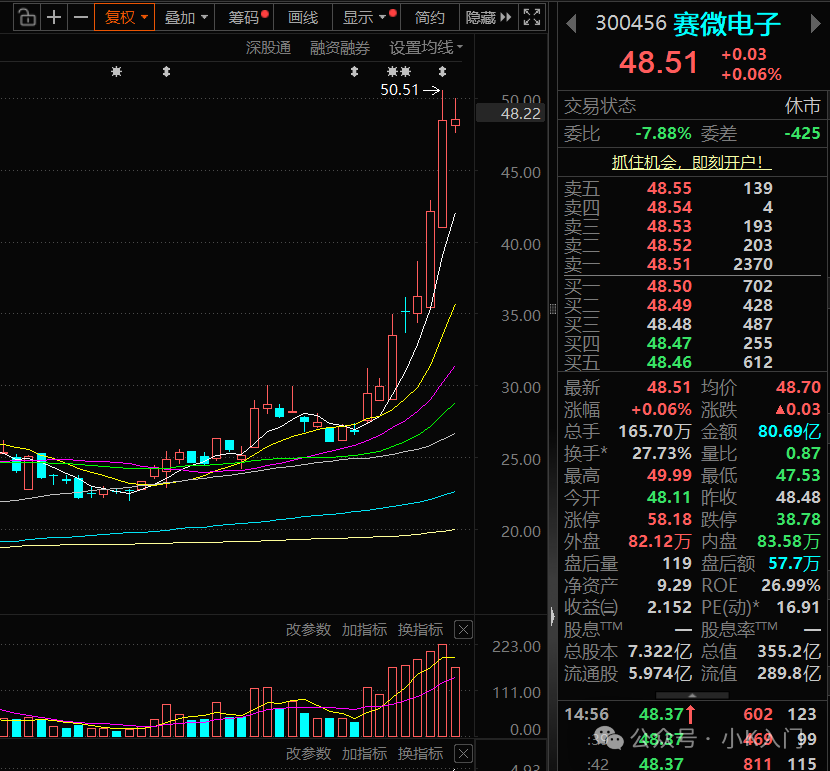
From late October to November 27, Saiwei Electronics (300456.SZ) saw its stock price rise from around 23 yuan at the low point to 50.51 yuan, setting a new historical high, with a **cumulative increase of over 100%**. This company, which is still in a loss-making state, has suddenly become a core target in the computing power concept.
01 Stock Price Surge
The recent surge in Saiwei Electronics’ stock price can be described as “rocket-like.” Starting from 23.28 yuan on October 23, the company’s stock price doubled in just one month.
The upward trend was unstoppable. On November 27, Saiwei Electronics hit the daily limit at 50.51 yuan, setting a new historical high. The closing price that day was 49.87 yuan, with an increase of 18.48% and a transaction volume of 8.211 billion yuan.
This performance stands in stark contrast to the company’s previous stock price slump. The 52-week price fluctuation range for Saiwei Electronics was 13.42 yuan to 50.51 yuan.
This means that from the lowest point to the highest point, the company’s stock price **increased by over 300%**.
The market’s enthusiastic pursuit has significantly boosted the company’s market value. As of November 26, Saiwei Electronics’ total market capitalization had reached 30.819 billion yuan.
02 The Computing Power Tailwind
The surge in Saiwei Electronics’ stock price is driven by the imagination brought about by the global wave of computing power infrastructure construction.
Google’s release of the next-generation multimodal AI model Gemini 3, trained using TPU (Tensor Processing Unit), has become the catalyst for this market trend. More importantly, Meta is negotiating with Google to use tens of billions of dollars worth of TPU chips in its data centers by 2027.
Global investments in computing power continue to increase. NVIDIA expects that global data center capital expenditures (CSPCAPEX) will reach $549 billion and $632 billion in 2026 and 2027, respectively.
**The capital expenditure growth rate of the five major cloud service providers in North America is expected to exceed 50% year-on-year in the third quarter of 2025**.
In this wave of computing power infrastructure, MEMS-OCS (Optical Circuit Switching) has become a key component for supercomputers and computing power infrastructure in data centers, attracting market attention. Saiwei Electronics happens to possess the manufacturing capability for related products.
03 Core Business
Saiwei Electronics primarily focuses on the process development and wafer manufacturing of MEMS (Micro-Electro-Mechanical Systems) chips.
In its semi-annual report for 2025, the company revealed that the production and sales of MEMS-OCS wafers from its Swedish production line saw significant growth during this reporting period.
MEMS-OCS is an optical switching device realized through micro-electromechanical system technology, enabling efficient and flexible optical connection scheduling within data centers, making it a key component for building large-scale computing clusters.
This technology has allowed Saiwei Electronics to successfully ride the wave of the computing power concept.
In addition to MEMS-OCS, the company is also continuously developing various MEMS devices such as MEMS micro-mirrors, BAW filters, high-frequency communication devices, biochips, and silicon photonics, covering fields such as communications, biomedicine, industrial automotive, and consumer electronics.
04 Performance Reality
Compared to the booming stock price, Saiwei Electronics’ fundamental performance appears particularly bleak.
In the first three quarters of 2025, the company reported a 17.4% year-on-year decline in revenue, but net profit reached 1.58 billion yuan. Behind this unusual data is the fact that the company’s net profit excluding non-recurring items remains in a loss state.
In the first half of 2025, the net profit attributable to shareholders of the listed company was -650,300 yuan, although this represented a significant reduction in losses of 98.48% compared to the same period last year, the core business still failed to achieve profitability.
From historical financial data, Saiwei Electronics’ profitability has been unstable. From 2022 to 2024, the company’s basic earnings per share were -0.10 yuan, 0.14 yuan, and -0.23 yuan, showing a typical alternating profit and loss state.
In the first half of 2025, the company reported a net cash flow from operating activities of 166 million yuan, showing some improvement year-on-year.
05 Sale of Swedish Production Line
In July of this year, Saiwei Electronics completed a significant asset restructuring—selling control of Silex in Sweden, transforming it from a wholly-owned subsidiary to an important equity investment.
Silex in Sweden is a high-quality asset under Saiwei Electronics, with good order, production, and sales conditions in the first half of 2025, especially the production and sales of MEMS-OCS wafers achieving significant growth and maintaining good profitability.
The company explained this decision as a response to the complex international situation: “To prudently respond to the complex and changing international situation, to mitigate systemic risks brought about by changes in the geopolitical environment to the greatest extent, and to effectively safeguard the long-term interests of the listed company and all shareholders.”
Although the company has lost control over the Swedish production line, it still retains a minority stake and can continue to enjoy the benefits of Silex’s business growth.
06 Challenges of the Beijing Production Line
Compared to the Swedish production line, the operational status of Saiwei Electronics’ Beijing production line faces significant challenges.
The semi-annual report for 2025 shows that the Beijing MEMS production line continues to be in the capacity ramp-up stage, and due to ongoing capacity construction and the continuous expansion of operational activities, there are rigid operational expenses.
In particular, “the depreciation and amortization pressure on the production line is enormous”, while maintaining a high level of R&D intensity, leading to continued losses for the Beijing MEMS production line.
The company admitted in its 2023 annual report that after the application for technology and product export from Silex in Sweden to the Beijing production line was rejected,Beijing FAB3 needs to rely on its own accumulated processes to independently promote the production process, increasing the uncertainty of the time cycle and capacity digestion speed.
07 Institutional Perspectives
Despite the challenges in the company’s fundamentals, market analysts have given Saiwei Electronics a positive evaluation.
According to data from Investing.com, analysts’ overall consensus on Saiwei Electronics is “strong buy.” However, this evaluation is based on a survey of one analyst over the past three months.
Institutional interest in the computing power sector continues to rise. Since the fourth quarter, many computing power and related concept stocks have received research from over a hundred institutions, including Luxshare Precision, Newyea, Zhongji Xuchuang, and Ruijie Networks.
CITIC Securities recently stated, “Alibaba’s continued firm investment in AI infrastructure marks a steady advancement in the self-controllable process of domestic computing power, and domestic computing power is expected to usher in an industry turning point.”
08 Accumulating Risks
After the stock price doubled, the risk factors for Saiwei Electronics are also accumulating.
The company’s price-to-earnings ratio can no longer be calculated normally— as of November 26, the company’s rolling price-to-earnings ratio was 20.23 times, but due to the negative net profit attributable to shareholders for the 2024 fiscal year, there is effectively no price-to-earnings ratio.
From the financial data, the company shows a certain dependence on government subsidies. From 2021 to 2023, the amounts of government subsidies recognized in the current profit and loss were 131 million yuan, 138 million yuan, and 107 million yuan, respectively.
Additionally, the company’s R&D expenditures remain high, with R&D expenses reaching 266 million yuan, 346 million yuan, and 357 million yuan from 2021 to 2023, **accounting for 28.69%, 44.01%, and 27.44% of operating revenue, respectively**. However, the commercialization of R&D results remains uncertain.
The doubling of Saiwei Electronics’ stock price is a typical phenomenon of speculative trading— the market has overlooked the company’s current performance losses and is more focused on its future growth potential in the computing power infrastructure sector.
As global data center investments exceed $600 billion, as a member of the computing hardware industry chain, Saiwei Electronics indeed faces unprecedented market opportunities.
The gap between concepts and performance, the balance between valuation and risk, these key issues will determine whether Saiwei Electronics can transition from speculative trading to genuine value growth.