
Microneedles
With the increasing global demand for food and the unprecedented pressure on agricultural systems due to environmental challenges, understanding the role of ions (i.e., key nutrients) in crop productivity has become more important than ever.Unfortunately, current tools for plant ion analysis rely on destructive sap collection, which cannot capture the dynamic changes in ion concentrations. On the other hand, non-invasive optical methods lack practicality for field applications due to reliance on expensive equipment and complex operational procedures. Recent advancements in microneedle (MN) sensing technology indicate that by directly detecting various important biomarkers, including but not limited to ions, MN sensing technology has tremendous potential for real-time monitoring of plant health. By providing a minimally invasive approach, MN sensors can precisely penetrate plant tissues for continuous internal monitoring, ensuring that natural growth is not disturbed. However, the application of manganese sensors, particularly for in vivo ion measurements, is still in its very early stages. Here, we delve into the technical potential and application pathways of plant manganese sensors, focusing on custom sensor designs to meet the specific requirements of various plant growth environments and ion detection performance. This article also discusses the fundamental correlations of ion levels in plants, provides a comprehensive assessment of existing ion detection methods, and identifies key challenges associated with achieving effective plant monitoring. Notably, we emphasize the potential of manganese sensors as a transformative approach to reveal plant stress responses, optimize crop yields, and play various roles in connecting precision agriculture and plant science research.
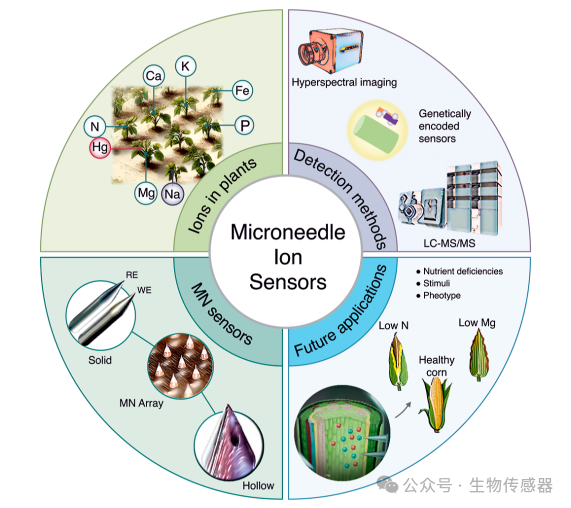
Figure 1. The summary figure describes the four main discussion areas of this perspective paper: the importance of ions in plants, current detection methods, various microneedle sensor designs, and future application prospects.
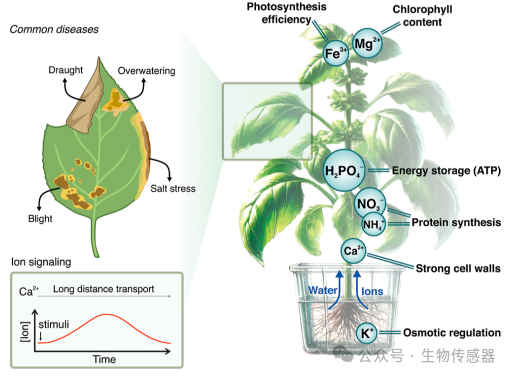
The important role of ions in regulating physiological processes in plants.
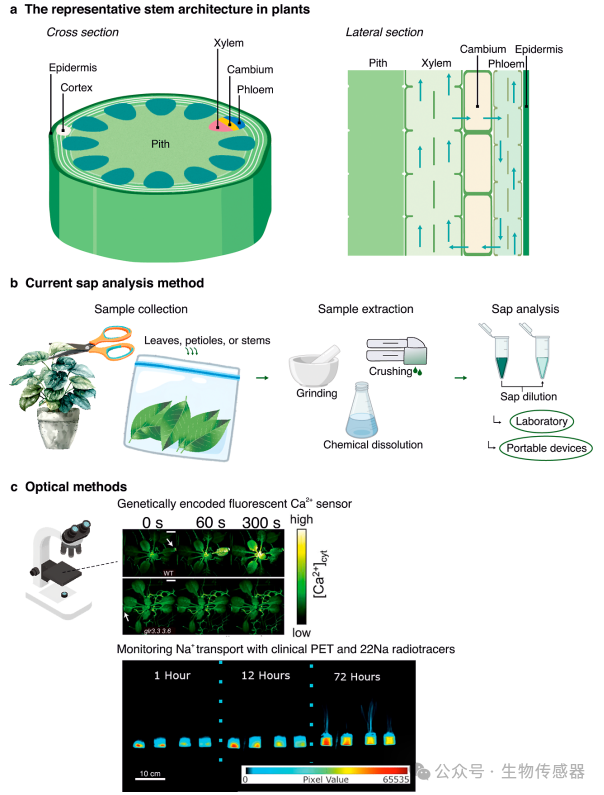
(a) Cross-section and side view of a dicot stem. (b) Overview of the sap analysis workflow: collection, extraction, and analysis. (c) Optical techniques for in vivo ion monitoring in plants.
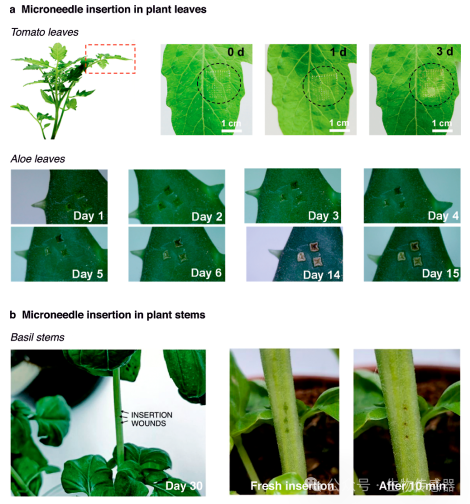
(a) Wound healing after microneedles are inserted into plant leaves and (b) plant stems.
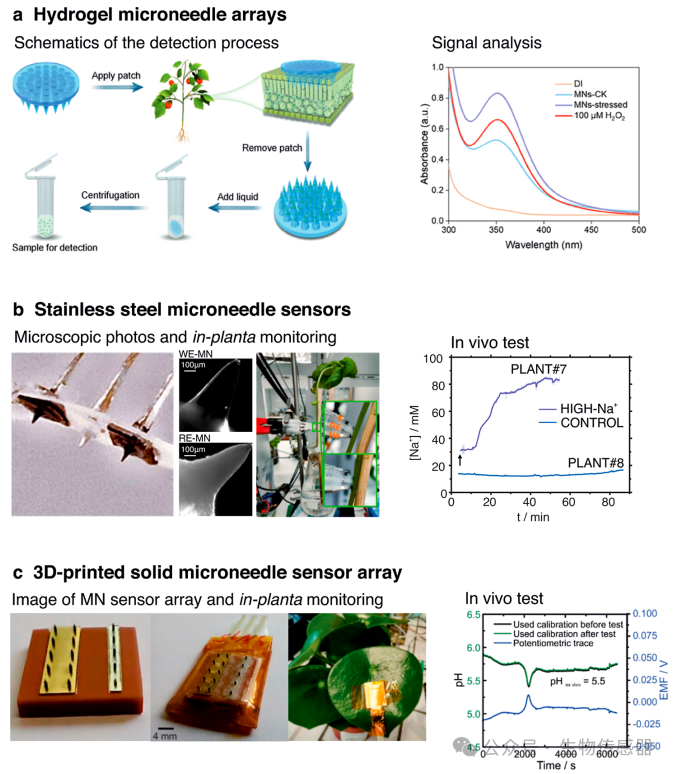
Solid MN sensors for internal monitoring of plants. Different manufacturing techniques were used: (a) molded hydrogel MN arrays for sap extraction, (b) coated stainless steel MN sensors for K+ and Na+ detection, and (c) 3D printed MN arrays for in vivo pH monitoring.
Reference link
https://doi.org/10.1021/acssensors.5c01215

—END—
The content is from【Biosensors】 official account,
Please indicate the source as【Biosensors】
Add WeChat group
To promote the dissemination and exchange of cutting-edge research, we have established severalprofessional discussion groups. Long press the QR code below to add the editor’s WeChat to join the group. Due to the high number of applications, please note when adding WeChat:Profession/Field, and if you are aPI/Professor, please also specify.

If you find this article interesting, please click here👇👇!