Recently, a Chinese team launched the world’s first general-purpose AI Agent—Manus AI, which has quickly ignited the tech community. It is not just a simple text generation tool, but an ‘intelligent intern’ capable of autonomously planning, executing complex tasks, and delivering complete results. NVIDIA CEO Jensen Huang clearly stated at the GTC conference that: Agentic AI will be a key phase in the evolution of AI technology, with its core being the upgrade from ‘single response’ to ‘continuous autonomous reasoning.’
The recent roundtable discussion organized by Tencent Research Institute and Tencent Academy deeply analyzed the technical architecture and product innovation of next-generation Agents like Manus and Deep Research. This article will help you penetrate the marketing fog and systematically interpret the true value of AI Agents from three dimensions: technical essence, capability boundaries, and future trends.
01 Manus: A Revolutionary Breakthrough in Product Experience
Core Highlights:
- Full Process Visualization: Manus presents the ‘thinking process’ of AI to users for the first time. For example, when generating industry reports, it displays real-time task breakdown, data collection, analysis, and reasoning steps, allowing users to clearly perceive progress.
- Multi-task Collaboration: Supports 29 types of tool calls, including code writing, web development, and social media operations, covering everyday office scenarios.
- User-friendly Design: Compared to earlier Agent tools that required complex configurations (like MetaGPT), Manus achieves ‘out-of-the-box’ usability, allowing ordinary users to operate it easily.
Product Positioning:
- Although it claims to be a ‘general Agent’, its actual capabilities are still limited by its tool library (e.g., it cannot handle specialized tasks like stock trading). Essentially, it is a basic intelligent assistant that integrates multiple tools, with advantages in productization rather than technological breakthroughs.
02 Technical Dissection: The Underlying Logic and Bottlenecks of Agents
Comparison of Current Mainstream Solutions:
| Product | Technical Features | Limitations |
|---|---|---|
| Manus | Multi-Agent fixed workflows, model distillation to reduce costs | Not true multi-Agent collaboration, relies on centralized scheduling |
| Deep Research | End-to-end training of a single model, driven by reinforcement learning | Extremely high training costs, requires massive trajectory data |
| MetaGPT | Dynamic routing Agents, resource allocation based on task difficulty | Relies on prompt engineering, significant challenges in context management |
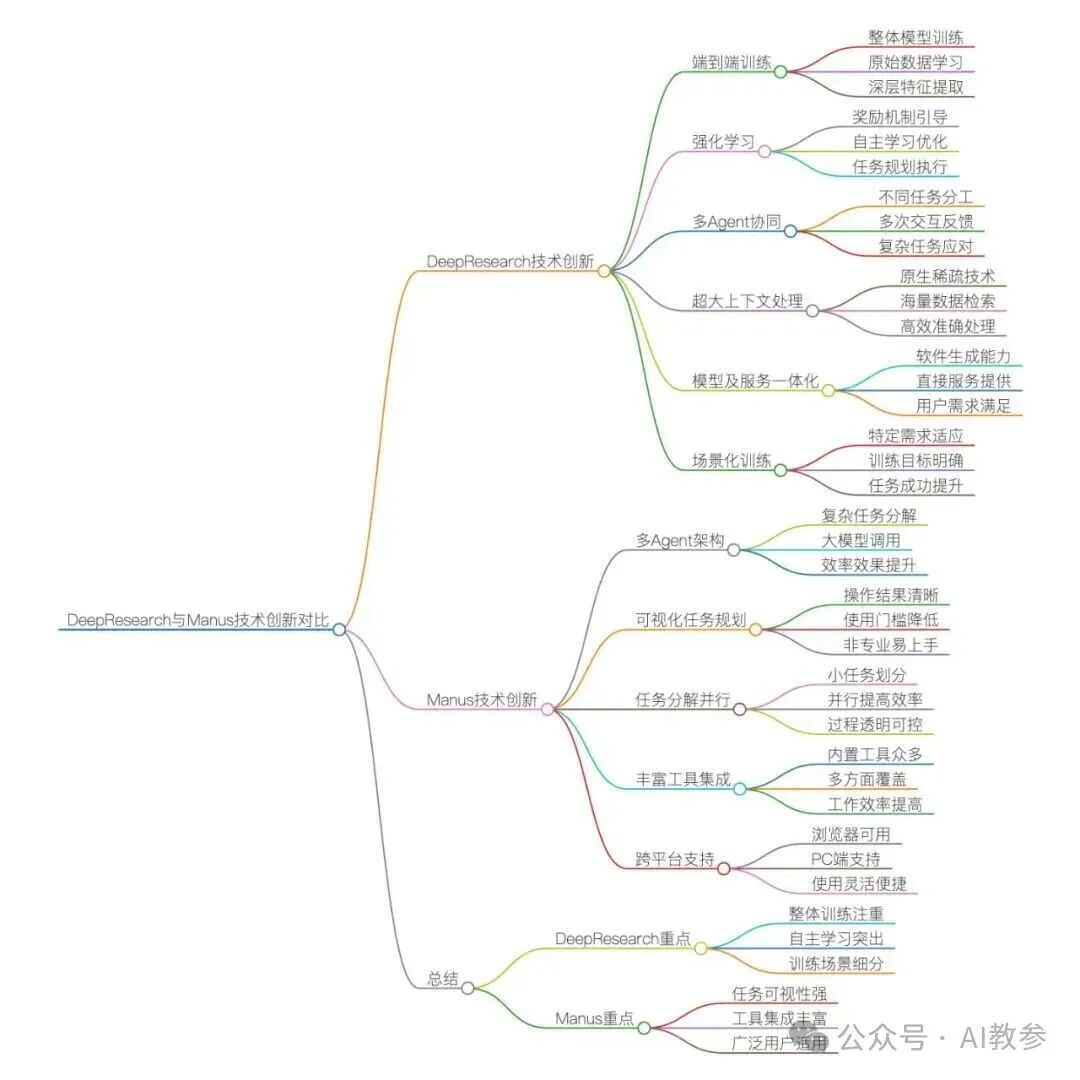
Core Technical Bottlenecks:
- Variations in Error Tolerance Scenarios: Report generation can tolerate errors, but the error tolerance rate for code and data operations is extremely low, requiring human intervention;
- Memory and Context Management: Current models are ‘stateless systems’, relying on limited context windows and RAG technology, making it difficult to handle long-range tasks;
- Balancing Cost and Efficiency: Multiple model calls lead to error accumulation, and while end-to-end training is beneficial, the data collection costs are enormous.
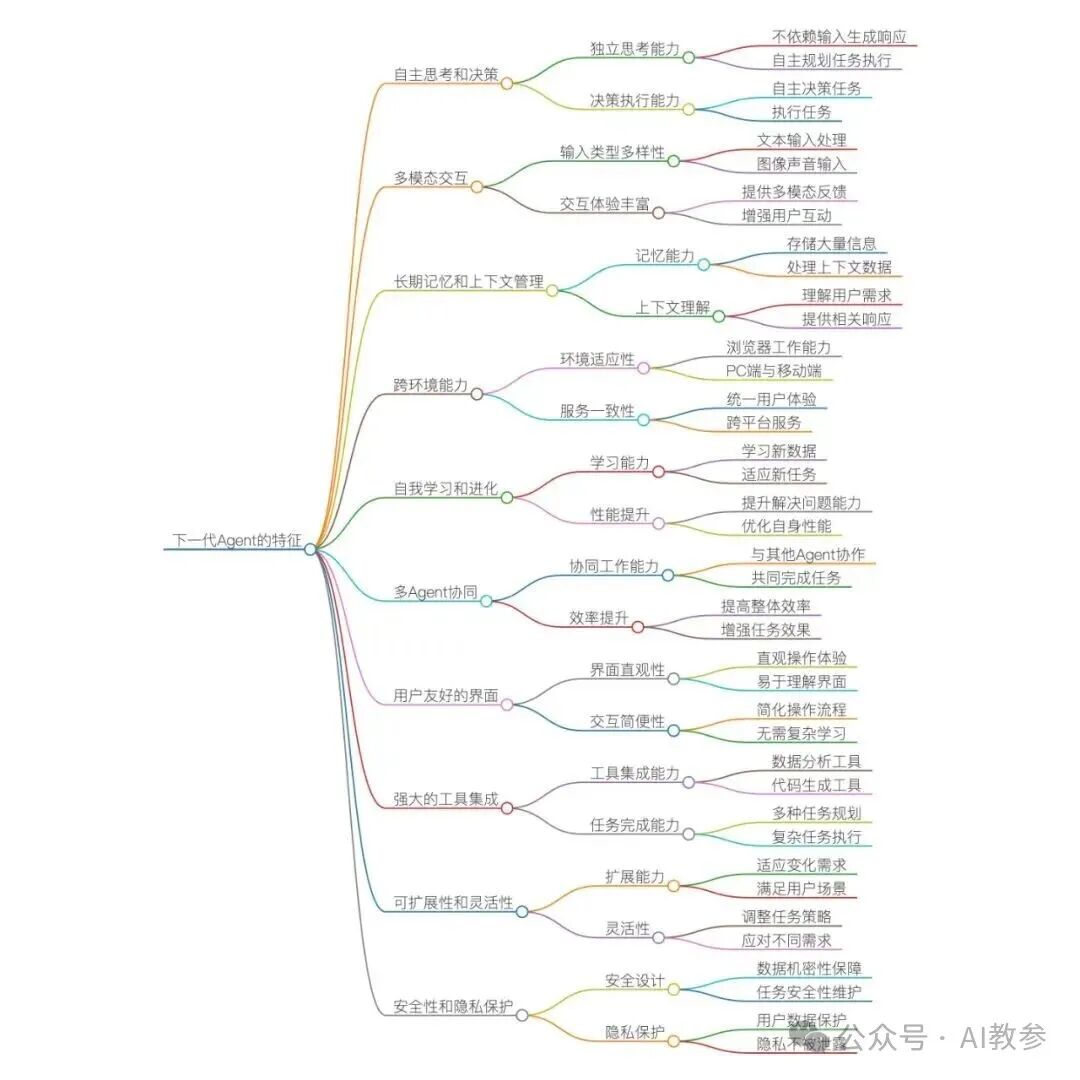
03 Three Evolution Directions for Next-Generation Agents
1. Self-assessment and Reflection Capability: Current Agents can execute tasks but cannot assess the quality of results. In the future, it is necessary to introduce environmental feedback mechanisms (such as reinforcement learning rewards) to enable Agents to have ‘self-check and correction’ capabilities.
2. Cross-environment Collaboration Capability: Agents should not be limited to browsers. Ideally, they should be able to autonomously call professional software (like Photoshop, Excel), becoming true ‘digital employees’.
3. Continuous Evolution and Personalization: By continuously learning from user data, optimizing task execution paths (e.g., compressing from 50 steps to 10), achieving a ‘personalized Agent’ that becomes smarter the more it is used.
04 How Should Humans Respond to the Era of Agents?
Incremental Thinking Replaces Stock Anxiety: History has proven that technological revolutions will eliminate jobs but create more new opportunities (for example, cars replaced coachmen but gave rise to drivers and automotive companies). In the AI era, everyone can become a super individual— leveraging Agent capabilities to cover full-stack work.
Core Capability Transformation: AI Leadership
- From executor to goal setter: Define tasks, accept results;
- From professional skills to resource integration: Provide unique data and scenario value for AI;
- Personal Trial and Error: Only by deeply using Agents can one find their irreplaceability.
Harsh Reality:
- Companies are actively embracing AI to reduce costs: Cases show that a certain team reduced from 8 to 2 people, and Silicon Valley companies are using AI to reconstruct outdated code systems;
- 2025 will be a critical turning point: Those who do not master AI collaboration capabilities may be eliminated.
Summary: Core Insights for the Second Half of the Agent Era
- Return of Technology to Training Paradigms: End-to-end training + reinforcement learning will replace traditional prompt engineering, achieving ‘model as a service’;
- Vertical Scene Priority: General Agents are not yet realistic; specialized Agents in fields like healthcare and programming will land faster;
- Human-Machine Collaboration is Essentially Value Reconstruction: Humans need to focus on goal management, creativity, emotional connection, and other areas where AI is weak.
Action Recommendation: Start using at least one Agent tool (like Manus or Cursor) immediately to personally experience its advantages and limitations. Only by becoming the ‘boss of AI’ can one win the ticket to the next era.