The development of large AI models is progressing rapidly, with the most common functionality we encounter being dialogue flows or Co-Pilot. The so-called AI Agent focuses on autonomous systems, capable of making decisions and executing tasks without human intervention. In simple terms, while we are still relying on AI for “assisted driving,” AI Agents are about to take the wheel themselves.This article briefly introduces the relevant developments in Agent technology based on large AI models.
First, what is an Agent?
A more straightforward explanation can be illustrated with the example of essay writing. Previously, large models used for question answering were akin to writing an essay in an exam, where one could not make modifications and had to write from start to finish in one go. The hallucinations inherent in large models led to suboptimal results. A method was conceived where the large model could check and modify its generated results, significantly improving the quality of generation. It could also create outlines, gather materials, and revise its own work, further enhancing quality. This is the approach of an Agent.
The following diagram illustrates a conceptual framework for an Agent based on large models:
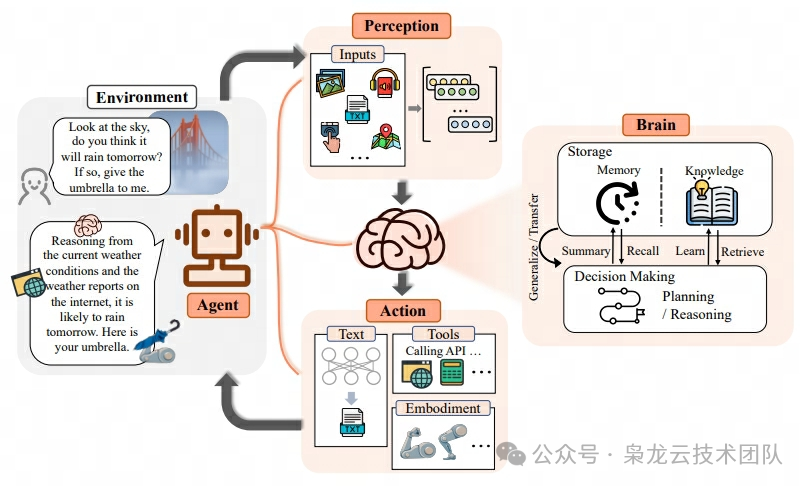
Source: https://arxiv.org/pdf/2309.07864
From the diagram, it can be seen that in addition to the core capabilities of large models, Agent technology expands many capabilities of large models and continues to evolve as model capabilities enhance.
1. Information Processing Capability: As the capabilities of large models evolve, the context window they can handle continues to expand, allowing them to process more information. From text to audio and video, multimodal capabilities enhance the information processing abilities of large models. On August 6, 2024, OpenAI announced that the Structured Outputs feature officially launched in the API, available from GPT-4o onwards, greatly expanding the structured information interaction capabilities during tool usage and feedback processes.
2. Reasoning/Planning Capability: The application of Chain of Thought (CoT) and reinforcement learning in large models has improved their reasoning and planning abilities, allowing them to enhance the quality of thought in “slow thinking”.
OpenAI o1 is a series of AI models focused on complex reasoning tasks launched by OpenAI in September 2024. This series is developed based on Chain of Thought reinforcement learning technology. On December 20, 2024, OpenAI announced the release of the OpenAI o3 model and o3-mini model.
3. Tool Usage Capability
In June 2023, OpenAI introduced “Function Calling,” an API extension mechanism that has been available since the GPT-3.5-turbo-0613 version. The model can use external tools through standardized input and output.
To unify communication between large language models and external data sources and tools, Anthropic launched the MCP (Model Context Protocol) open standard in November 2024, further enhancing the ability of large models to use external tools.
4. Memory/Knowledge Capability
In traditional AI dialogues, methods such as Retrieval-Augmented Generation (RAG) and long-short memory have been introduced to expand the memory capabilities and knowledge acquisition range of large models.
Against the backdrop of these technological developments, the development of AI Agents is maturing, with related products continuously emerging.
Operator is an AI agent product launched by OpenAI on January 23, 2025. It uses its own browser to browse the web and interacts with web pages through input, clicking, scrolling, and other operations to perform tasks for users. The core driving capability behind Operator is CUA (Computer-Using Agent), which combines the visual capabilities of GPT-4o with advanced reasoning capabilities achieved through reinforcement learning.
Deep Research is an intelligent agent product feature launched by OpenAI on February 3, 2025, aimed at the deep research field. Based on OpenAI’s o3 model, it can complete research tasks that would typically take hours in just a few minutes, applicable in various fields such as finance, science, policy analysis, and consumer decision-making.
Of course, as Agent development progresses, related patterns and tools are continuously emerging. For design patterns of Agent applications, the following resources can be referenced.
LangChain: A large model application development framework, one of the earlier and more comprehensive Agent development frameworks.
https://www.langchain.com/
Andrew Ng’s talk on four Agent design paradigms elaborates on some design approaches for Agent development.
https://www.deeplearning.ai/the-batch/how-agents-can-improve-llm-performance/
Chinese version: Agent > GPT5? Andrew Ng’s latest talk: Four Agent design paradigms (easy to understand version)
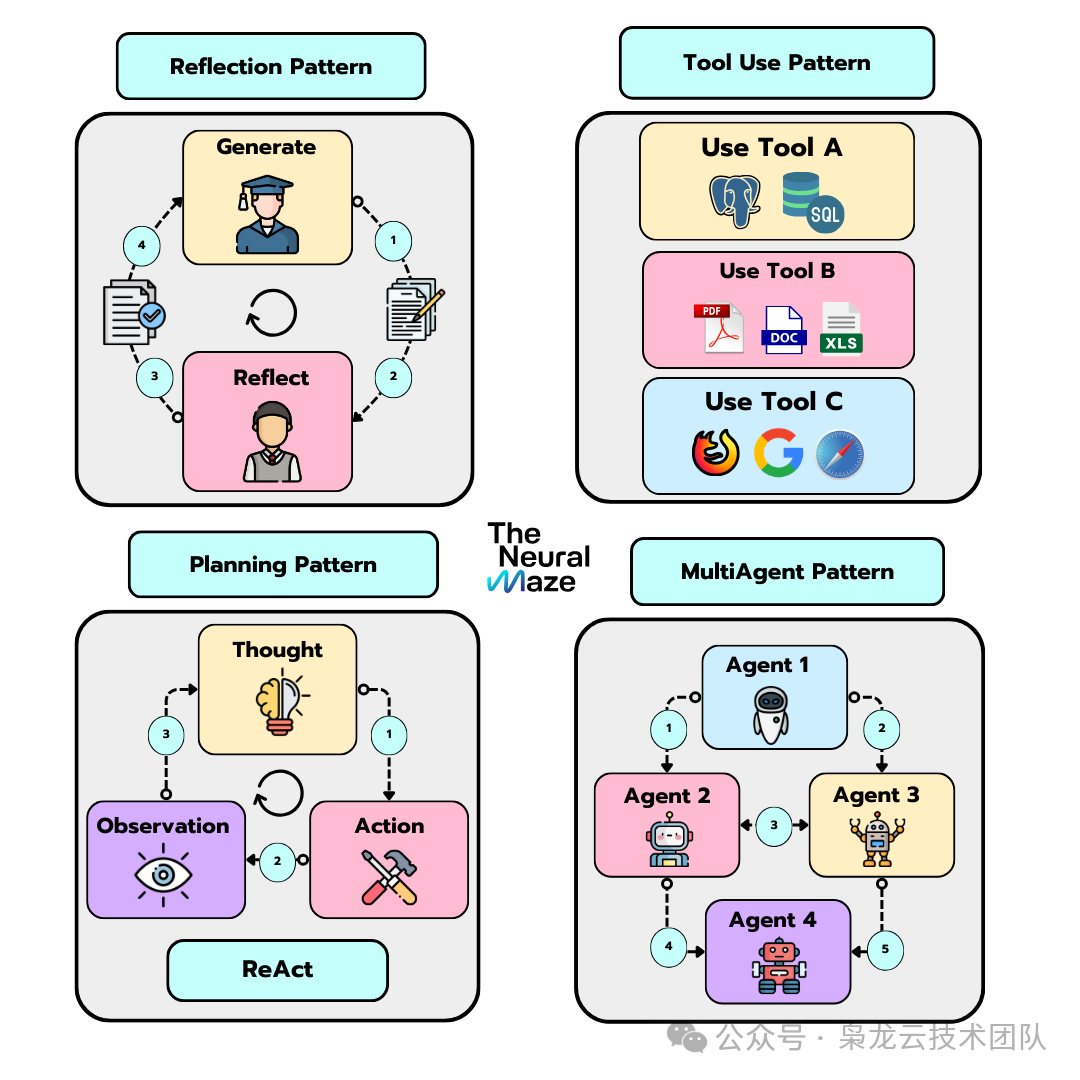
Source: https://github.com/neural-maze/agentic-patterns-course
Anthropic’s Agent development guide: Building effective agents, based on their accumulated experience in development.
https://www.anthropic.com/engineering/building-effective-agents
https://github.com/anthropics/anthropic-cookbook/blob/main/patterns/agents/README.md
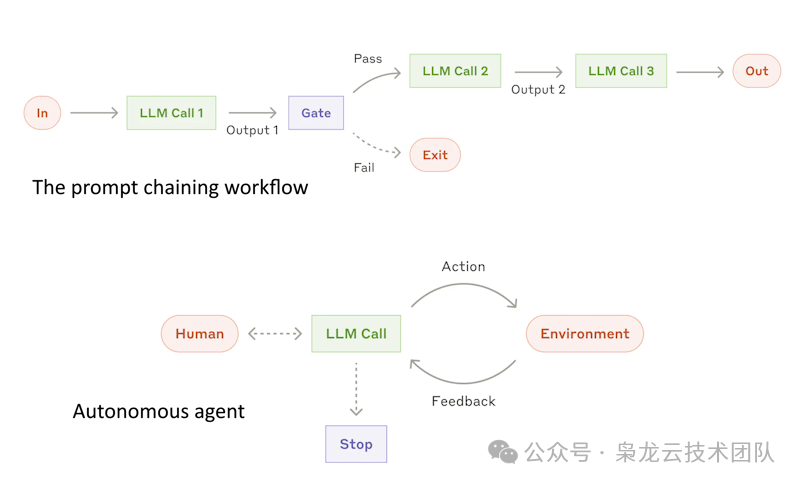
On March 11, 2025, the OpenAI Agent SDK was released to assist developers in Agent development.
https://github.com/openai/openai-agents-python
https://openai.github.io/openai-agents-python/
Technology is evolving rapidly, and the times are changing~~