In recent years, with the accelerated development of domestic processors, a multi-architecture ecosystem has become a reality. How to build a unified virtualization capability across diverse hardware platforms has become a core issue of concern in the industry.
Developed by the Syswonder Open Source Community (Syswonder), hvisor is a Type-1 lightweight virtual machine monitor (Hypervisor) implemented in Rust, featuring a partitioned kernel design that focuses on security, simplicity, and efficiency. The latest release, version v0.2, launched in September 2025, brings significant upgrades in hardware support, architecture optimization, and engineering stability.
01
Introduction to hvisor
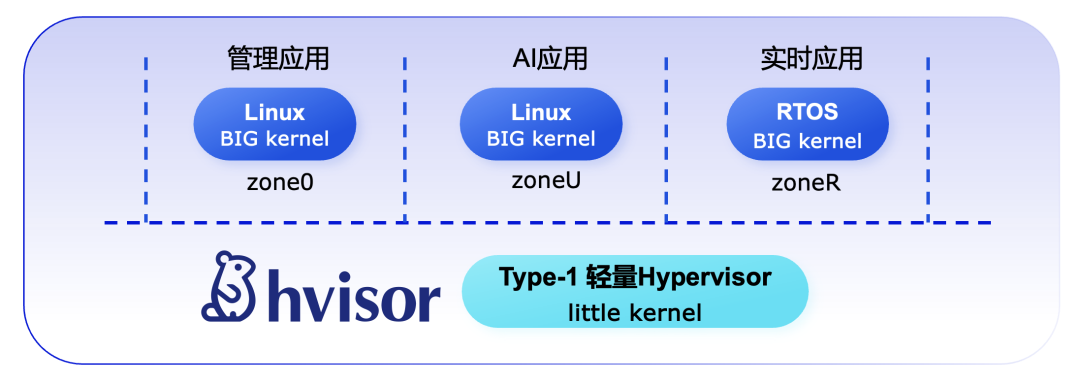
hvisor is a Type-1 (bare-metal) virtual machine monitor (Hypervisor) designed with a separation kernel architecture, implemented in Rust. Its core lies in providing a secure isolation runtime environment for tasks of different security levels and criticality through strict hardware resource partitioning, achieving an excellent balance between security and low-overhead virtualization.
Core Architecture and Partitioning:
-
Zone0 (Management Zone): Responsible for system boot, management, and monitoring of virtual machines.
-
ZoneU (User Zone): Used to run general-purpose operating systems (such as Linux) or application environments.
-
ZoneR (Real-time Zone): Provides an isolated, low-latency runtime environment for real-time operating systems (RTOS) or high-priority tasks.
This partitioning design makes hvisor more lightweight compared to traditional virtual machine monitors, making it particularly suitable for embedded systems and domestic hardware platforms. Currently, it supports multiple architectures including aarch64, riscv64, loongarch64, and is compatible with QEMU simulation environments and various domestic development boards and chips.
Key Features:
-
Strict Partition Isolation:
Physical isolation of Zone0/ZoneU/ZoneR ensures performance and security.
-
Lightweight and Security Assurance:
Implementation in Rust ensures memory safety and code robustness; some core modules are undergoing formal verification using the Verus tool.
-
CPU Virtualization:
Static partitioning of physical CPU cores to each Zone, eliminating the need for complex schedulers, ensuring high determinism.
-
Memory Virtualization:
Virtual machine memory is statically pre-allocated via configuration files, supporting physical memory isolation verification.
-
Flexible I/O Virtualization:
Supports device passthrough for native performance, as well as virtio paravirtualization for efficient access to general devices; covering key devices such as storage, networking, and GPU.
-
Extensive OS Support:
Can run a variety of guest operating systems in different Zones, including Linux, Zephyr, RT-Thread, etc.
02
Key Updates in hvisor v0.2
Expanded Hardware Compatibility
The most notable change in version v0.2 is the significant expansion of hardware support.
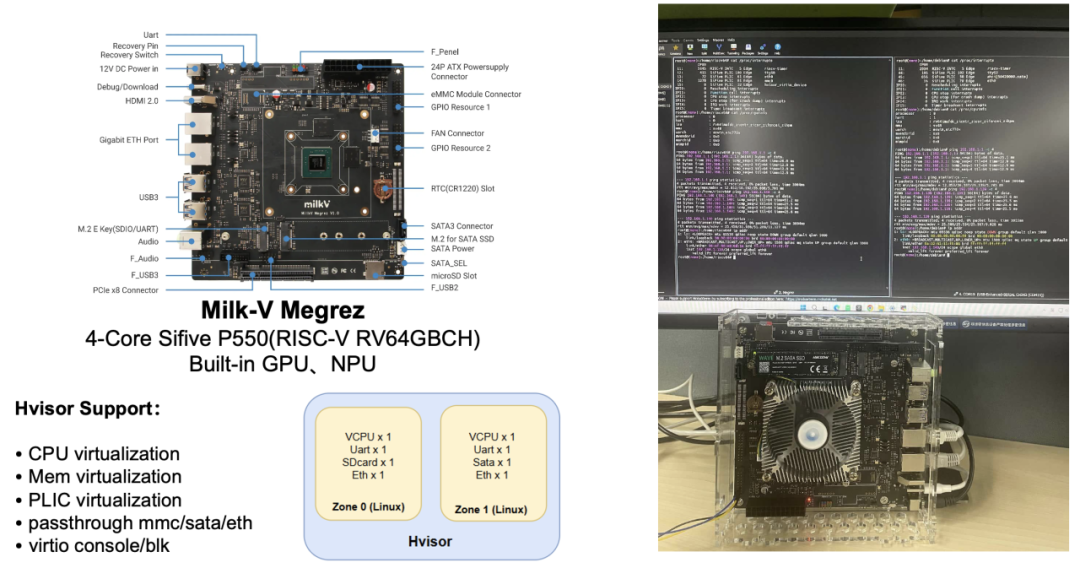
Figure: New support for Milk-V Megrez
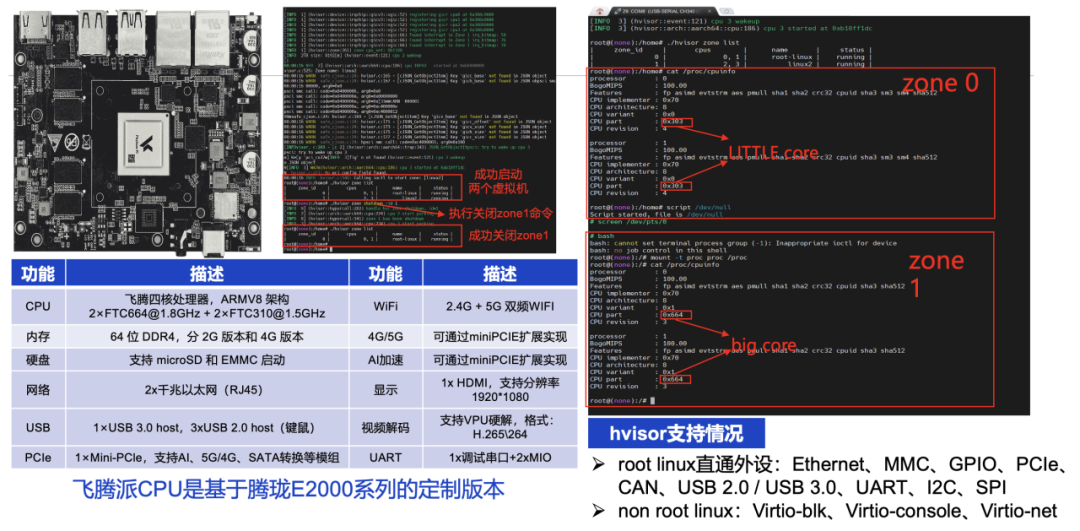
Figure: New support for Phytium-Pi
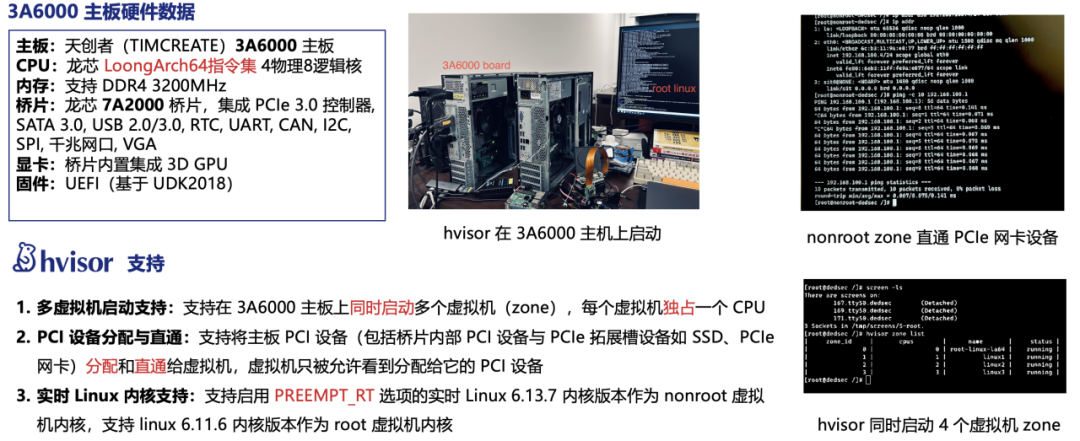
Figure: New support for Loongson 3A6000 platform
In addition to continuing to support mainstream development boards such as RK3588 and ZCU102 on the AArch64 architecture, this update adds:
-
RISC-V platform: Milk-V Megrez, SiFive HiFive Premier P550
-
Arm64 platform: Phytium-Pi
-
LoongArch platform: Loongson 3A6000 (7A2000 bridge chip)
This series of updates means that hvisor now covers both domestic RISC-V and LoongArch chips, as well as more typical Arm64 development boards, providing solid virtualization support for a diverse hardware ecosystem.
Multi-architecture Enhancements: Coverage of RISC-V, LoongArch, and Arm64
hvisor v0.2 significantly enhances multi-architecture support, with a focus on optimizing the RISC-V, AArch64 (Arm64), and LoongArch platforms:
-
RISC-V:
Improved initialization process and PLIC interrupt controller management.
-
AArch64:
New support for AArch32 guest virtual machine mode (e.g., running Zephyr on RK3588).
New support for running the standard version of RT-Thread in a non-root zone on the RK3588 platform.
Improved GICv2/v3 interrupt controller configuration.
-
LoongArch:
Fixed guest virtual machine timer compensation logic and added key support for PCIe device virtualization under the LoongArch architecture (covering integrated graphics, network cards, SSDs, etc.).
Infrastructure Optimization and Reliability Improvements
-
Interrupt Controller Enhancements: Improved VMCR calculations, optimized GIC parameter structures (including a corresponding hvisor-tool configuration file refactor), and strengthened GICR handling.
-
Code Architecture Optimization: Refactored key logic to reduce inter-module coupling, mainly including: improved mapping mechanism from mpidr register to cpuid; optimized handling of serial port register base addresses (reg base addr); rewritten hvisor-pt initialization logic.
-
Hardware Platform Compatibility Fixes: Resolved configuration file issues for hvisor on the Xilinx Zynq UltraScale+MPSoC ZCU102 development board.
-
Continuous Integration Enhancements: Further improved the coverage and reliability of GitHub CI testing.
These improvements significantly enhance the underlying stability, maintainability, and scalability of hvisor, laying a solid foundation for future functional evolution and broader hardware platform deployment.
03
Hardware Support in hvisor v0.2
-
AArch64: QEMU virt, NXP i.MX8MP, ZCU102, RK3588/RK3568, Forlinx OK6254-C, Phytium-Pi
-
RISC-V: QEMU virt, Milk-V Megrez, SiFive P550, Xiangshan FPGA
-
LoongArch: Loongson Tianchuang 3A5000 (7A2000 bridge chip), Tianchuang 3A6000 (7A2000 bridge chip) motherboard
-
x86_64: QEMU virt, ASUS NUC14MNK (in progress)
📌 The adaptation for the x86_64 architecture is nearly complete, supporting the QEMU Virt platform, and final testing is currently underway on the ASUS NUC, with an official release expected in the next version.
Supported Peripherals:
-
Virtio series: virtio-blk, virtio-net, virtio-console, virtio-gpu (only QEMU)
-
Serial ports: pl011, ns16550, imx-uart, xuartps, etc.
-
PCIe device passthrough, USB, SATA, Ethernet, GPU/HDMI, eMMC
04
Outlook and Planning
Future versions will continue to enhance hardware compatibility and virtualization capabilities, including:
-
Support for Android and OpenHarmony as virtual machine OS
-
Support for running on x86_64 NUC physical hardware
-
Support for ARMv9, GICv4, IOMMU/PCIe bus virtualization
-
More comprehensive GPU/NPU passthrough
-
Web management tools and device tree configuration tools
-
Support for platforms such as NVIDIA Orin, Thor, and Raspberry Pi 5
05
How to Obtain hvisor v0.2
-
hvisor Project Homepage: https://github.com/syswonder/hvisor
-
hvisor v0.2 Release Homepage: https://github.com/syswonder/hvisor/releases/tag/v0.2
-
hvisor Official Manual: https://hvisor.syswonder.org
-
Syswonder Community Homepage: https://www.syswonder.org
06
Community Invitation
As an open-source project, the growth of hvisor relies on the participation of developers. We sincerely invite members of the ubiquitous operating system community to:
-
Try out hvisor v0.2 on various domestic platforms
-
Submit feedback and PR to the GitHub repository (https://github.com/syswonder/hvisor)
-
Participate in discussions and development within the Syswonder community
Together, let’s promote the development of domestic virtualization technology.