
This article discusses the disruptive impact of ETSI NFV on traditional telecom operators and telecom equipment vendors, the architecture of ETSI NFV, network function virtualization (NFV) of mobile core networks, and its impacts.
1. Disruptive Impact of ETSI NFV on Traditional Telecom Operators and Telecom Equipment Vendors
Network function virtualization (NFV) is a product of the integration of Communication Technology (CT) and Information Technology (IT).
In October 2012, to accelerate the promotion of NFV concepts, 13 operators initiated the establishment of the NFV working group under the ETSI organization, officially forming the ETSI ISG NFV, dedicated to defining the requirements for network virtualization and developing system architecture. The goal of ETSI NFV is to achieve virtualization of various network elements in mobile and fixed networks on an open IT platform, meeting the explosive growth of dynamic business demands in the mobile internet era with lower costs and higher flexibility, while breaking free from dependence on vendor-specific hardware systems and closed software platforms.
As the most influential research organization in the field of NFV, ETSI NFV currently has over 170 member units, covering almost all top operators, equipment vendors, and IT companies in the CT and IT fields. ETSI NFV is not strictly an international standardization organization and does not formulate international standards; rather, it outputs and influences the industry and related standardization organizations through technical white papers, requirement documents, and liaison letters. According to a market research report on NFV released by IHS Infonetics in July 2015, the NFV market space is expected to grow from $950 million in 2014 to $11.6 billion in 2019, with a compound annual growth rate of 65%.
In today’s increasingly competitive environment, traditional device product architectures dominated by proprietary hardware and pre-planned construction models have become inadequate to meet the demands of high-speed data service development. The technology of ETSI NFV will become an important technical means for operators to reconstruct networks, architectures, operations, and businesses, decoupling the software and hardware of traditional telecom equipment, replacing proprietary telecom network elements with standardized IT hardware platforms and virtualization technologies, improving network operation flexibility, enhancing management and maintenance efficiency, and reducing costs.
2. Architecture of ETSI NFV
NFV disrupts the traditional closed proprietary platform concept in telecommunications, introducing a flexible elastic resource management concept. The NFV technology mainly consists of three domains (Figure 1):
-
Network Function Virtualization Infrastructure (NFVI)
-
NFVI includes computing, storage, and network hardware resources along with their corresponding virtualization resources, as well as a virtualization layer that supports resource invocation for VNFs, such as COTS servers and general-purpose switches.
-
Virtualized Network Function (VNF)
-
VNF is the software implementation of network element functions, running on NFVI, such as the logical implementations of network elements in the EPC network: vMME, vEPG, vPCRF, etc.
-
NFV Management and Orchestration (MANO)
-
MANO centralizes all NFV-related management functions within the NFV framework; it manages NFVI and VNF, orchestrates network services, and manages the lifecycle of physical/software resources and VNFs.
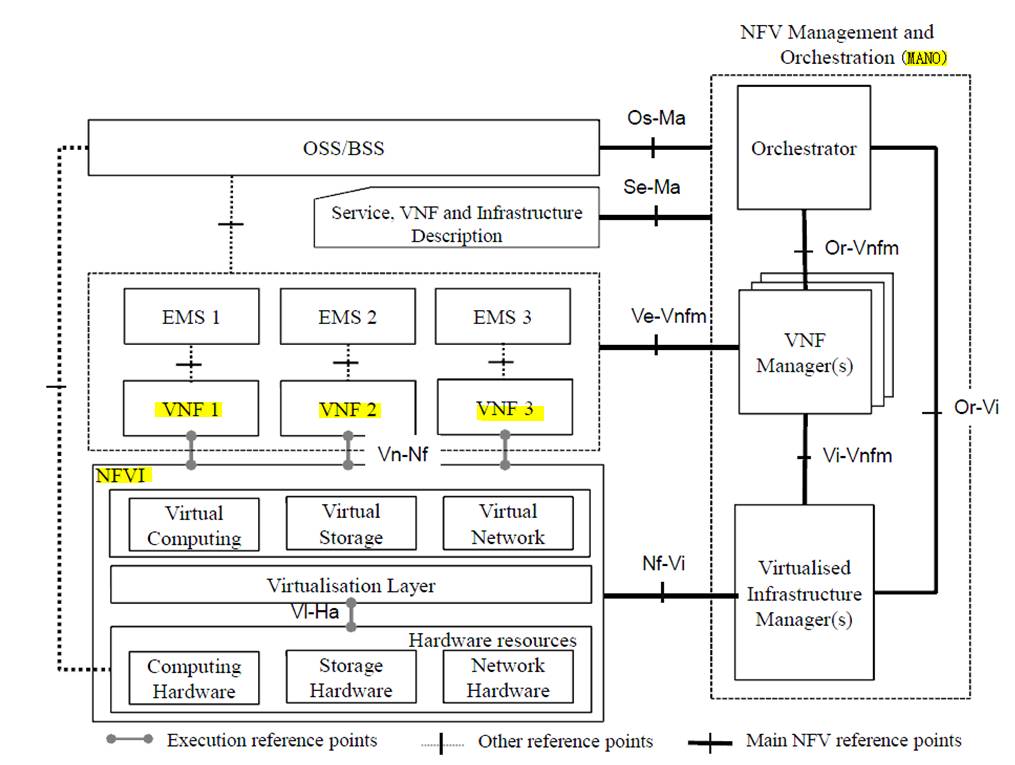
Figure 1. Architecture of ETSI NFV
Undoubtedly, the era of NFV is fully arriving. However, operators’ networks are large and complex; how can NFV be implemented?
In mobile operators’ networks, there are many different functional hardware devices in the mobile core network. Currently, major participants in the industry chain, including mainstream operators and equipment vendors, have reached a preliminary consensus on the development of NFV: the development path of NFV will start from the core network.
Network elements in the traditional EPC core network can be categorized into two main types: control plane network elements and user plane network elements.
-
Control Plane Network Elements: Mainly include MME, HSS, PCRF, etc.; control plane devices primarily handle mobility management, session management, user subscription management, and policy control, focusing on control plane signaling interactions;
-
User Plane Network Elements: Mainly include SGW, PGW, etc.; user plane devices accept signaling control from control plane devices, primarily handling user data exchange and forwarding, billing data processing, policy execution, and other functions.
Implementation of NFV in the EPC core network will first start with the control plane, followed by the user plane. The core network will become an important scenario for operators to introduce NFV.
3. Network Function Virtualization (NFV) of Mobile Core Networks and Its Impact
The virtualized mobile core network deploys network applications using standard industry servers, switches, and storage devices, reducing network complexity, providing flexible network elasticity, improving network resource utilization while lowering network operation and maintenance costs.
The mobile core network achieves deployment of network elements on the same hardware platform through NFV technology, particularly suitable for control plane network element devices that primarily handle control signaling. Since COTS servers have strong computing capabilities, they are well-suited for handling state transitions and signaling interactions.
All network elements will be uniformly deployed on general-purpose server hardware (H/W), abstracted through a virtualization layer into normalized virtual resources for upper-layer mobile core network element software applications to invoke. For user plane devices, necessary hardware acceleration features need to be implemented to handle user high-speed data.
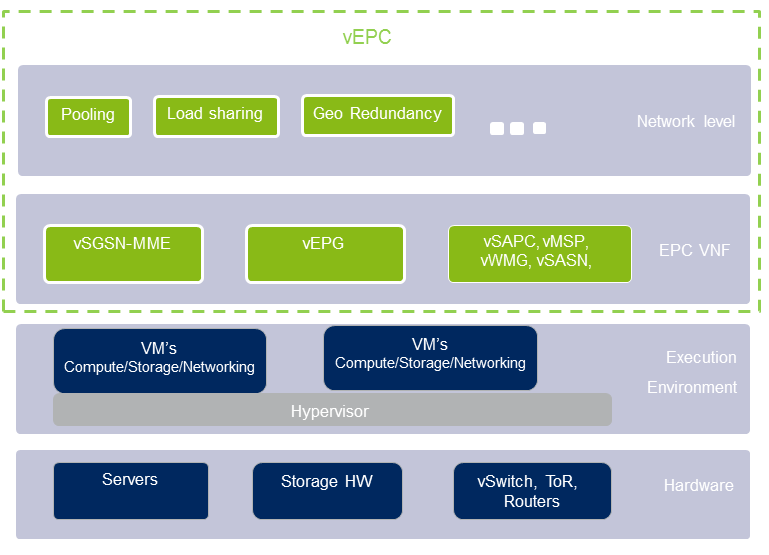
Figure 2. NFV of Mobile Core Network
EPC’s network function virtualization (NFV) divides the network into three layers (Figure 2): device layer (Hardware), virtual layer (Execution Environment), and application layer (vEPC).
-
Device Layer: Includes computing, storage, and networking resources; homogenized and normalized through virtualization technology; can be dynamically shared by various upper-layer logical network applications.
-
Virtual Layer: Manages the device layer, organizes the underlying facility modules, and invokes underlying resources as needed by the service;
-
Application Layer: Virtualizes logical network elements (such as MME, SGW, PGW, PCRF, etc.) through software. With this architecture, operators only need to maintain a unified virtualization platform, while different network elements will run in the form of virtual machines on top of the virtualization platform. New network elements or upgrades will manifest as new virtual machine instantiations or software version upgrades within the virtual machine.
Since virtualization technology shields the differences in underlying physical platforms, issues related to cross-network element and cross-vendor hardware resource sharing will be easily resolved. Furthermore, using features like dynamic migration and dynamic generation of virtual machines, along with intelligent management of the virtualization platform, network elements can dynamically scale up or down based on changes in service volume, fundamentally improving hardware utilization and software portability while significantly reducing operational costs and application deployment times.
Operators have fully recognized the importance of NFV for the future evolution of networks and its enormous commercial value, but the transformation of networks towards NFV is not something that can be accomplished overnight; large-scale commercial use in the future remains a long way to go.
Conclusion:
ETSI NFV brings disruptive impacts to traditional telecom operators and telecom equipment vendors, and ETSI NFV technology will become an important technical means for operators to reconstruct networks, architectures, operations, and businesses; the core network will become an important scenario for operators to introduce NFV. The implementation of NFV in the EPC core network will initially start from the control plane, followed by the user plane; thanks to virtualization technology, issues regarding cross-network element and cross-vendor hardware resource sharing will be resolved, and network elements can dynamically scale up or down based on changes in service volume, fundamentally improving hardware utilization and software portability while significantly lowering operational costs and application deployment times. However, the transformation of networks towards NFV is not something that can be accomplished overnight; large-scale commercial use in the future remains a long way to go.
The author of this article, Shang Hong, is a key teacher at the Ericsson Academy, a globally certified senior solution architect, and a globally certified senior lecturer at Ericsson. Since joining the Ericsson Academy in 2004, he has been engaged in training and consulting work in telecom network operation and maintenance, integration of telecom networks and the internet, PCC intelligent pipelines, and IMS multimedia services.
Ericsson Academy is a professional training institution in the field of mobile communication and information technology created by Ericsson. The Ericsson Academy WeChat public account regularly holds and publishes a series of lectures and expert articles on hot technologies and cutting-edge theories, please follow us!

↑↑↑ Long press the QR code to recognize and follow