Citation:W. Liu, X. Wang and S. Li, “Formation Control for Leader–Follower Wheeled Mobile Robots Based on Embedded Control Technique,” in IEEE Transactions on Control Systems Technology, vol. 31, no. 1, pp. 265-280, Jan. 2023
Paper Overview
Journal:IEEE Transactions on Control Systems TechnologyAuthors:W. Liu, X. Wang and S. LiDOI:10.1109/TCST.2022.3173887Linkhttps://ieeexplore.ieee.org/document/9775002
Content Summary
This paper addresses the formation control problem of leader-follower wheeled mobile robot (WMR) systems, proposing a novel control strategy based on Embedded Control Technique. Unlike traditional methods that design controllers directly based on formation errors, this approach decomposes the formation task into two relatively independent sub-modules: virtual signal generator (virtual follower) design and trajectory tracking controller design. The virtual signal generator simulates a virtual robot that maintains a desired relative pose to the leader, with its output serving as the reference trajectory for the real follower; the trajectory tracking controller drives the real robot to accurately follow this virtual trajectory, thus achieving formation control.
The main innovations of this paper include:
Modular design concept: Decoupling the complex formation control problem through embedded control technology, reducing the complexity of system design;
Plug-and-play functionality: No need to modify the original controller of the robot; different formation tasks can be achieved simply by adjusting the output of the virtual signal generator;
Strong practicality: Designed solely based on the robot’s kinematic model, independent of dynamic parameters, suitable for controller encapsulation and commercial robot systems with unknown parameters;
Proposing a constrained trajectory tracking controller (CTC) with input saturation compensation, effectively addressing speed limitation issues in practical systems.
The paper proves the global uniform asymptotic stability (GUAS) of the proposed controller through Lyapunov stability theory and validates the effectiveness and robustness of the method through numerical simulations and physical experiments.
Background of the Problem
Multi-robot formation control is an important research direction in the field of robotics, with wide applications in logistics, resource exploration, environmental monitoring, and more. Among existing formation control methods, such as virtual structure method, behavior method, graph theory method, artificial potential field method, and leader-follower method, the leader-follower structure is widely adopted due to its simple control structure, low computational burden, strong scalability, and good real-time performance. In this structure, follower robots are typically required to track the leader’s movement while maintaining the expected relative distance and angle.
However, most existing methods are based on traditional design concepts, which directly design controllers on the robot model based on formation tracking errors. This approach has significant limitations: many commercial robots are pre-installed with trajectory tracking controllers (such as PID controllers), and if different formation tasks are to be completed, the original controller must be redesigned and replaced. Since many robot system controllers are encapsulated and their parameters are not adjustable, redesigning and replacing controllers is not only difficult but often infeasible, greatly limiting the practical application of formation control technology.
Therefore, this paper aims to address the following issues:
-
How to provide a flexible and scalable formation control method for wheeled mobile robots with encapsulated controllers;
-
How to achieve stable formation control in practical systems with input saturation (such as maximum speed limits);
-
How to reduce the complexity of the formation control system through modular design, enhancing practicality and generalization capability.
Method Overview
The embedded control method proposed in this paper systematically decomposes the formation control task into two steps: the first step is virtual signal generator design, and the second step is trajectory tracking controller design.
In the virtual signal generator design, this paper constructs a virtual follower with the same kinematic model as the real WMR. Through mathematical derivation, the position, orientation, and velocity signals of the virtual follower are analytically expressed as functions of the leader’s state and desired formation parameters. This virtual robot can always maintain the expected relative distance and angle to the leader, with its generated trajectory serving as the reference input for the real follower. To ensure the physical realizability and boundedness of the virtual signal, this paper proposes two assumptions: the leader’s speed must be continuously excited and differentiable, and excludes two specific infeasible scenarios (such as speed constraints at certain angles).
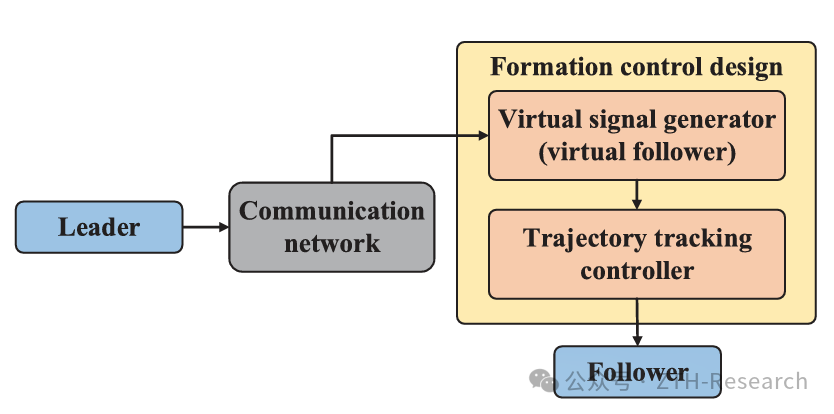
In the trajectory tracking controller design section, this paper proposes both unconstrained controller (UTC) and constrained controller (CTC) with input saturation. The unconstrained controller is designed based on the backstepping method, proving through Lyapunov functions that it can asymptotically converge the tracking error to zero. To address the speed limitation issues present in actual robots, the constrained controller adapts the control gain by introducing a nonlinear dynamic gain term (such as the square root of the norm of the error term plus one), ensuring that the control input never exceeds the system’s maximum allowable value. This controller not only theoretically guarantees the global asymptotic stability of the system but also effectively avoids performance degradation caused by input saturation.
Ultimately, by embedding the virtual signal into the follower’s control loop and using the output of the tracking controller as the robot’s speed command, leader-follower formation control is achieved. This method demonstrates good tracking performance and anti-saturation capability in both simulations and experiments, particularly suitable for robot systems with encapsulated controllers and limited model information.
The method has been thoroughly validated through simulations and physical experiments
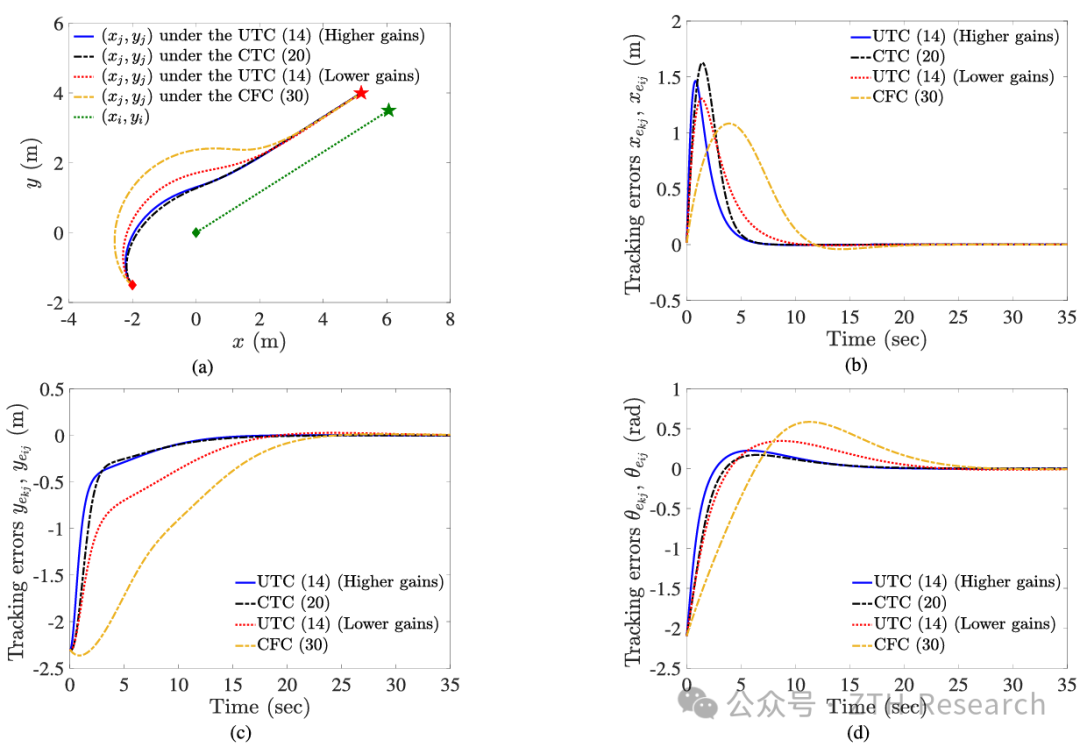
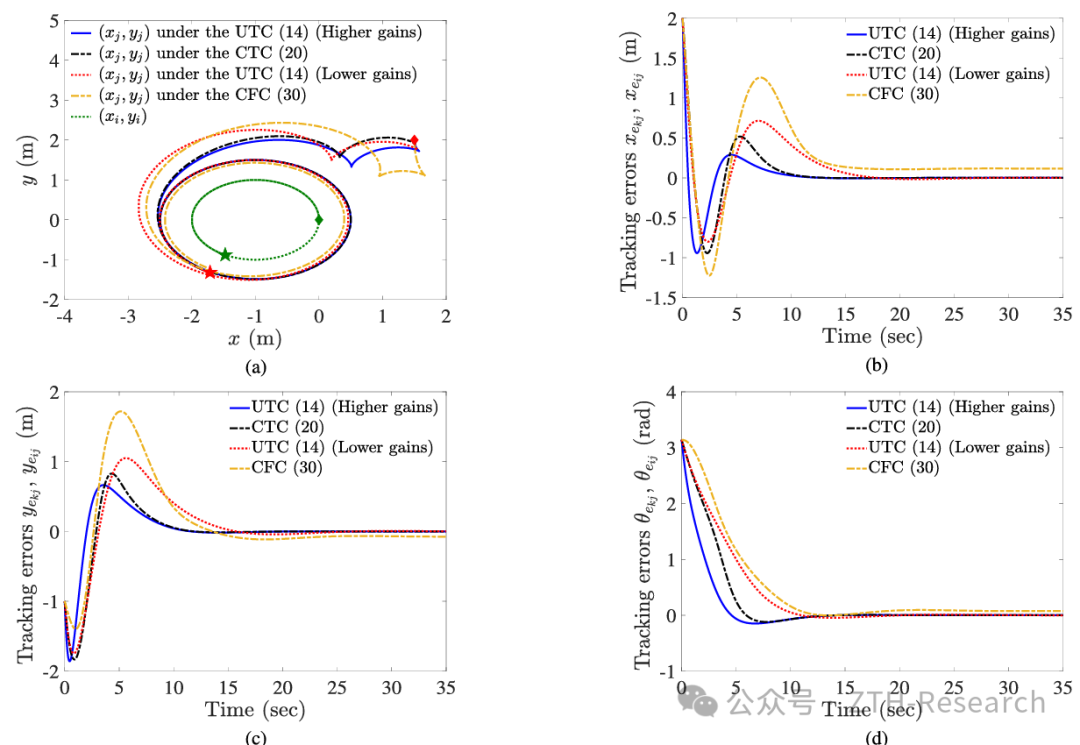
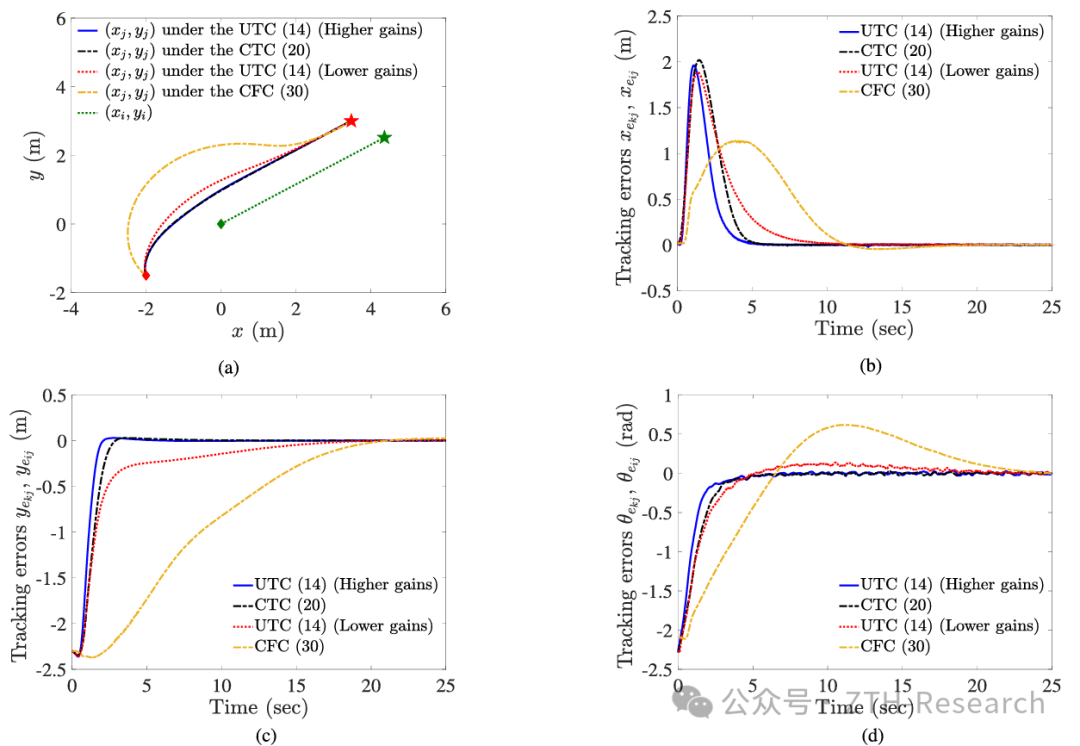
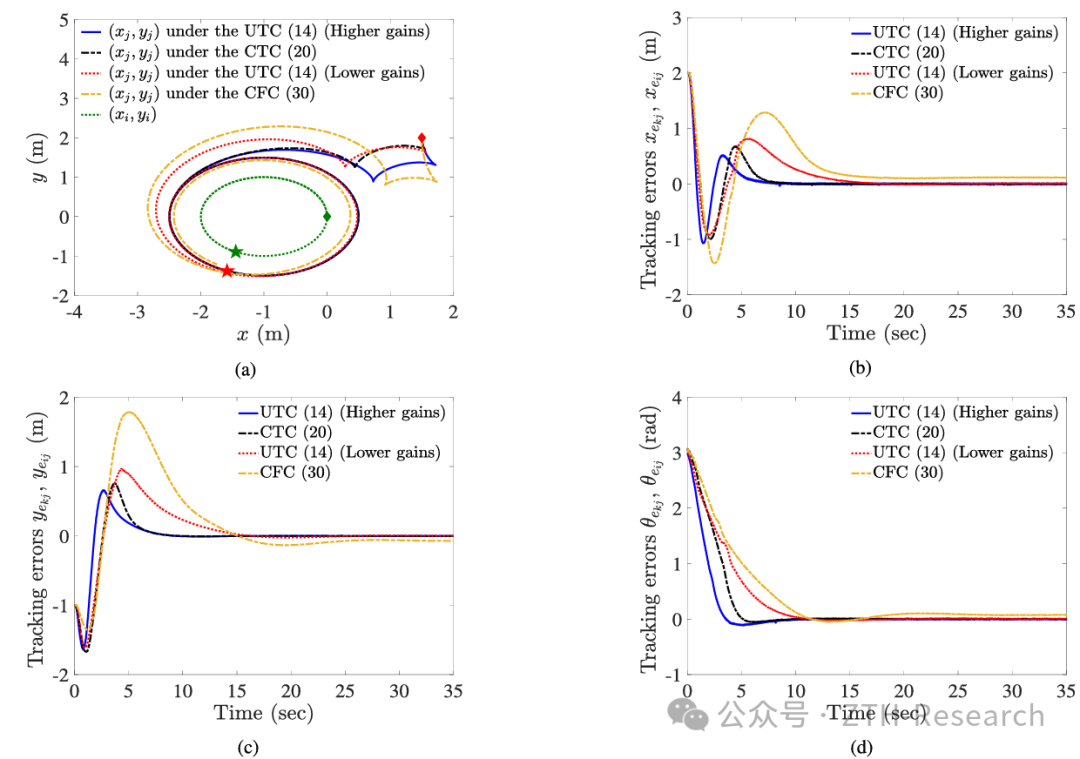
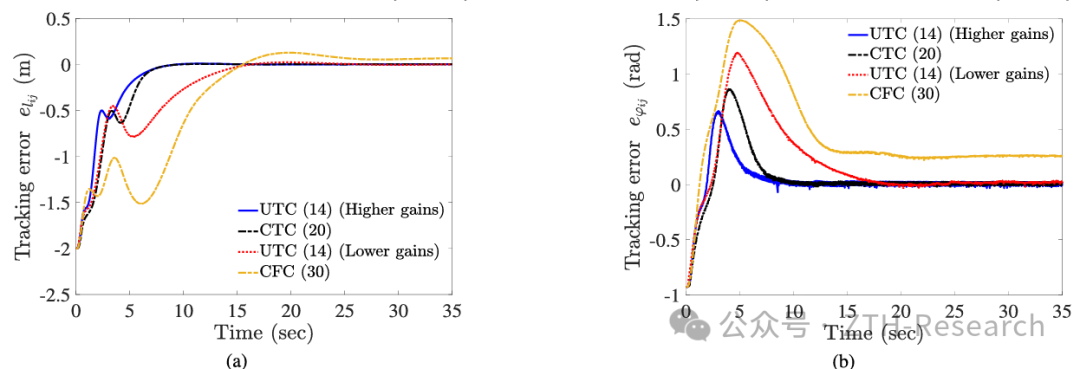
Some simulation results
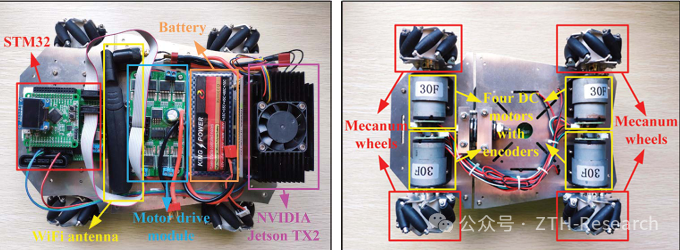
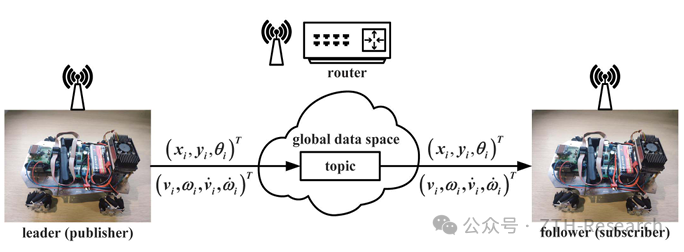
Experimental Platform
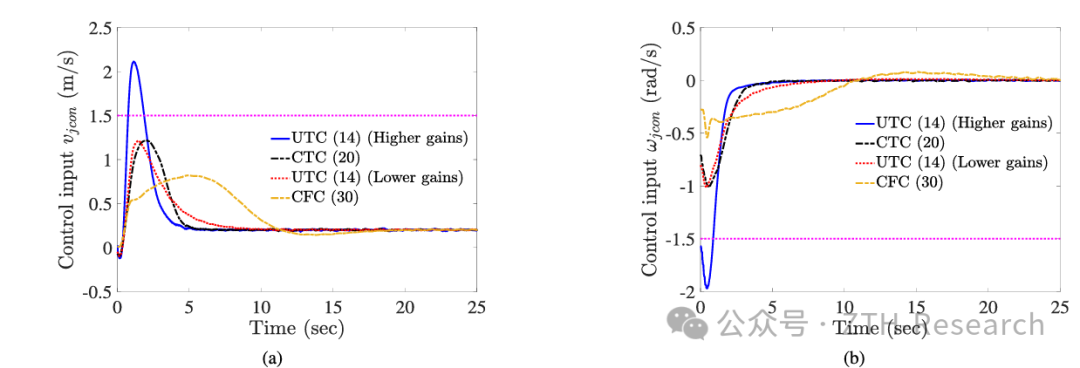
Some experimental results
Conclusion and Reflection
This paper addresses the limitations of traditional formation control methods in applications, proposing a novel leader-follower formation control strategy based on Embedded Control Technique. The core idea is to decouple the complex formation control problem into two relatively independent sub-tasks:
1) Virtual signal generator (virtual follower) design: Constructing a virtual robot with the same kinematic model as the real robot. The motion of this virtual robot is strictly designed to always maintain the expected relative distance and angle to the leader, thus achieving the formation goal “perfectly”. The generated trajectory (position, orientation, velocity) serves as the reference trajectory for the real follower. 2) Trajectory tracking controller design: Designing a controller for the real follower to accurately track the reference trajectory generated by the virtual follower. The paper designs both unconstrained controller (UTC) and constrained controller (CTC). The latter cleverly addresses the input saturation (speed limitation) issues in actual robot systems by introducing nonlinear dynamic gains, ensuring the feasibility of control commands.
The paper proves the global uniform asymptotic stability (GUAS) of the closed-loop system under both controllers through rigorous Lyapunov stability analysis. Through a large number of simulations and physical experiments (including straight and circular trajectories), comparisons with traditional methods validate the significant advantages of the proposed strategy in control performance, anti-saturation capability, and practicality.
In summary, this paper not only proposes an effective new method for formation control but also introduces a highly valuable modular system design concept. It skillfully balances the rigor of control theory with the flexibility of engineering practice, providing important references for solving cooperative control problems in practical robot systems. Its value lies not only in the technology itself but also in the inspiration for designing universal modules.