The field of ovarian cancer treatment is evolving at an unprecedented pace. With continuous advancements in surgical techniques and the emergence of new therapies, patients’ survival prospects are steadily improving. However, as Dr. Ryan M. Kahn, a gynecologic oncologist at Baptist Health Miami Cancer Institute, states, we still need to address ongoing challenges and unmet needs in the field by developing therapies that could change clinical practice.
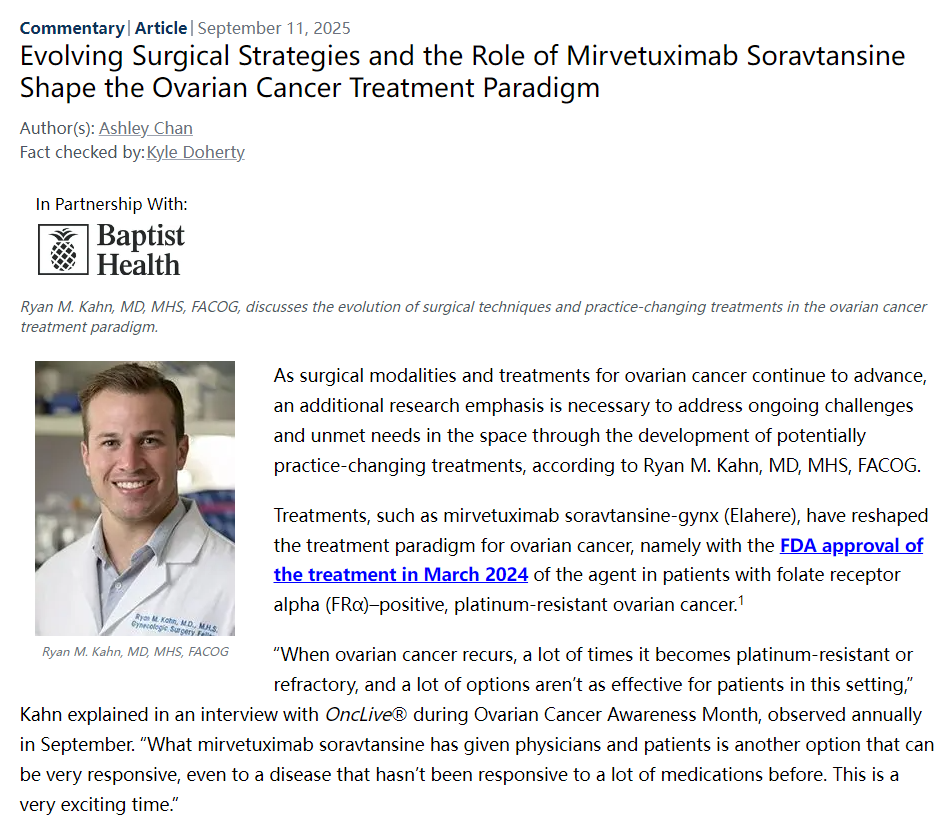
(Image sourceonclive.com)
The Evolution of Surgical Roles

NO.1
Pursuing “Complete Gross Resection” (CGR)
Over the past decade, the role of surgery in the multidisciplinary management of ovarian cancer has undergone significant changes. The core objective has become increasingly clear: to achieve “complete gross resection” (CGR) after primary or interval tumor debulking surgery. This has been shown to provide patients with the best overall survival and prognosis.
To achieve CGR, the surgical scope of gynecologic oncologists has expanded far beyond traditional hysterectomy and lymphadenectomy. Nowadays, to “track the traces of cancer cells,” they perform more complex debulking surgeries involving the diaphragm, spleen, pancreas, liver, and even lesions within the thoracic cavity. This emphasis on surgery and technical refinement has allowed many patients who were previously advised to undergo neoadjuvant chemotherapy to now have surgical opportunities and benefit significantly from them.

(Image generated by AI)
Application and Considerations of Minimally Invasive Surgery

NO.2
Laparoscopic or Robotic-Assisted Surgery
Minimally invasive surgery (laparoscopic or robotic-assisted) is increasingly being applied in gynecologic oncology due to its advantages of faster recovery and less pain. However, its application must be tailored to the individual and the disease:
Endometrial Cancer: Studies such as LAP2 have confirmed its safety and efficacy.
Cervical Cancer: The LACC trial previously indicated that minimally invasive radical hysterectomy might have worse outcomes, but the latest ROCC trial is re-evaluating this issue, focusing on the impact of techniques such as cervical closure. Its results will provide clearer guidance in the coming years.
Current Core Challenges in Surgery

NO.3
Precise Patient Stratification
The greatest challenge lies in the precise stratification of patients: how to determine which patients can directly benefit from surgery (achieving CGR) and which patients are more suitable for neoadjuvant chemotherapy first?
The difficulty lies in small bowel lesions. When ovarian cancer spreads to the small intestine, it often forms numerous small lesions that are difficult to remove, resembling “grains of millet.” Current imaging technologies struggle to accurately detect these small disseminations. Researchers are working to improve preoperative assessment accuracy by developing algorithms based on imaging and patient characteristics, even incorporating artificial intelligence, to reduce the proportion of “futile laparotomies.”
ADC New Drugs

NO.4
“Precision Missiles” Changing the Treatment Landscape
When ovarian cancer recurs and develops platinum resistance, treatment options are limited and often unsatisfactory. The emergence of antibody-drug conjugates (ADCs) has brought breakthroughs to this dilemma.
Among them, mirvetuximab soravtansine is an ADC drug targeting folate receptor alpha (FRα). It was approved by the FDA in March 2024 for the treatment of FRα-positive, platinum-resistant ovarian cancer patients.
This approval was based on the pivotal MIRASOL Phase III study, which showed that for FRα high-expressing platinum-resistant ovarian cancer patients who had received 1-3 lines of treatment:

· The objective response rate (ORR) reached 42.3%;
· Both progression-free survival (PFS) and overall survival (OS) showed significant improvement.

Images sourced from public channels (such as FDA website, original drug manufacturer websites, etc.) are for reference only.
This provides a very effective new option for platinum-resistant patients. Even more exciting is that current research is exploring the application of this drug in patients with low to moderate expression of FRα, which may allow more patients to benefit in the future.
The treatment paradigm for ovarian cancer is being reshaped. On one hand, surgical techniques are continuously refined to achieve more thorough tumor removal; on the other hand, precision-targeted therapies like mirvetuximab soravtansine are bringing new hope to patients with recurrent and refractory disease.
Disclaimer:This page’s content is sourced from onclive.com, and does not represent the views of this public account. The content is for reference only for individuals with medical professional qualifications for medical and pharmaceutical research, and does not constitute any treatment advice or drug recommendations. The drugs mentioned may not be approved for sale and use in mainland China. For treatment, please consult a formal medical institution.


References:
·https://www.onclive.com/view/evolving-surgical-strategies-and-the-role-of-mirvetuximab-soravtansine-shape-the-ovarian-cancer-treatment-paradigm
·FDA approves mirvetuximab soravtansine-gynx for FRα positive, platinum-resistant epithelial ovarian, fallopian tube, or primary peritoneal cancer. FDA. March 22, 2024. Accessed September 10, 2025. https://www.fda.gov/drugs/resources-information-approved-drugs/fda-approves-mirvetuximab-soravtansine-gynx-fra-positive-platinum-resistant-epithelial-ovarian
·Moore KN, Angelergues A, Konecny GE, et al. Mirvetuximab soravtansine in FRα-positive, platinum-resistant ovarian cancer. N Engl J Med. 2023;389(23):2162-2174. doi:10.1056/NEJMoa2309169