Topic Introduction
The college entrance examination combines unfamiliar information to create questions that not only test the examinee’s ability to extract key information, absorb, and integrate knowledge, but also promotes the examinee’s autonomous learning and active problem-solving skills. This is an important embodiment of the integration of “teaching, learning, and assessment,” thereby comprehensively enhancing the examinee’s subject literacy. In the 2025 Shaanxi exam, question 5 on “mechanical keys,” the hydrocarbon, and in the 2025 Henan exam, question 5, and in the 2025 Jiangsu exam, question 4 on crown ethers, as well as in the 2025 Gansu exam, question 9, all examined supermolecules.
In the 2024 Hubei exam, question 15, the context of the question combines knowledge of supermolecules and material structures with a nanomolecular bus, enhancing the novelty and applicability of the questions.
Analysis of Real Exam Questions
1.【2025 Shaanxi 5T】“Mechanical key” is a form of binding where two or more molecules interlock spatially. Chinese researchers have synthesized a hydrocarbon composed of two fully phenyl macrocyclic molecules with a “mechanical key,” as shown in the figure. Which of the following statements is incorrect?
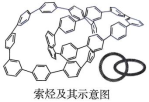
A.This hydrocarbon belongs to aromatic hydrocarbons.
B.The relative molecular mass of this hydrocarbon can be determined using a mass spectrometer.
C.There is no van der Waals force between the two macrocycles of this hydrocarbon.
D.Breaking the “mechanical key” in this hydrocarbon requires breaking covalent bonds.
【Answer】C
【Analysis】 This hydrocarbon is composed only of carbon and hydrogen, containing a benzene ring, thus it belongs to aromatic hydrocarbons,A is correct; a mass spectrometer can be used to determine the relative molecular mass of organic compounds,B is correct; the two macrocycles of this hydrocarbon interlock spatially, and there is van der Waals force between them,C is incorrect; the two macrocycles interlock to form a “mechanical key.” To break the “mechanical key” in this hydrocarbon, at least one ring must be broken, thus breaking covalent bonds,D is correct.
2.【2025 Henan 9T】Spin crossover compounds have potential applications in molecular switches, information storage, etc. The structure of a certain spin crossover compound and its thermogravimetric curve in a helium atmosphere are shown in figures 1 and 2, respectively. The relative molecular mass of this compound(x is an integer).
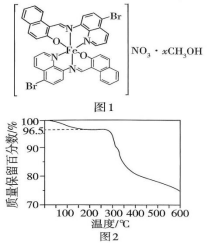
Which of the following statements is correct?
( )
A. x=1
B.The first ionization energy:C<N<O
C.This compound does not contain ionic bonds.
D.The coordination number of this compound is equal to the number of ligands.
【Answer】C
【Analysis】 This question comprehensively examines the types of chemical bonds, ionization energy comparisons, and the structure of coordination compounds. To determine whether ionic bonds exist, one must analyze the composition of the compound; if it does not contain cations and anions, there are no ionic bonds; the order of first ionization energy must be combined with periodic law and atomic structure characteristics; the relationship between coordination number and ligands must clarify the definition of coordination number and the type of ligands (monodentate or polydentate).
A. Since the specific data of the thermogravimetric curve is not provided in the question, it is impossible to directly calculate the value ofx, it must be excluded in conjunction with other options;
B. The first ionization energy of the second period isC<O<N, since the nitrogen atom has a smaller radius and presents a stablep orbital half-filled structure, thus optionB is incorrect;
C. The compound is a neutral complex, as the metal and ligands are combined through coordination bonds, thus it contains only covalent bonds and no ionic bonds, henceC is correct;
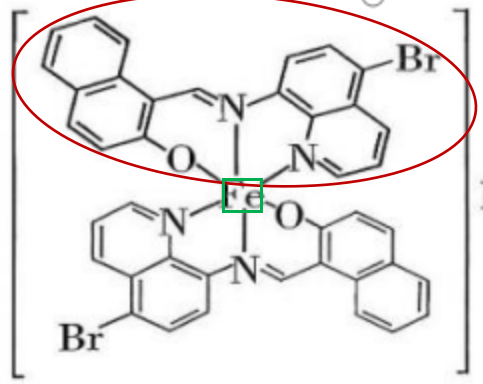
D. If the ligand is a polydentate ligand (such as ethylenediamine), then the number of ligands is less than the coordination number. The number of ligands in this complex is2, and the coordination number is6, thus optionD is incorrect.
Judgment skills: The coordination number is determined by the number of covalent bonds connected to the center; for polydentate ligands, remove the central atom and circle the connected overall part. As shown in the figure:
【Answer】
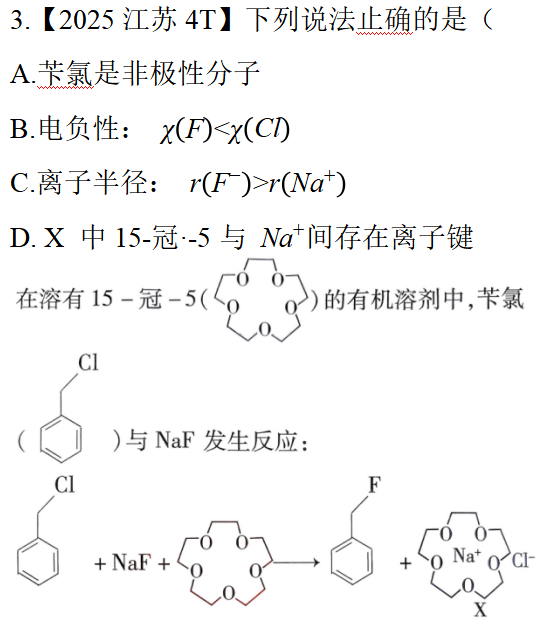
【Analysis】Examines material structure, periodic law of elements. From the structural formula given in the question, it can be seen that benzyl chloride is a polar molecule,A is incorrect; the electronegativity of the same group elements decreases from top to bottom, thus the electronegativity: X(F)> (Cl), B is incorrect; F⁻, Na⁺ have the same electron configuration, thus the larger the nuclear charge, the smaller the ionic radius, henceC is correct; X belongs to supermolecules, which are aggregates formed by two or more molecules through intermolecular interactions, thus in X, 15-crown-5 and Na⁺ have intermolecular forces, thus D is incorrect.
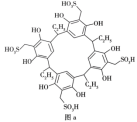
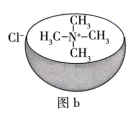
4.【2025 Gansu 9T】Chinese chemists have synthesized a cup-shaped molecule with a cavity (structure shown in figurea), which can form a host-guest complex with guest molecules(CH3)4NCl that can be fixed inside the cavity (structural schematic shown in figureb). Which of the following statements is incorrect?
A.
The host molecule has intramolecular hydrogen bonds.
B.There are covalent bonds between the host and guest molecules.
C.The S-O bond energy in the sulfonic acid group is smaller than that of S=O.
D.(CH3)4N+ and (CH3)3 both use sp3 hybridization.
【Answer】B
【Analysis】 Examines hydrogen bonds, covalent bonds, bond energy, and atomic hybridization. According to the structure of the host molecule, it contains-SO3H and —OH which can form intramolecular hydrogen bonds, thusA is correct; according to the structure of the host-guest complex, there are no chemical bonds formed between the host and guest molecules, thusB is incorrect;S=O containsσ and π bonds, while S—O contains onlyσ bonds, thus the bond energy of S—O in the sulfonic acid group is smaller than that of S=O,C is correct;
In the case of the nitrogen atom, it forms4 σ bonds, and there are no lone pairs on the nitrogen atom, thusN adopts sp3 hybridization, whileN forms3 σ bonds, and has1 lone pair, thusN adopts sp3 hybridization, thusD is correct.
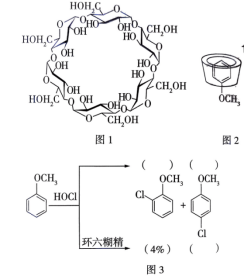
5.【2024 Liaoning 9T】Cyclohexyl-dextrin (D-glucopyranoside condensation) has a cavity structure, with low polarity inside the cavity and high polarity outside, allowing it to encapsulate certain molecules to form supermolecules. Figures 1, 2, and 3 represent the structure of cyclohexyl-dextrin, a schematic of the supermolecule, and related applications. Which of the following statements is incorrect?( )
A.Cyclohexyl-dextrin belongs to oligosaccharides.
B.Non-polar molecules can all be encapsulated by cyclohexyl-dextrin to form supermolecules.
C.In figure 2, the methoxy group is exposed in the reaction environment.
D.Cyclohexyl-dextrin and chlorobenzyl ether can be separated by extraction methods.
【Answer】B
【Analysis】
A item, 1 mol of sugar molecules can produce2~10 mol of monosaccharides after hydrolysis, which is called oligosaccharides. From figure1 of the structure of cyclohexyl-dextrin, it can be seen that 1 mol of cyclohexyl-dextrin produces6 moles of D-glucopyranoside, thus cyclohexyl-dextrin belongs to oligosaccharides,A is correct;
B item, only when the size of the molecule matches the cavity size of cyclohexyl-dextrin can it be encapsulated to form a supermolecule,B is incorrect.C item, from figure3 after adding cyclohexyl-dextrin, 96% of para-chlorobenzyl ether is generated, thus in figure2 the methoxy group is exposed in the reaction environment,C is correct;
C item, cyclohexyl-dextrin has high polarity outside and low polarity inside, based on the principle of “like dissolves like” and the fact that cyclohexyl-dextrin contains many hydroxyl groups, it can form hydrogen bonds with water and is easily soluble in water, thus it can be separated from chlorinated benzyl ether by extraction methods,D is correct.
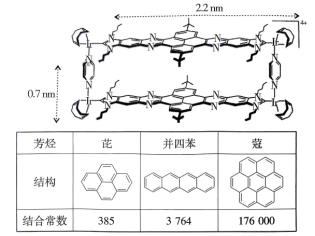
6.【2024 Hubei 15T】Scientists have synthesized a nanomolecular “bus” as shown in the figure, which can load various polycyclic aromatic hydrocarbons. The binding constants of three aromatic hydrocarbons with the “molecular bus” (the larger the value, the more stable) are shown in the table. Which of the following statements is incorrect?( )
A.
Aromatic hydrocarbons and the “molecular bus” can form supermolecules through intermolecular interactions.
B.The stability of vertically loaded and horizontally loaded para-terphenyl is basically the same.
C.From the perspective of molecular size matching, the “molecular bus” can load 2 pyrene.
D.The more π electrons in aromatic hydrocarbons, the more favorable it is for binding with the “molecular bus.”
【Answer】B
【Analysis】
A item, the “molecular bus” and material structure of nanomolecular “bus” can load various polycyclic aromatic hydrocarbons, successfully forming aggregates of different molecules through intermolecular interactions, which meets the definition of supermolecules,A is correct;
B item, from a longitudinal perspective, the “molecular bus” has a structure similar to para-terphenyl, while from a height perspective, there is no similar structure, thus the stability of horizontally loaded is greater than that of vertically loaded,B is incorrect;<!–
C item, pyrene matches the size of the middle part of the “molecular bus,” thus the “molecular bus” can load 2 pyrene,C is correct;
item, all carbon atoms in the aromatic hydrocarbons are sp² hybridized, thus the number of carbon atoms in the aromatic hydrocarbons equals the number of π electrons, thus the number of π electrons in pyrene, para-terphenyl, and phenanthrene are 16, 18, and 24 respectively, and based on the data in the table, the more π electrons in aromatic hydrocarbons, the larger the binding constant, thusD is correct.
Reference materials:
Compilation of College Entrance Examination Questions from Various Provinces in 2025