Too much to say… Is today’s smart home becoming more and more like an “artificial idiot”?
When you’re tired and want to sleep, you have to tell the speaker: “Close the curtains,” “Set the air conditioning to 26 degrees,” “Adjust the bedside lamp to warm light.” If you miss one command, it stops working.… These moments of “talking past each other” hit your pain point precisely, don’t they?
Just when everyone was complaining that “smart homes are not smart enough,” Xiaomi suddenly made a big move——by releasing the future exploration plan for smart homes called “Miloco”. And they announced: Open source! Open! Developers can now deploy, experience, and participate in technical co-construction.
However, many netizens expressed confusion. Can this “Miloco” really end the era of “artificial idiot” homes? What practical help does it offer for our future lives?Can this system really understand human language, or is it just another empty promise?

Understanding human language: Goodbye to “artificial idiot”?
Miloco, short for Xiaomi Local Copilot. In simple terms, it is a smart home system driven by a large model. You can also understand it as installing an AI brain in your home that can “understand human language and comprehend life“.
First, let’s talk about why it can understand human language.
Those of us who are used to traditional smart homes know that the experience is, how should I put it… a bit like talking to a “contrarian”. It can only understand parameters, not your needs. If you want to achieve a function, you have to set the rules in detail, like writing a manual:
“When room temperature ≥ 26℃, turn on the air conditioning”
“Turn on the water heater when the door opens”
“At 8 AM, pull open the curtains”
These “if… then…” rules take time and effort to configure manually. The key is that smart devices can only mechanically follow the conditions you set; you have to explicitly tell them every step before they will act.
Rigid! Too rigid!

Especially in this era where AI large models are everywhere, such smart homes seem even less intelligent, even a bit “idiotic”.
Xiaomi’s Miloco, however, takes a different approach—simple and effective! Miloco integrates the edge-side visual language large model Xiaomi MiMo-VL-Miloco-7B, allowing you to communicate with it directly in “human language”. It can automatically reason and calculate the layers of meaning in your commands. After analysis, it automatically fulfills related needs or creates rules.

For example, before going to bed, you had to hold your Xiao Ai speaker and shout a string of commands: “Close the curtains, set the air conditioning to 26 degrees, dim the bedside lamp, turn on the purifier in sleep mode…” It was somewhat troublesome! But now, you only need to say one sentence: “I want to sleep well.” Temperature, light, and air quality needs will all be taken care of by Miloco at once.

Of course, it will also learn your habits and preferences. For example, if you lower the air conditioning by one degree, it will remember next time: “Oh, the owner likes it a bit cooler.” The next time you turn on the air conditioning, it will automatically adjust to a more suitable temperature for you——Isn’t this a significant improvement over the “artificial idiot”?~
Understanding life: Giving the AI brain “eyes”
After discussing how it understands “human language,” don’t you also want to know how it understands life?
Actually, it’s quite simple. Xiaomi Miloco can understand life when used with “home cameras”.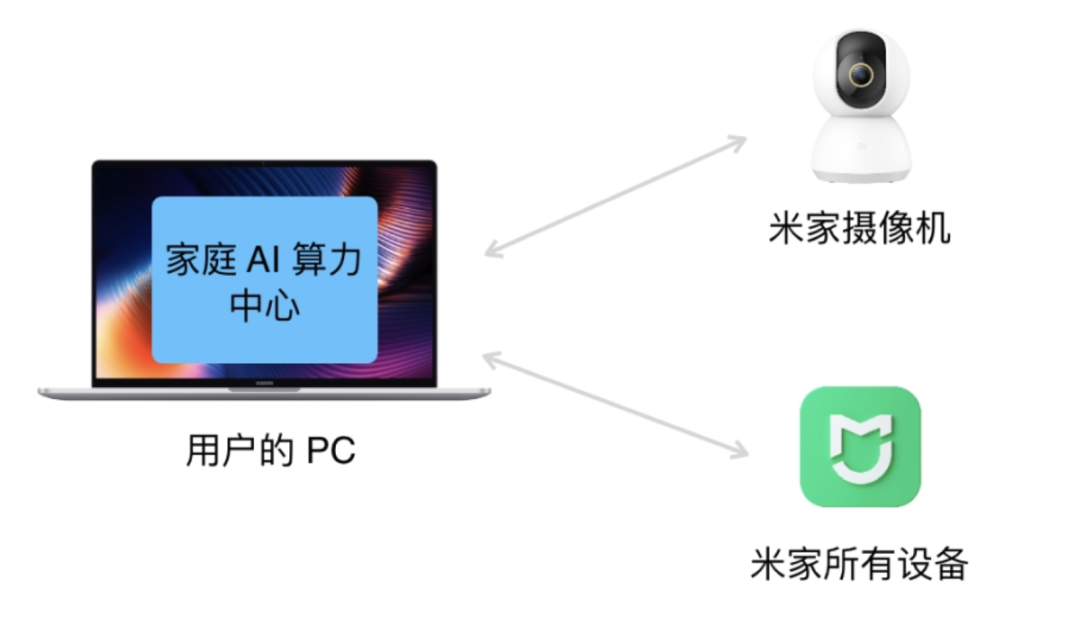
If the edge-side visual language large model is the brain, then the home camera is the eyes of this system. With the support of the brain, the home camera has gained the ability to actively perceive. Functions that you wanted to achieve before are now easy:
For example, you can ask Miloco, where is the dog hiding?
“Your dog is sleeping next to the curtains, sleeping very soundly”
Or, set intelligent trigger rules:
When it detects a child near the kitchen gas stove, it automatically plays a reminder through the speaker: “Kitchen is dangerous, please do not approach.”
When it detects someone reading at home, it automatically turns on the desk lamp.
In traditional smart homes, you would need to use light sensors, and when someone is near the sensor… then set a bunch of triggering conditions. But now, you just need to tell Miloco in the background, and it can use the AI large model to analyze your needs, automatically determine which camera to use, set what kind of trigger conditions, and execute what kind of actions…
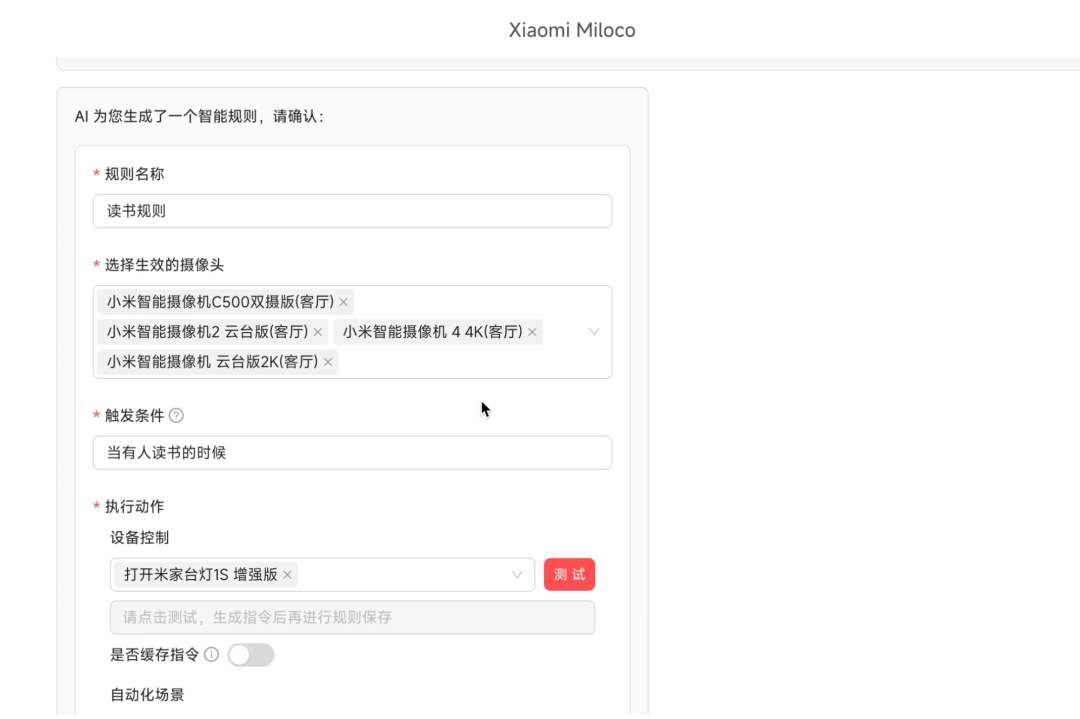
Ultimately, it acts like an AI Agent, creating and executing intelligent rules for you clearly.

Miloco’s approach not only brings convenience but also directly replaces those small sensors! In many scenarios, a single camera can handle what used to require multiple sensors, like presence sensors and light sensors. After all, whether someone is present or if there is light, a camera can accurately determine at a glance, eliminating the need for a bunch of scattered sensors.
Data only runs locally, never “leaves the house”
At this point, some friends might ask: “You talk so grandly, what about my privacy and security? Installing an ‘eye’ at home means everything is being watched, right?”
This is a good question! This is also a key point emphasized in the Miloco plan from the beginning—”Privacy and security first” principle.

According to Xiaomi’s official statement, all visual data processing of Miloco is done directly on the edge locally. What does this mean? It means that the images captured by your home camera, all analysis and recognition are performed on your home gateway or local device, and no raw data will ever be transmitted to Xiaomi’s servers.
You can understand that this data only “runs a lap” in your home, completes its tasks, and never “leaves the house”. Xiaomi has taken into account the most concerning pain points for users.
With the support of large models, operations that previously seemed like a fantasy can now be easily achieved by Miloco:
Automatically close windows on rainy days; Recognize when someone is sleeping without a blanket and automatically raise the air conditioning temperature; See a user rubbing their eyes and proactively remind them to take a break while adjusting the lighting to be softer.…
These operations, which were once considered impossible, can now be achieved by Miloco in the future. The possibilities are truly limitless.
Xiaomi’s ecosystem opens up a “circle of friends”?
Many people complain that smart devices operate in isolation: Xiaomi’s lights can’t control Huawei’s speakers, Home Assistant’s sensors can’t interact with brand-specific curtains, resulting in a pile of “smart orphans” at home that can’t form a truly smart home. The emergence of Miloco aims to break down this “wall”.
Its openness is not just a slogan but a real ecological compatibility. According to Xiaomi’s official plan, whether it’s the Home Assistant open-source platform commonly used by overseas players or mainstream third-party smart devices, as long as they meet unified protocol standards, they can smoothly “join the team” and become part of Miloco’s whole-house smart scene interaction.
For example, if you are using Xiaomi’s temperature and humidity sensor but paired with a third-party brand air purifier, previously the two belonged to different ecosystems and could not connect at all; after integrating with Miloco, when the sensor detects that indoor humidity is too high, it will automatically send a command to the air purifier to trigger ventilation mode while coordinating with the humidifier to adjust to the appropriate level—devices from different brands instantly become “good teammates” to maintain a comfortable indoor environment.
This pattern won’t open up all at once!Miloco’s focus is not on the Xiaomi-exclusive ecosystem but on a super smart ecosystem of interconnected devices. For users, there’s no need to painfully replace old devices to fit into a complete ecosystem; for manufacturers, it also provides an outlet to connect with a vast user base. This wave of openness truly embodies the spirit of “win-win”.
Final Thoughts
Overall, Xiaomi has successfully combined smart homes with AI large models this time. In the future, your smart system will bid farewell to the “artificial idiot” era—it will understand your implied meanings and even read your potential needs; and with AI having “eyes,” smart homes will upgrade from “following orders” to “reading the room,” proactively providing services for you.
Although it is still in the testing phase and features are being refined, Miloco’s most powerful move is choosing to open-source the core framework completely. This is equivalent to extending a “co-creation” invitation to developers worldwide, and the speed of technological iteration may exceed our imagination. It seems that Xiaomi is determined to turn the grand vision of a “human-centered, proactive service” super smart ecosystem into reality.
References:
-
https://www.163.com/dy/article/KEFUTF8U0556CAYF.html
-
https://www.sohu.com/a/954317519_122004016
— The End —Click here👇 to follow us