
SLA 3D Printing Equipment
Technical Principles, Advantages, and Application Prospects

3D printing methods commonly used in healthcare applications include Fused Deposition Modeling (FDM), Direct Ink Writing (DIW), Stereolithography (SLA), Digital Light Processing (DLP), Selective Laser Sintering (SLS), and Inkjet Printing/Laminated Object Manufacturing (LOM). These technologies achieve layer-by-layer deposition of materials through different printing mechanisms, thereby constructing complex 3D structures, and they have broad application prospects in the biomedical field.
Among them, SLA/DLP/LCD equipment, with its ultra-high printing precision and excellent surface quality, has become a core tool in industrial manufacturing, healthcare, and cultural creativity.
This article will outline the working principles, technical advantages, and market overview of SLA equipment.
The Core Principles of SLA Equipment
Since the first SLA (Stereolithography) device was born in the 1980s, SLA technology has diversified into branches such as DLP (Digital Light Processing), LCD Mask Curing, and Visible Light Curing (VLC). With micron-level precision, the ability to form complex structures, and customizable material functionalities, it has become a core technology in high-end fields such as medical implants, precision casting, and rapid prototyping.
Currently, with breakthroughs in visible light initiators, nano-enhanced resins, and the proliferation of intelligent devices, SLA 3D printing is penetrating from industrial-grade “high-end” technology into the consumer market, quietly initiating a manufacturing industry focused on efficiency, precision, and sustainability.

SLA 3D printing utilizes ultraviolet (UV) light to cure liquid photosensitive resin layer by layer. Depending on the type of light source, it is mainly divided into three technologies:
1. SLA (Stereolithography)
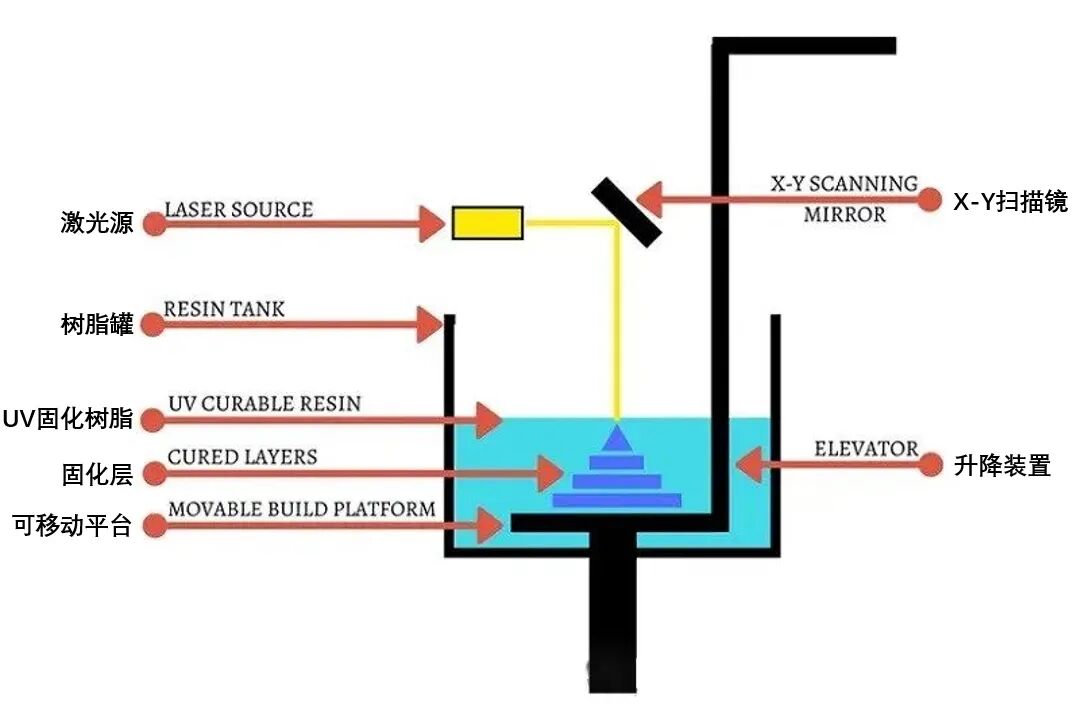
SLA printers use a laser beam to cure photosensitive resin layer by layer. It controls the laser to move back and forth on the resin surface, curing the resin layer by layer according to sliced data, meaning it sweeps out the pattern to be printed on each layer. After completing one layer, the printing platform moves to prepare for the next layer.
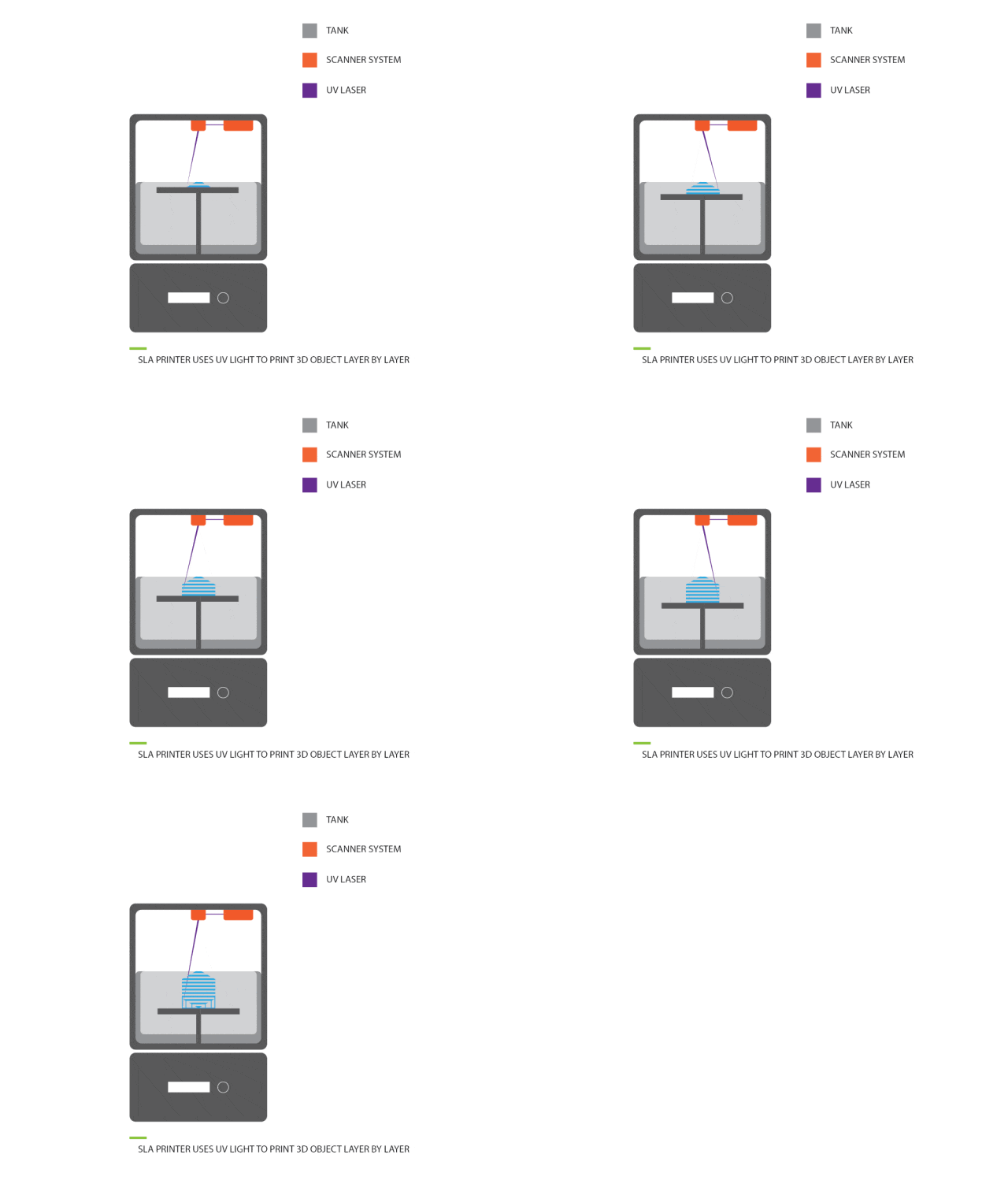
SLA devices are typically large and are generally used for printing large parts and models. Especially for industrial-grade SLA devices, due to the need for complex optical systems and lasers, the size and cost of the equipment are relatively high. The composition is generally as shown in the figure below (different models may vary).
2. DLP (Digital Light Processing)
DLP printers use digital projection technology to form images by reflecting light with micro-mirrors. During printing, the projection illuminates the entire pattern of each layer.
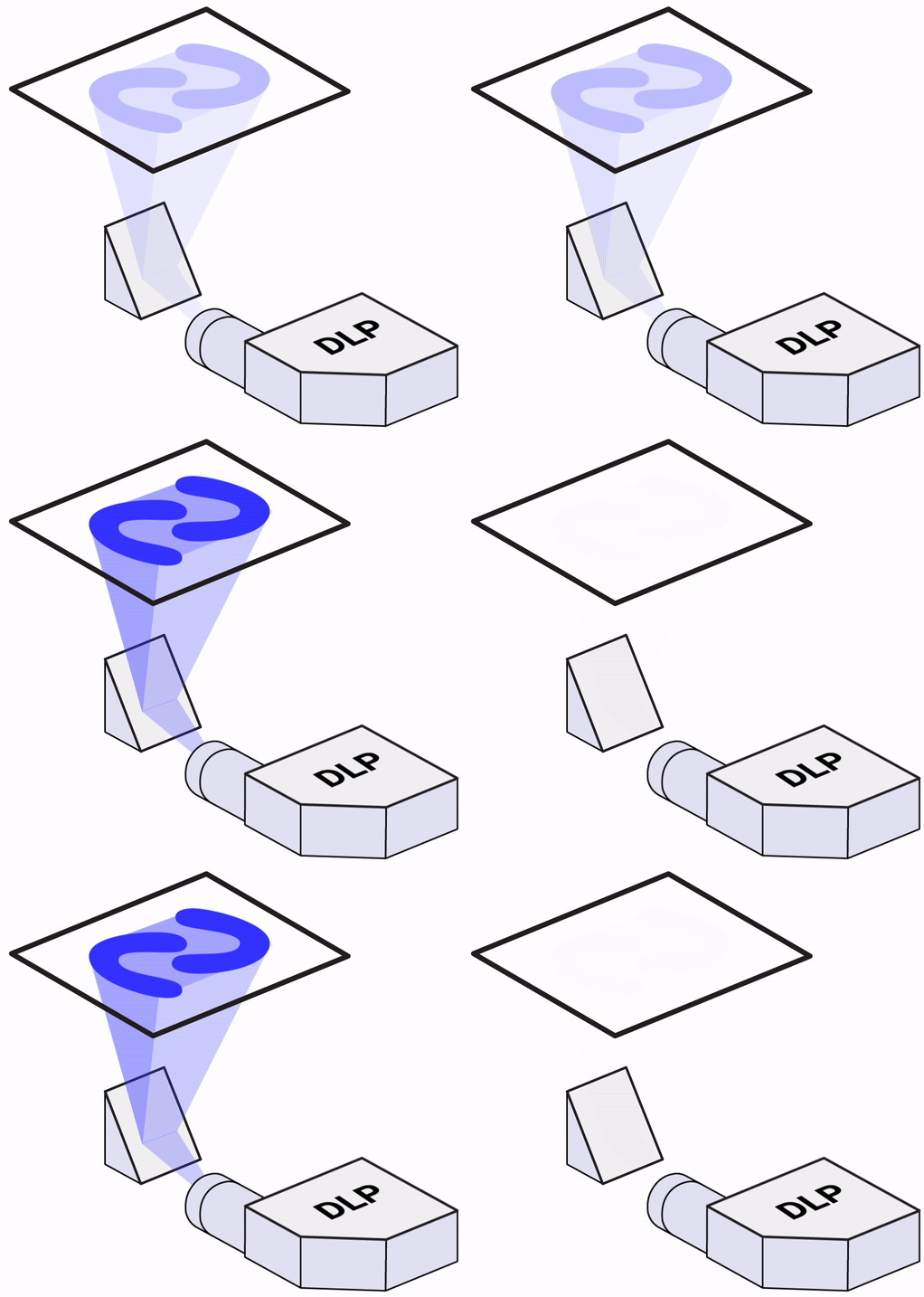
The reason it can produce projections is that it uses a Digital Micromirror Device (DMD chip), which consists of millions of tiny mirrors that can tilt rapidly to reflect light from the source, forming the projected image. The projector directly projects a layer image onto the resin surface, curing an entire layer of resin at once, achieving rapid printing.
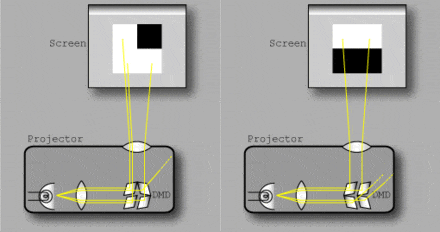
Because it is a beam projection, the precision of DLP printers depends on the optical precision of the projection system and the image resolution, which is related to the projection area. The larger the projection area, the more the beams will disperse, reducing resolution and affecting precision. However, this impact is not significant; even in large-size printing, DLP can maintain good sharpness. Of course, the printing effect of DLP will be sharper and clearer in small, fine models, especially in curved surfaces and richly detailed areas.
3. LCD (Liquid Crystal Display Mask Curing)
LCD uses mature screen technology and is generally lower in cost compared to SLA and DLP, especially desktop-level LCD 3D printers, which can ensure a certain level of precision at a relatively low price, making them suitable for individual users and small businesses.
The light source of LCD is usually UV LED light, which controls the LCD screen to display black and white images of each layer of the model slices, allowing light to pass through the set image to cure the resin in the display area, and then the printing platform moves to achieve layer-by-layer printing, ultimately printing a complete model.
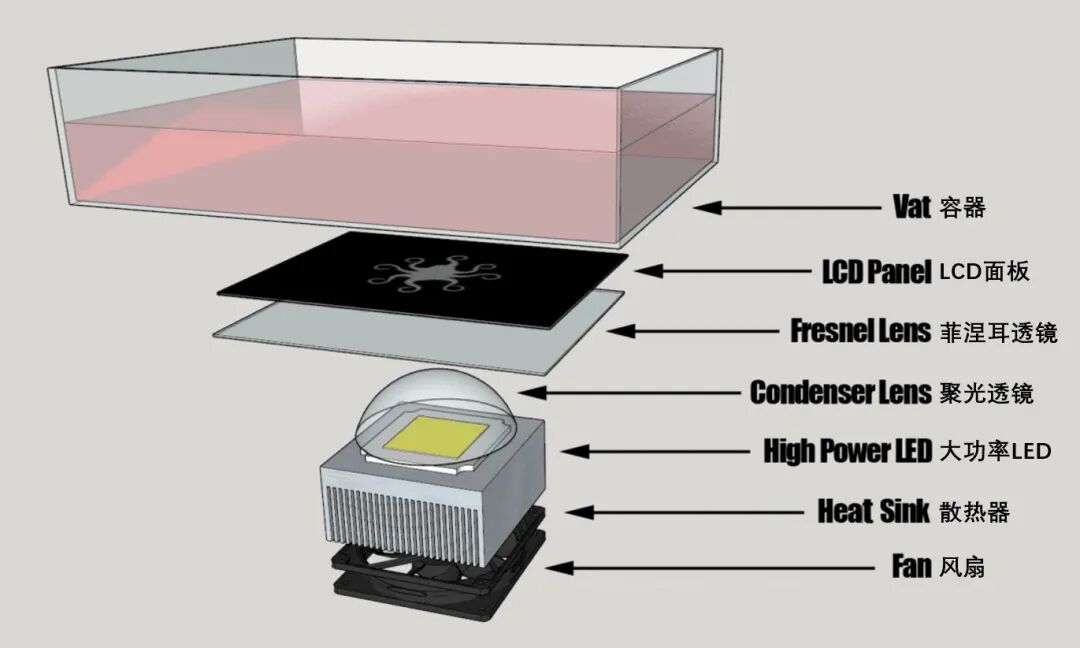
Therefore, the precision of LCD printers depends on the resolution of the LCD screen; higher resolution ensures a certain printing precision. Since it also cures the entire layer image at once rather than point by point, the printing speed is faster than SLA. Moreover, the image displayed on the LCD screen is fixed, and the light source directly illuminates the resin through the screen, so the speed does not fluctuate significantly with the model size. Especially in large area printing with uniform distribution, LCD can maintain stable speed.
Of course, since the light needs to pass through the LCD screen, on one hand, the LCD screen will be exposed to UV light for a long time, leading to a relatively short lifespan; the LCD panel may show aging phenomena after prolonged use, resulting in decreased resolution and printing precision. On the other hand, there will also be some loss of light intensity as it passes through the LCD screen, so the light intensity may not be as concentrated and uniform as DLP. Therefore, consideration should be given to replacing the LCD screen, but the above situations can be overlooked when the requirements are not high.
II. Outstanding Advantages of SLA Equipment
1. Ultra-high Precision
Can print micron-level details (10-50μm), far exceeding FDM (Fused Deposition Modeling) technology, suitable for precision parts and complex structures.
2. Smooth Surface
Unlike FDM 3D printers that form layer lines through the accumulation of filament materials, the models printed by SLA printers have very smooth surfaces, requiring almost no sanding or post-processing to achieve high surface quality. This feature not only saves a lot of post-processing time and effort but also ensures that the appearance of the model is more outstanding, especially suitable for making products with high surface finish requirements, such as high-end crafts and medical implants.
3. Material Diversity
In addition to standard resins, there are also special resins such as flexible, high-temperature resistant, and biocompatible resins to meet the needs of different industries.
III. Typical Application Scenarios
1. Medical Dentistry
In the medical field, SLA 3D printing technology has enormous application potential. Doctors can use SLA printers to create models of patients’ bones, organs, etc., based on CT or MRI scan data for surgical planning and simulation, helping doctors better understand the patient’s condition and develop more precise surgical plans. In dentistry, SLA printers can be used to create tooth models, crowns, braces, etc., achieving personalized dental restoration and correction, improving treatment outcomes and patient satisfaction.
2. Industrial Manufacturing
High-precision prototype verification in the automotive and electronics industries, as well as the production of small injection molds.
3. Cultural and Creative Jewelry
Rapid prototyping of complex artistic sculptures and jewelry wax models, shortening the traditional manual carving cycle.
IV. Overview of Global SLA 3D Printing Manufacturers
Formlabs (USA)
• Technology Route: Laser Stereolithography (SLA) and Low Force Stereolithography (LFS)
• Main Products: Form 3/3+, Form 3B, Form 3L
• Application Fields: Medical, Jewelry, Industrial Design
• Market Characteristics: Known for high precision, closed ecosystem, and supporting materials, targeting professional users
Anycubic (Shenzhen, China)
• Technology Route: LCD Stereolithography
• Main Products: Photon, Photon S, Photon M3/M5 series
• Market Characteristics: Leading global sales in desktop-level, gaining consumer market share with high cost-performance ratio and open material system
Prusa Research (Czech Republic)
• Technology Route: SLA
• Main Products: SL1, SL1S Speed, Mini SLA
• Market Characteristics: Active open-source hardware community, high market share in Europe
UnionTech (Shanghai, China)
• Technology Route: Industrial-grade SLA
• Main Products: Lite, RSPro, DLP series
• Application Fields: Aerospace, Automotive, Molds
• Market Characteristics: Leading domestic industrial-grade SLA installation volume, providing integrated solutions of equipment-materials-services
Raise3D (Shanghai, China)
• Technology Route: Multiple technologies in parallel, including SLA
• Main Products: DF2, E2 series
• Market Characteristics: Global sales network, with warehouses and technical support centers in North America and Europe
Other Active Manufacturers
• Creality (Shenzhen): LCD stereolithography product matrix covering consumer and quasi-industrial levels
• Shining 3D (Hangzhou): Supplier of digital dental and orthodontic SLA solutions
• MiiCraft (Shenzhen), LuxCreo (Beijing), etc.: Continuously investing in micro-nano level DLP and high-speed stereolithography fields
END
Content Source: Internet
This issue edited by: Xiao Ai
Paper Submission: As a leading advanced manufacturing technology service platform, AMT accepts academic paper submissions; the publication of manuscripts is entirely public welfare and free; paper submission email: [email protected]
Copyright Statement: AMT respects copyright and thanks every author’s hard work and creativity; except for works that cannot be traced, we have noted the source at the end of the article; if articles, videos, images, or texts involve copyright, please contact us immediately with proof materials, and we will confirm the copyright and delete the content or pay remuneration according to national standards!