
To participate in the Meet 35 conference, please click ↑
To achieve edge computing (computations close to the data source) on devices such as 5G networks and the Internet of Things, it is necessary to deploy sufficient computing power on micro devices.
To realize this idea, future efforts will focus on utilizing artificial intelligence (AI) computing technology—also known as edge AI. While some are concerned about how technical experts can apply AI that exceeds traditional computing capabilities to micro devices—some are racking their brains, unsure which country will dominate this new field—this technology is still in the early stages of development.
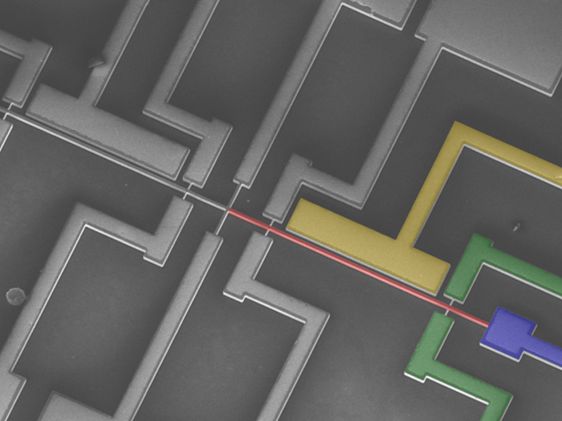
Image | A single silicon beam (red part), along with its driving electrodes (yellow part) and read/write electrodes (green and blue parts), gives microelectromechanical systems significant computational capabilities. (Image source: Guillaume Dion)
However, this so-called “early stage” has seen some changes. Researchers at the University of Sherbrooke in Quebec, Canada, have successfully configured an artificial intelligence for microelectromechanical systems (MEMS) devices, marking the first time AI has been integrated into MEMS devices in history.
The results of the experiment achieved neuromorphic computing within MEMS, simulating the operation of the human brain on micro devices. This combination allows the devices to process data internally, thereby improving the prospects of edge computing.
“Last year, we published a paper theoretically demonstrating the possibility of AI in MEMS,” said Julien Sylvestre, a co-author of the paper and a professor at the University of Sherbrooke, detailing this advancement. “Our latest breakthrough shows that we can create such devices in the lab.”
The researchers described the AI method implemented in MEMS in their publication in the Journal of Applied Physics, which they refer to as reservoir computing. Professor Sylvestre explained that to understand reservoir computing, one must grasp some knowledge about how artificial neural networks operate. These artificial neural networks acquire data through an input layer, transform the data through hidden layers containing multiple computational units called neurons, and then output the final result in the output layer. Reservoir computing is most commonly used for time-dependent data (whereas input data like images are static and not time-dependent).
Thus, reservoir computing utilizes dynamic systems driven by time-dependent inputs. Dynamic systems are generally chosen to be relatively complex, where the response to inputs may differ significantly from the inputs themselves.
Additionally, systems that respond to inputs with multiple degrees of freedom are selected. In this way, inputs are “mapped” to high-dimensional space, with each dimension corresponding to a degree of freedom. This creates a richness of information, meaning that inputs undergo many different transformations.
“The special technique used in reservoir computing is to linearly combine all dimensions to obtain outputs consistent with our expected computer outputs under given input conditions,” Sylvestre said. “This is what we refer to as the ‘training’ process of reservoir computing. Unlike other AI methods, the computation of linear combinations is very simple, and people will attempt to modify the internal mechanisms of the dynamic system to achieve the desired output.”
In most reservoir computing systems, the dynamic system is software. In this work, the dynamic system is the MEMS device itself. To achieve this dynamic system, the device utilizes nonlinear dynamics—silicon beams oscillate in space when they are very thin, and these oscillations create a neural network capable of mapping input signals to the higher-dimensional space required for neural network computations.
Sylvestre explained that modifying the internal workings of MEMS devices is challenging, but in reservoir computing (modifying internal workings) is not necessary, which is why they used the silicon beam vibration method to implement AI in MEMS.
“Our work demonstrates that AI capabilities can be realized using nonlinear resources in MEMS,” Sylvestre said. “This is a new way to create artificial intelligence devices that can be compact and efficient.”
According to Sylvestre, it is difficult to compare the processing capabilities of these MEMS devices with desktop computers. “Computers operate in a completely different manner than our micro devices,” he explained. “Computers are large and consume a lot of power (up to several tens of watts), while our MEMS devices can even be made on the width of a human hair and operate at microwatt power. Despite the low power consumption, these micro devices can still perform some interesting tasks, such as classifying certain spoken vocabulary—this task may use resources equivalent to 10% of a desktop computer.
According to Sylvestre, a potential application for these AI-equipped MEMS is in accelerometer MEMS, where all data collected by the device is processed internally without needing to send data back to a computer.
While the researchers have not yet focused on how to power these micro devices, it can be assumed that they operate on energy harvesters without needing batteries. With this in mind, the researchers are seeking to apply their AI MEMS in applications such as sensors and robotic control.
-End-
Editor: Li Gen Editor-in-Chief: Huang Shan
References:
https://spectrum.ieee.org/tech-talk/robotics/artificial-intelligence/artificial-intelligence-on-a-mems-device-brings-neuromorphic-computing-to-the-edge