In the field of industrial automation, the role of a PLC programmer is far more complex and critical than it appears on the surface. They are not just code writers, but also architects of industrial control systems, experts in fault diagnosis, and specialists in efficiency optimization. This article will take you into the real working world of PLC programmers, reveal the technical details of control cabinet programming, and explore the knowledge system required to become an industry expert.
I. The In-depth Daily Work of PLC Programmers: Engineering Thinking Beyond Coding
1. System-level Architecture Design
– Control strategy planning: Selecting the most suitable control architecture (centralized vs. distributed) based on process requirements.
– Redundancy design: Designing hot standby/cold standby solutions for critical systems (such as petrochemical and power systems).
– Safety level assessment: Conducting SIL level classification in accordance with IEC 61508/62061.
2. In-depth Hardware Integration
– Module selection calculation:
– Accurately calculating I/O point margins (usually 20-30% reserved).
– Power supply capacity verification (considering inrush current and peak load).
– Backplane bus load evaluation (crucial for large-scale systems).
– EMC design practices:
– Signal classification wiring (power lines, analog quantities, digital quantities routed in layers).
– Grounding system design (single-point grounding vs. multi-point grounding).
– Shielding processing technology (double-ended grounding vs. single-ended grounding).
II. In-depth Technical Analysis of Control Cabinet Programming
1. Advanced Signal Processing Technologies
– Analog quantity processing:
– 4-20mA signal disconnection detection (via 250Ω resistor + voltage monitoring).
– Software filtering algorithms (moving average, median filtering).
– Non-linear compensation for range conversion.
2. In-depth Application of Communication Protocols
– Modbus TCP optimization:
– Transaction ID management.
– TCP sticky packet processing.
– Timeout and retry mechanism.
– Profinet real-time performance guarantee:
– IRT (Isochronous Real-Time) configuration.
– Bandwidth reservation settings.
– Device clock synchronization.
3. Safety Programming Specifications
– IEC 61131-3 best practices:
– Variable naming conventions (prefixes: b_ for boolean, w_ for word, f_ for float).
– Reasonable division of Program Organization Units (POUs).
– Comment standards (modification records, version control).
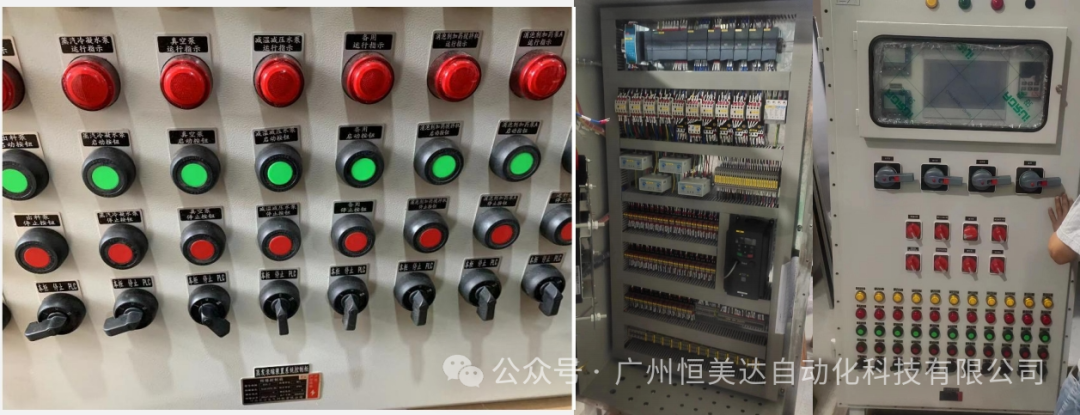
III. Construction of Expert-level Knowledge System
1. In-depth Understanding of Underlying Principles
PLC scanning mechanism:
Input sampling → Program execution → Output refreshing → Communication processing → Self-diagnosis.
Interrupt handling mechanism:
– Timed interrupts (for precise periodic tasks).
– Event interrupts (for emergency stop signal processing).
– Communication interrupts (triggered by data reception).
2. Cross-platform Technology Integration
– Industrial PC collaboration:
– OPC UA data exchange.
– C and PLC DLL interaction.
– Python data analysis interface.
– Edge computing applications:
– Local data preprocessing.
– Machine learning model deployment.
– Cloud data synchronization.
3. Industry-specific Technologies
– Process industry:
– Batch processing control (S88 standard).
– Recipe management systems.
– Tank farm interlocking logic.
– Discrete manufacturing:
– Robot collaborative control.
– Vision-guided positioning.
– Flexible production scheduling.
IV. Cutting-edge Technology Trends and Career Development
1. Industry 4.0 Technology Stack
– Digital twin applications:
– Virtual debugging technology.
– Real-time data mapping.
– Predictive maintenance.
– IT/OT integration:
– MQTT protocol application.
– RESTful API development.
– Industrial firewall configuration.
2. Expert Growth Path
1. Basic stage (1-2 years):
– Master 3 or more PLC brands.
– Independently complete small projects.
2. Advanced stage (3-5 years):
– Large-scale system architecture design.
– Implementation of complex algorithms.
3. Expert stage (5+ years):
– Industry solution design.
– Research and promotion of new technologies.
Continuous learning resources:
Certification systems:
– Siemens SIMATIC certification.
– Rockwell Certified Engineer.
– TÜV functional safety certification.
Practice platforms:
– Codesys development environment.
– Raspberry Pi + industrial IO expansion.
– Virtual PLC simulation system.
The career development of PLC programmers has no ceiling. With the accumulation of experience, you will gradually grow from simply writing code to being able to:
– Design the automation architecture of entire factories.
– Formulate industry technical standards.
– Lead the direction of technological innovation.
In this era of industrial digital transformation, talents who master in-depth PLC technology will become the core driving force of intelligent manufacturing. Are you ready to meet this challenge?