Those engaged in enterprise digital consulting are likely familiar with the concept of an enterprise middle platform, but the term “robotic middle platform” may be less known. What does this term mean, and how does it differ from the enterprise middle platform? In fact, during an RPA salon in the financial industry last year, I mentioned two key concepts in my presentation: the RPA-based “data sharing platform” and the “robotic middle platform.” The former has been discussed in a previous article, while today I will focus on the latter. I hope this sharing will bring new insights into product forms and contribute to the industry.
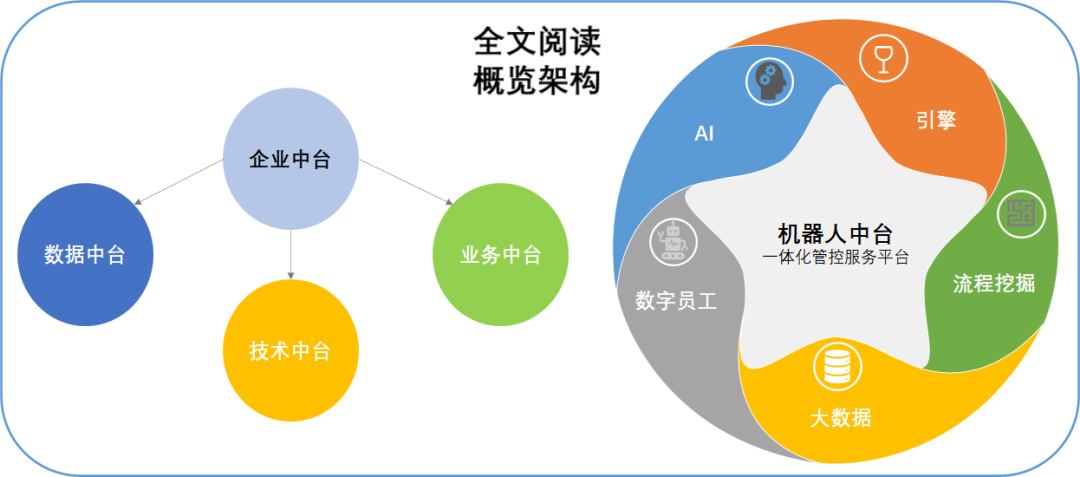
Before discussing the robotic middle platform, let’s first understand the enterprise middle platform and why it is well-known among information builders in large organizations.
-
Enterprise Middle Platform
In recent years, the concept of the enterprise middle platform has gained significant popularity. To summarize, many companies in China face similar issues, which can be broadly categorized into two types:One type involves numerous business or functional requirements that are highly similar and generalized. However, due to the lack of dedicated teams for planning and development, there is a lot of redundant system development and construction, leading to low reusability, inefficiency, wasted research and development resources, and inconsistent user experiences.The other type arises during the early stages of business development, where vertical, personalized business logic is too tightly coupled with foundational systems. Without a platform-oriented plan, there is a significant amount of cross-logic between horizontal systems and upstream/downstream systems, making it impossible to directly reuse systems or quickly iterate during the expansion into new businesses and markets.These two types of problems are often referred to as “reinventing the wheel” and “siloed architecture“. The essence of the problem is that, during the development process, enterprises quickly launched many functions to address immediate business issues. However, as the enterprise matures, these problems become apparent and severely impact operational efficiency and costs. The fundamental starting point for developing a middle platform is to find a way to mechanize and productize these solutions, allowing for unified planning and development of highly generalized data, functions, products, and even experiences within the enterprise, thereby enabling front-line business departments to focus more on operations, improve operational efficiency, and enhance enterprise competitiveness.
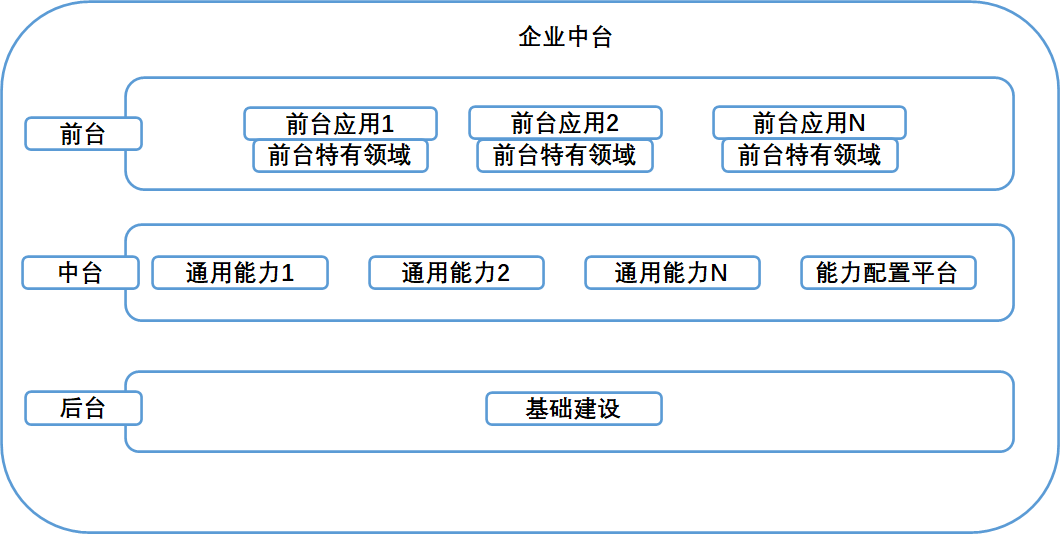
Moreover, the construction of the enterprise middle platform model requires a certain scale of the enterprise, typically being leading enterprises or industry leaders with large and complex organizational structures, numerous capable subsidiaries or sub-units, and a diversified, multi-segmented business model (such as State Grid, State Energy, etc.). At the same time, the group must have sufficient financial resources, strong technical teams, and well-established information infrastructure, with the capability to integrate business and information systems across upstream and downstream.In recent years, the enterprise middle platform has gained significant favor among large clients, and the construction of a middle platform typically consists of three parts: the technical middle platform, data middle platform, and business middle platform. Regardless of the type of middle platform, the core objective is to reduce costs and increase efficiency.
> Technical Middle PlatformThe technical middle platform is an evolved product of platform architecture development. From a technical perspective, the middle platform technology inherits the characteristics of high aggregation, loose coupling, high data availability, and easy resource integration from platform architecture. It then combines with microservices to embed core business functions into the infrastructure, creating a shared platform that connects and integrates everything based on a front-end and back-end separation model.Typically, the underlying architecture of the technical middle platform provides an application layer for enterprise information systems or partner client-related information systems. The upper layer is the integrated PaaS layer, which incorporates middleware products and technologies such as service buses, data buses, identity management, and portal platforms as technical support. The DaaS data layer, through the data middle platform, utilizes technologies like master data and big data to perform data governance, computation, and configuration analysis, supporting industry-specific applications in the service middle layer and shared service layer to provide personalized services to users.> Data Middle PlatformThe data middle platform assists enterprises in data management and building digital operational capabilities. It encompasses not only the governance of business data but also a series of methods for collecting, storing, computing, configuring, and presenting massive amounts of data. Typically, the data middle platform collects structured, semi-structured, and unstructured data from systems, social media, and networks, using different technical means to access data based on the required business model. The data is then stored in the corresponding databases for processing, with master data governance cleaning dirty data to ensure the consistency, accuracy, and completeness of the required data. Subsequently, the data is extracted or distributed to the computing platform for multi-dimensional analysis and processing based on business segments and themes, resulting in valuable data for presentation and decision analysis.
> Business Middle Platform
The technical middle platform focuses on technology, while the data middle platform focuses on business data. The business middle platform takes a holistic view of the enterprise, planning from the perspectives of overall strategy, business support, user connection, and business innovation. It is constructed with the support of the foundational middle platform, technical middle platform, and data middle platform. The architecture of the business middle platform typically relies on a PaaS-based internet middle platform, encapsulating open-source, externally sourced, and internally developed information systems and platforms into a core technology layer. Through system integration, business process reengineering, and data governance analysis, it supports the enterprise’s business, forming a unique business layer that connects upstream and downstream partners, internal and external customers, and resource systems, establishing a balanced ecosystem to support business development and innovation.
-
Robotic Middle Platform
Before discussing the robotic middle platform, let’s first look at the basic characteristics of current enterprises.
In daily operations, over half of the business involves repetitive tasks, which is a norm for enterprise operations and development, unlike projects that are unique and unsustainable. On the other hand, this indicates that the two main factors in enterprise operations are people and business, with business revolving around a multitude of systems. People are immersed in business, facing various internal and external systems daily, where the systems primarily consist of logic and data. If the logic is fixed and the data sources are highly structured, it is evident that this is very suitable for robotic process automation.However, current enterprises are business-centric, with people constantly facing a multitude of systems, working overtime around business, often feeling mundane. Therefore, how can technology empower digital transformation in enterprises to achieve genuine cost reduction and efficiency improvement, rather than merely updating or replacing systems, or believing that using popular business systems in the market can fundamentally solve problems? Reflecting on the continuous updates and iterations of domestic IT systems over the past few decades, enterprises have merely accumulated a pile of systems, with issues like cross-departmental collaboration and system interconnectivity remaining unresolved.Many people say RPA is good because it can simulate human operations and solve issues like data silos between systems. This is a somewhat outdated perspective on RPA, as many integrators and consulting firms know that RPA can help enterprises address some repetitive and inefficient business processes, replacing manual work to achieve so-called cost reduction and efficiency improvement. For small enterprises, this may suffice, but for large groups, can RPA only handle a dozen processes? What about the time saved? How can enterprises derive effectiveness from these processes? Therefore, we need to consider how to scale deployment and operation and how to assess scale, ultimately impacting human efficiency.
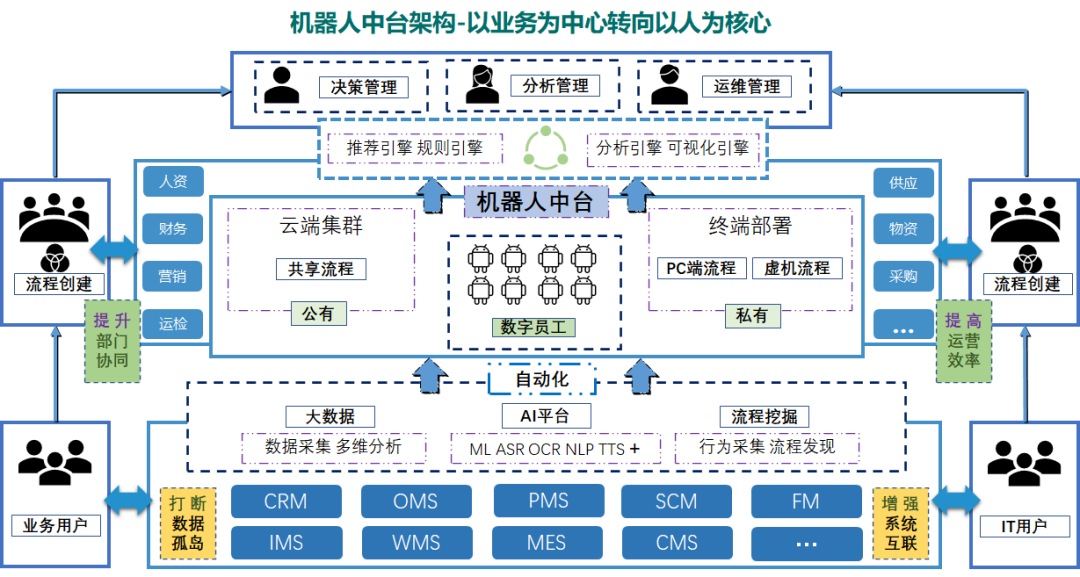
The robotic middle platform effectively connects people and systems, providing business personnel with an excellent experience of “seamless perception” while handling work. By building a robotic middle platform, enterprises can offer a comprehensive control service platform integrated with digital employees. By using digital employees as assistants, various convenient services will be provided, allowing people to avoid facing a multitude of cumbersome business systems and performing repetitive, inefficient tasks. Consequently, human responsibilities will shift from basic functional roles to analytical and decision-making managerial roles, and the entire framework of the enterprise will transition from a business-centric approach to a human-centric approach.According to a 2020 research report, the top ten technology trends include “Hyperautomation“, “Intelligent Composable Business“, and “AI Engineering“. This highlights the importance of process automation, and research institutions have pointed out that the core of future enterprise development is “people-oriented”, which aligns with the construction philosophy of the robotic middle platform.However, in the long-term operation of the robotic middle platform, relying solely on RPA as platform support may be insufficient. For large groups, it requires the integration of other technologies to maximize the operational benefits of the robotic middle platform. RPA serves as an effective connector for system interconnectivity within the group, addressing data silo issues, enhancing departmental collaboration, and improving operational efficiency. However, to maximize platform benefits, future scalable deployment must also consider the integration of big data, process mining, AI, engines, and other relevant technologies.
> Big Data
For instance, a big data platform can effectively collect and analyze data generated by robots. Some may ask why a regular database cannot handle storage and why big data needs to be integrated. For example, in a Fortune 500 company I previously served, the accounts payable data generated monthly in the Asia-Pacific region alone approached three million entries, even outside of the fiscal year. Financial analysts from the subsidiaries not only need to produce monthly reports but also annual reports. The monthly report is slow to generate due to the sheer volume of data, often causing system crashes, which is why robots are used to automate the download and processing for report generation. However, for differentiated comparisons in annual reports, conventional databases struggle to support such needs, and this big data requirement is just a small part of the enterprise’s operational needs.It is well-known that big data is not merely about having a large volume of data; the most important aspect is analyzing big data. Only through analysis can valuable, intelligent, and in-depth information be obtained. Therefore, for groups, the operation of the robotic middle platform requires support from a big data platform.
> Process Mining
Business operations within groups are often numerous and complex. The future scalable deployment and operation of the robotic middle platform cannot rely solely on a few professional personnel from consulting firms or the enterprise to analyze requirements. If this is the only method employed, the path to the robotic middle platform may be long and obstructed. Process mining technology can effectively support demand analysis. Process mining, also known as workflow mining, is a technique for extracting useful information from workflow logs. It can automatically discover models, monitor, and analyze changes in business processes. Using process mining to monitor changes in processes is based on the assumption that all process changes are recorded in logs. For example, discovering workflow models from ERP system workflow logs, organizing models, and then analyzing to identify issues in processes. Currently, workflow mining can be categorized into workflow model mining, workflow organizational structure mining, and workflow task allocation. Process mining is a relatively new application of data mining in workflow management. The original intention of workflow mining is to analyze logs generated during workflow operations to reconstruct the actual business process, utilizing this knowledge for analysis and optimization. By combining process mining with RPA, we can achieve intelligent process mining, thereby accelerating RPA implementation, shortening deployment time, and improving overall business performance.For groups, process mining can help improve operational efficiency, enhance customer experience, and reduce task workloads, thereby promoting long-term stable growth. More importantly, process mining can provide deep insights based on data and identify automation opportunities. For businesses, it offers a comprehensive overview of group processes, increases process transparency, allows stakeholders to focus on the impacts of processes, and facilitates self-development. It can be said that process mining is one of the core supports for the scalable deployment of the robotic middle platform. Of course, promoting scalable applications is not solely reliant on process mining; there are other better methods as well.
> AI
We also know that nearly fifty percent of data within enterprises is unstructured, such as images, audio, and video. The processing of this unstructured data requires AI support. For instance, invoice recognition often requires image recognition OCR, while voice customer service requires speech recognition ASR and speech synthesis TTS. When converting to structured data, natural language processing NLP is needed for information extraction. Therefore, the operation of the robotic middle platform is heavily reliant on AI. RPA serves as a low-code platform service, and if AI can seamlessly integrate into it, it will significantly lower the barriers to AI usage, allowing business personnel to apply it easily through drag-and-drop methods without needing specialized IT skills.However, for AI, how can we lower the threshold so that even those without AI experience can use it out of the box? For some user-friendly products, business personnel can select the required fields from the invoice template and obtain the necessary data in the generated results. Compared to other AI capabilities available in the market, which may require developers to parse code to obtain structured data, this product offers a new approach with pre-trained models and a visual interface that is convenient and easy to use, likely appealing to business personnel.
> Engines
There are many engines that can empower the robotic middle platform, but it is essential to choose the most suitable ones, such as a rules engine. The rules engine provides rule management functions, allowing for modifications, additions, and deletions of rules. Upon receiving feedback messages from terminals, the rules engine matches them with existing rules to determine if adjustments are necessary. By managing rules, decision-making strategies can be dynamically modified, making them more flexible and accurately aligned with actual business conditions. Through flexible and realistic strategy settings, the rules engine can automatically adjust the orchestration of digital employees based on current business conditions, providing users with an excellent experience.For example, in common automation processes, changes in elements or positions due to system updates can be flexibly configured through the rules engine, allowing digital employees to adjust automatically. Additionally, it can proactively conduct inspections based on rules to identify anomalies in elements, issuing warnings to interrupt plans and avoid resource waste or anomalies. Once an anomaly occurs, it will undoubtedly cause trouble for business and operations. In cross-departmental collaboration, changes in business requirements can also be managed by the rules engine, automatically orchestrating digital employee tasks to serve enterprise personnel.Overall, the demand for enterprise business applications constantly evolves with changes in the business environment. Decisions are rarely static, and competitive pressure requires business logic design and implementation to be flexible to quickly adapt to changing demands. In the past, changes to business logic typically required developers to implement them, followed by extensive testing, which is a time-consuming process. Moreover, after modifications to digital employees, they need to be redeployed to servers, necessitating scheduled downtime to prevent unavailability for users. A better solution to this issue is to implement certain business decisions through changing a set of rules outside of digital employees. These rules are not compiled into the digital employees but are read and applied at runtime. This way, changes can be made without altering code or stopping running digital employees.Of course, within the robotic middle platform, multiple engines can be referenced for operational upgrades, such as a recommendation engine, which can help business personnel discover applicable robots quickly, as well as analysis engines, visualization engines, and others, all playing crucial roles within the robotic middle platform.
> Digital Employees
Digital employees are the core members providing services within the robotic middle platform. They can simulate human operations in a non-intrusive manner, handling repetitive, fixed, cross-system business operations 24/7. However, digital employees are categorized based on process characteristics. For common processes, they are typically deployed in the cloud and authorized to various business personnel for identity authentication to use shared digital employees. For personalized needs, they are usually deployed on terminals or virtual machines for private authorization to prevent unauthorized external use or takeover by third-party platforms. Therefore, digital employees will have private and public labels to ensure legal use and secure management.The robotic middle platform serves as a bridge connecting enterprise personnel and business, offering numerous application values beyond those mentioned above, including:1. Ensuring comprehensive data circulation at the business level within the groupDigital employees can store and reuse all data from the robotic middle platform, allowing data to support business processes and accelerating the data business process. Feedback data generated from data business can flow back to the robotic middle platform, continuously optimizing existing data services and ensuring data flows within the business.2. Reducing redundant data downloads and processingDifferent data applications at the front end may have similar data needs. For example, both customer profiling and precise marketing require customer characteristic tags. By creating digital employees through unified data services that include the necessary data for customer characteristics, these can be authorized separately to the profiling and marketing departments, thus delivering through a single creation and multiple authorizations. Compared to previous siloed system demands, this approach avoids redundant data downloads and processing, ultimately saving significant time for the group.3. Ensuring timely and efficient data acquisition in businessThrough unified digital employee services, the management of the robotic middle platform can plan and allocate business demands from different departments, ensuring overall coordination of resources and needs, fully leveraging the quick and efficient service creation of digital employees to meet various business data demands.4. Enabling “Digital Custody”Based on the integrated big data platform, the group will have a vast amount of data accumulated from business operations. “Digital custody” can conduct “reinforcement learning” on industry data at the “AI Training Center” to form the group’s “data assets“, potentially revolutionizing future investment models for managers.Finally, the robotic middle platform can continuously expand third-party capabilities based on specific business needs or enterprise development plans, providing more service value for enterprise business applications.In summary, the construction and operation of the robotic middle platform is not a simple engineering task. Although the platform service support integrates RPA’s digital employees, many factors need to be considered, such as how to implement, how to refine support, and how to construct the ecosystem.-END-Author’s Statement: If you wish to reprint this WeChat article, please do so in its original form (no modifications allowed). If there are any changes to the content, prior written permission from the author must be obtained before publication.