
ChemSocRev (Chemical Society Reviews) is a top-tier journal published by the Royal Society of Chemistry in the UK, featuring high-impact, authoritative, and highly readable review papers. Since its inception in 1947 as the Quarterly Review of the Chemical Society, ChemSocRev has published many influential review articles over the past 70 years, establishing itself as one of the most impactful and recognized journals in the field of chemical sciences, consistently ranking among the top in various impact metrics across all scientific journals.
Sixty years ago, Bockris, Reddy, and Devanathan conducted the first in situ electrochemical elliptical polarization spectroscopy experiment, marking the beginning of a new era in electrochemical research using spectroscopy. After a decade of development, electrochemical spectroscopy, particularly electrochemical vibrational spectroscopy, has evolved from its initial stage with few methods and narrow applications to a mature stage with good material substrate versatility and significantly enhanced detection sensitivity and spectral resolution.
 The authors of this paper, Professor Chao-Yu Li from Tongji University and Academician Zhong-Qun Tian from Xiamen University, review the historical development of electrochemical spectroscopy (from UV to IR), categorizing its evolution into four stages, discussing trends in the field, and introducing new research methods and paradigms in operando electrochemical spectroscopy.⬇️Review Article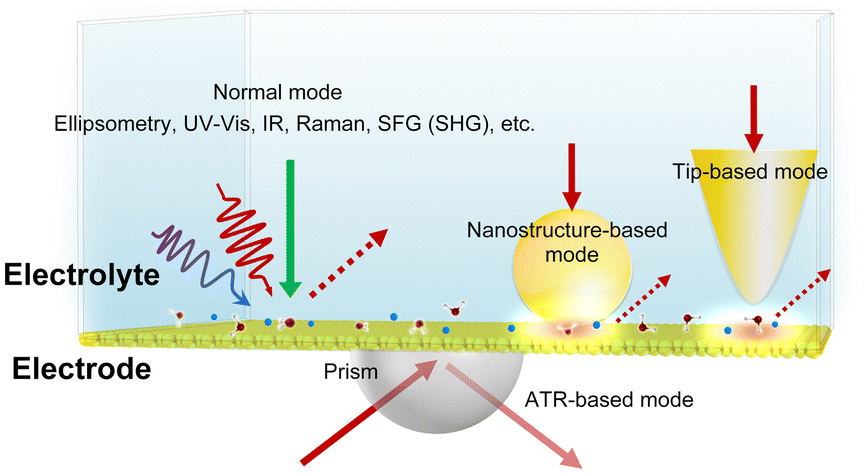
- Sixty years of electrochemical optical spectroscopy: a retrospectiveChao-Yu Li (李超禹, Tongji University) and Zhong-Qun Tian* (田中群, Xiamen University)Chem. Soc. Rev., 2024, 53, 3579-3605This review article is open access, please click the “Read the Original” link at the end of the article, or copy the following link to open the original:https://doi.org/10.1039/D3CS00734K

Chao-Yu Li
Tongji University
Professor in the School of Materials Science and Engineering at Tongji University, obtained a PhD in Physical Chemistry from Xiamen University at the end of 2016, and subsequently conducted postdoctoral research at MIT and Emory University. Joined Tongji University in 2023 and selected for the National High-Level Youth Talent Program. His main research interests include spectroscopic electrochemistry, electrochemical energy storage and conversion, plasmonics, and single-molecule spectroscopy.

Zhong-Qun Tian
Xiamen University
This article’s corresponding author, Professor at the School of Chemical Engineering at Xiamen University. He obtained his bachelor’s degree from Xiamen University in 1982 and pursued his PhD at the University of Southampton from 1983-87 under the supervision of M. Fleischmann, a Fellow of the Royal Society, focusing on electrochemical surface-enhanced Raman spectroscopy (SERS). He has worked at Xiamen University since then. His main research interests include SERS, spectroscopic electrochemistry, plasmonics, nanochemistry, and catalyst assembly. He has received multiple academic awards from the International Society of Electrochemistry (ISE) and several countries, including the 2012 RSC Faraday Medal. He was elected as a member of the Chinese Academy of Sciences and a Fellow of the Royal Society of Chemistry in 2005, and became a Fellow of the International Society of Electrochemistry in 2010 and its president in 2019. He currently serves as the chair of the Royal Society of Chemistry’s China Senior Expert Committee, deputy editor of Chem. Soc. Rev. and Chinese Science: Chemistry, and is on the editorial board of more than ten international journals.
Introduction
The traditional electrochemical research methods that have gradually developed since the 19th century primarily use electrical signals as excitation and detection means to accurately measure the current, potential, and charge at electrochemical interfaces and study the structure and reaction mechanisms of these interfaces. With advancements in electronics technology, electrochemical measurement methods now possess extremely high detection sensitivity, capable of detecting changes at sub-monolayer levels of atoms or molecules. However, traditional electrochemical research methods have their limitations. To accurately identify various substances on the electrode and elucidate the mechanisms of electrochemical reactions, it is imperative to introduce various spectroscopic techniques into modern electrochemical research, providing a significant opportunity for the widespread application of spectroscopic techniques in electrochemical studies.
After sixty years of development, the main framework of electrochemical spectroscopy has been established, evolving from the early proof-of-concept stage to making significant contributions to the field of electrochemistry. Particularly since 2010, operando electrochemical spectroscopy has gained attention for its ability to correlate chemical and structural changes within electrochemical devices in real-time under actual working conditions, becoming a very important application of electrochemical spectroscopy.
This article reviews the historical development of electrochemical spectroscopy (from UV to IR) and categorizes its evolution into four stages, providing detailed introductions to each: the proof-of-concept of electrochemical spectroscopic methods (Stage I), the emergence of plasmonic enhancement-based electrochemical vibrational spectroscopic methods (Stage II), the study of electrochemical vibrational spectroscopies on well-defined surfaces (Stage III), and the development of operando electrochemical vibrational spectroscopies (Stage IV).In the outlook section, the authors point out:
The main development directions of electrochemical spectroscopy will inevitably align with the main research directions in electrochemistry. Currently, electrochemical energy is the primary research area in electrochemistry, thus, it is essential to further develop new research methods and paradigms targeting key scientific and technological issues in electrochemical energy research.
Current electrochemical research faces a strong demand for energy conversion and storage systems, along with challenges posed by complex new systems, all of which impose unprecedented high requirements on the detection sensitivity and spectral resolution of in situ/operando electrochemical spectroscopy. With ongoing development, electrochemical spectroscopy is expected to achieve breakthroughs in several important new fields, such as fiber-based operando spectroscopic studies in real battery systems, characterization under extreme climate/operating conditions (such as high and low temperatures), the use of higher-performance lasers (such as free-electron lasers FEL), and applications in synthetic electrochemistry (one of the top ten emerging technologies in the field of chemistry as recognized by IUPAC in 2023), among others. We can optimistically foresee that the new breakthroughs continuously emerging in electrochemical spectroscopy will not only have an immeasurable impact on electrochemistry but also on the development and progress of surface/interface science and the entire field of material science and technology.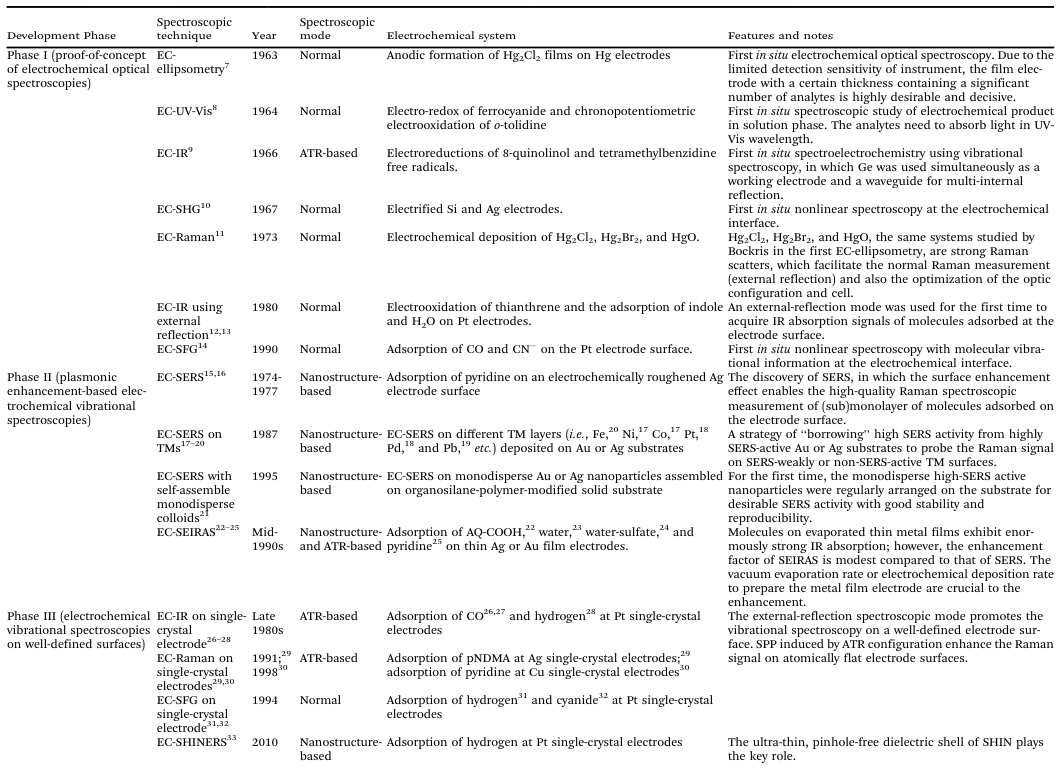
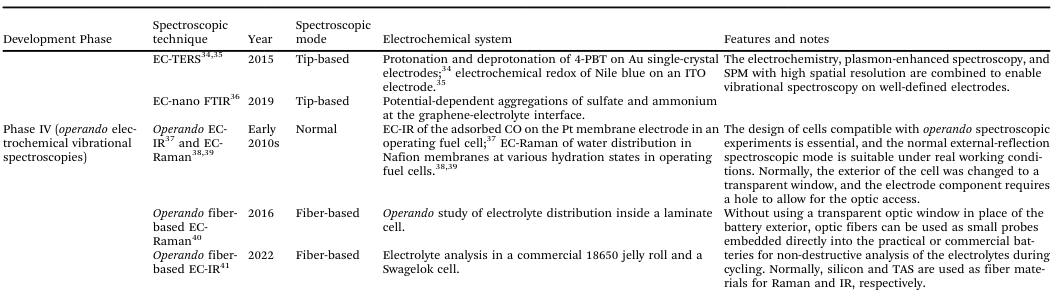
- Table 1. Four stages of development in electrochemical spectroscopy and related key spectroscopic techniques
Review Directory
- Introduction引言
- Four phases of development of electrochemical optical spectroscopy电化学光谱发展的四个阶段
Phase I (proof-of-concept of electrochemical optical spectroscopies)
第一阶段(电化学光谱方法的概念验证)
Phase II (plasmonic enhancement-based electrochemical vibrational spectroscopies)
第二阶段(基于等离激元增强的电化学振动光谱)
Phase III (electrochemical vibrational spectroscopies on well-defined surfaces)
第三阶段(在结构明确的表面上的电化学振动光谱)
Phase IV (operando electrochemical vibrational spectroscopies)
第四阶段(工况电化学振动光谱)
 ▲ Different electrochemical vibrational spectroscopic modes
-
Advances in in situ and operando applications原位和工况电化学光谱应用进展
Electrical double layer
双电层
Electrocatalysis
电催化
Rechargeable batteries
可充电电池
-
Summary and outlook总结与展望
Development trends
发展趋势New strategies, methodologies, and research paradigms新策略、方法和研究范式
Journal Introduction
 The home of high impact reviews from across the chemical sciences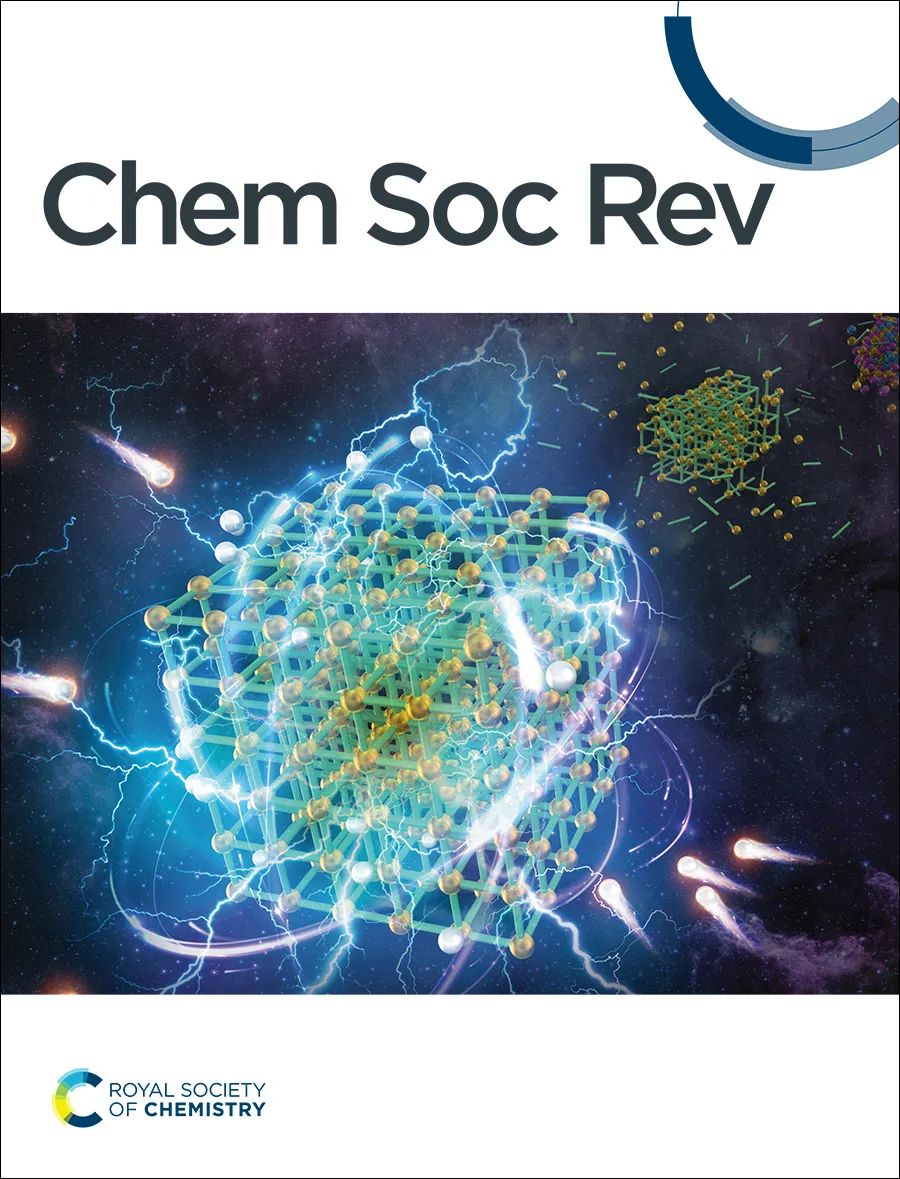
rsc.li/chem-soc-rev
Chem. Soc. Rev.
| 2-Year Impact Factor* | 46.2 points |
| 5-Year Impact Factor* | 51.2 |
| Highest JCR Quartile* | Q1 Chemistry – General |
| CiteScore† | 81.3 points |
| Median Peer Review Time‡ | 44.7 days |
Chem Soc Rev (Chemical Society Reviews) is a leading review journal globally, publishing high-impact, highly readable review papers that represent the forefront of chemical sciences, reflecting the highest quality and strong international influence. The journal particularly encourages cross-national and interdisciplinary collaboration among authors.
Chair
-
Jennifer Love🇨🇦 University of Calgary
Associate editors
|
|
Editorial board members
|
|
* 2022 Journal Citation Reports (Clarivate, 2023)
† CiteScore 2022 by Elsevier
‡ Median, only counting manuscripts that entered peer review


Welcome to contact us for publication reporting📧 [email protected] Click the “Read the Original” link below to view the full paper↓↓↓