
Input Events to State Machine
#include "stdio.h"
#define EXECUTE_VOID(func)  {if((func)!=NULL) (func());}
typedef void(*select_machine_t)(void);
typedef enum _event_index{ event_index_1 = 0, event_index_2, event_index_3, event_index_end} event_index_e;
typedef enum _status_index{ status_index_1 = 0, status_index_2, status_index_end} status_index_e;
void machine_1(void); void machine_2(void); void machine_3(void); void machine_4(void);
select_machine_t select_machine[event_index_end][status_index_end] = { {machine_1, machine_2}, {NULL, machine_3}, {machine_4, NULL}};
void machine_1(void){ printf("machine_1\r\n"); }
void machine_2(void){ printf("machine_2\r\n"); }
void machine_3(void){ printf("machine_3\r\n"); }
void machine_4(void){ printf("machine_4\r\n"); }
int main(void){ EXECUTE_VOID(select_machine[0][1]); } Corresponding:(1) Condition A: status_index_e(2) Condition B: event_index_e
(3) switch:
EXECUTE_VOID(select_machine[0][1]); When an external event occurs (such as a key press), the current real-time state is introduced through a global structure variable (the most common method in C language), directing various state machines based on conditions. The implementation here is through a two-dimensional array where two indices represent two conditions, and the intersection of these two conditions is the specific state machine.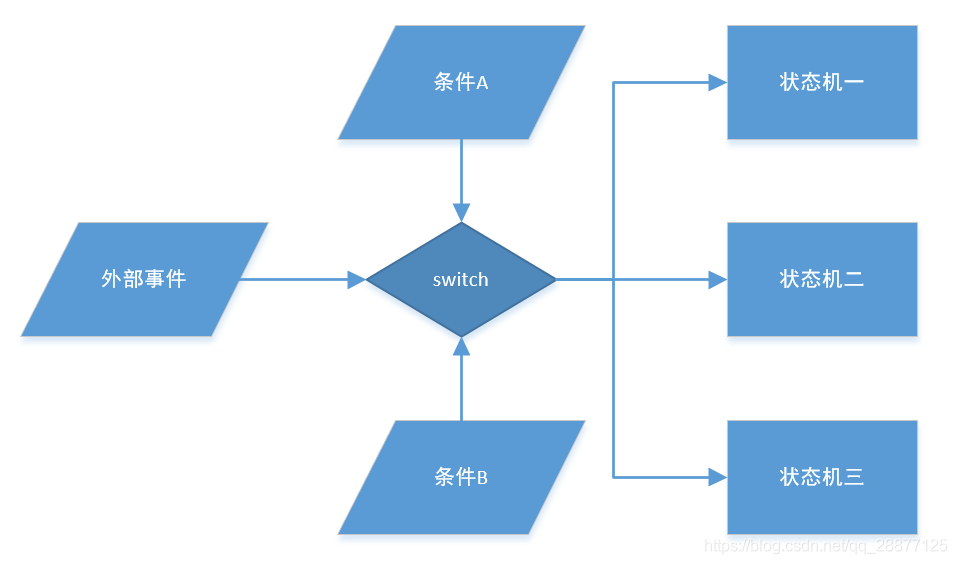
State Machine to Procedural Programming
The above implementation is “Input External Event >>> Directing to >>> State Machine” How to implement “State Machine >>> Execute >>> Specific Operations”? The state machine has a fixed execution flow (of course, there are branches that execute different processes based on conditions), and these processes are very definite execution sequences. Experience during development: it is essential to conduct a precise and complete analysis of all execution flows and list them all. This “listing all” execution flow can be represented in two ways in the program:1. List all execution flows in the form of “empty functions”.2. List all execution flows in the form of “function pointers”: Benefit 1: The software framework can be written out, and the specific logical flow is already prepared. Benefit 2: The specific function interfaces can be left empty (NULL), and once the functions are written, the function names can be assigned to them (sys_api_func* = you_func;). Benefit 3:
Higher generality and stronger logic.
void (sys_api_func1)(void);
void (sys_api_func2)(void);
void (sys_api_func3)(void);
...
void sys_api_init(void){ sys_api_func1 = NULL;   // Not yet implemented, set to NULL
 sys_api_func2 = NULL;
 sys_api_func3 = NULL;
 ...}
// State Machine 1
void machine_1(void){ execute_api_void(sys_api_func1);  // State Machine: Step One
 execute_api_void(sys_api_func2);  // State Machine: Step Two
 ...                               // State Machine: Steps ...}
Source: Internet, copyright belongs to the original author. If there is any infringement, please contact for deletion.
‧‧‧‧‧‧‧‧‧‧‧‧‧‧‧‧ END ‧‧‧‧‧‧‧‧‧‧‧‧‧‧‧Follow my WeChat public account, reply “Planet” to join the knowledge planet, and get answers to your questions.
Click “Read the original text” to view the details of the knowledge planet. Feel free to share, bookmark, like, and view.