FMD’s 32-bit line has two main branches:• Cortex-M0: Low power + high integration, running at 48 MHz is sufficient;• Cortex-M3: Performance + rich peripherals, 72 ~ 120 MHz with USB/CAN.Both lines share the same ultra-deep sub-micron embedded Flash, capable of 2 million erase/write cycles at 125 °C, with register mapping similar to STM32F0/F1, allowing for easy library function migration.
M0 Series: From “Little Powerhouse” to “Versatile Tool”
Overview of All Models
(This article is arranged by Flash/RAM from small to large)Naming conventions are easy to understand at a glance
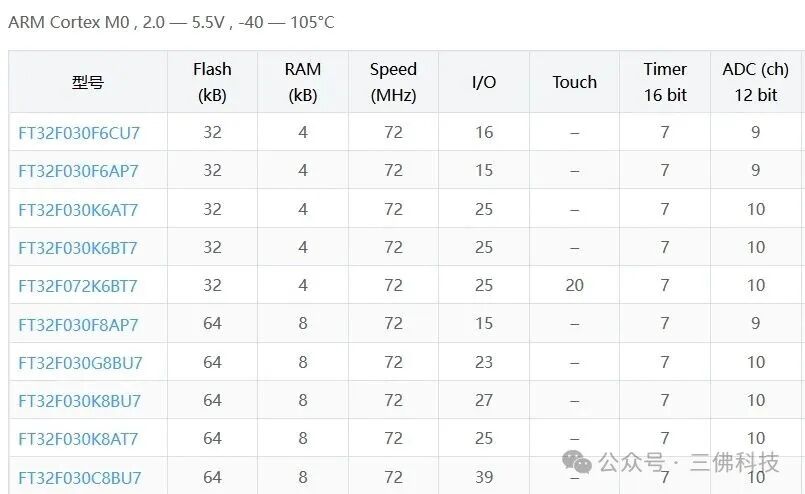
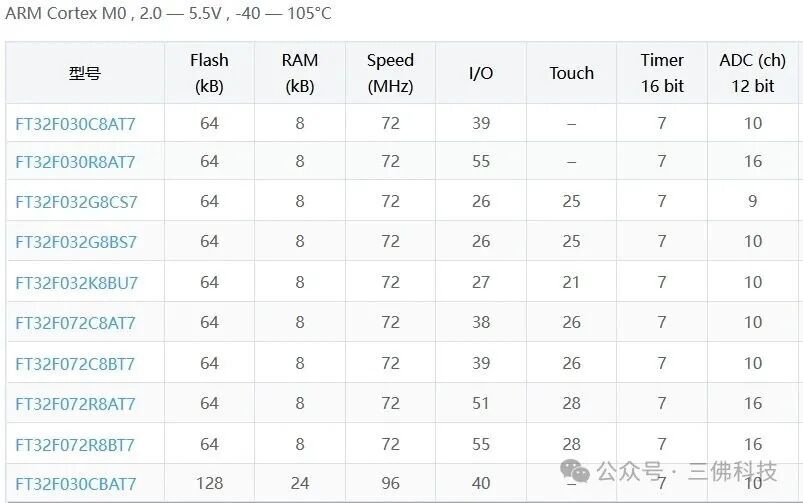
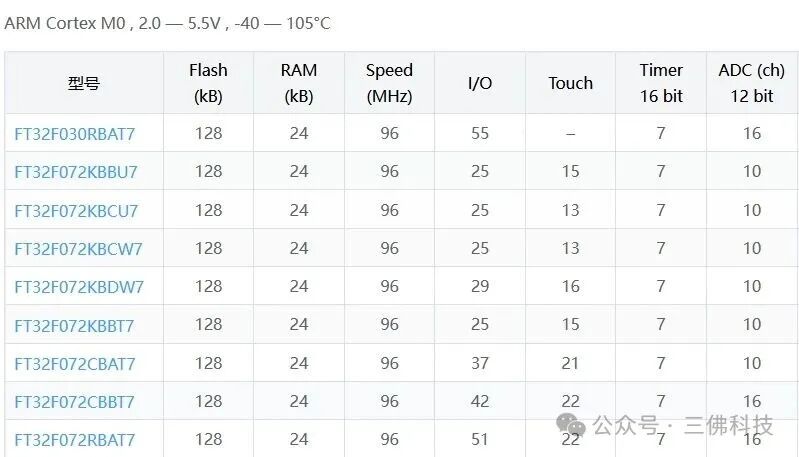
• “G/K/C/R” corresponds to QFN32 / LQFP32 / LQFP48 / LQFP64 packages;• A suffix “T” indicates an integrated Touch engine, which can directly connect to capacitive spring sheets.
Selection Mnemonic in One Sentence
“For small appliances with many buttons → choose T series; pure motor drive → no T is cheaper; if pin count is sufficient, do not choose 64-pin.”
M3 Series: Performance + Connectivity Fully Loaded
Overview of All Models
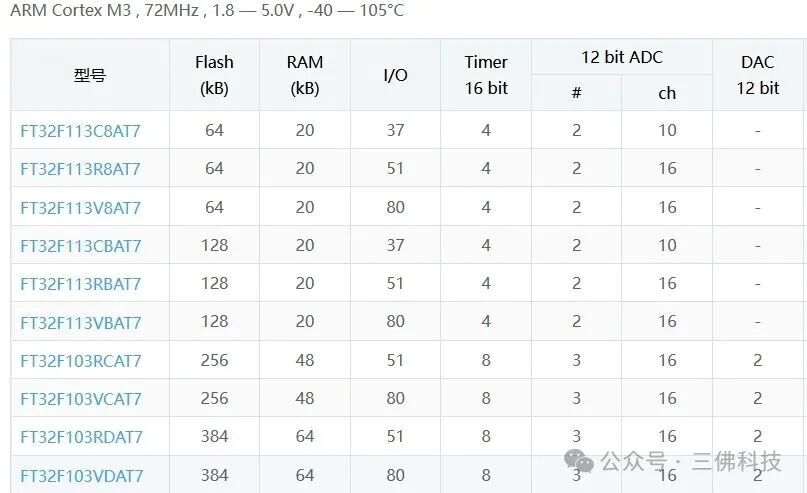
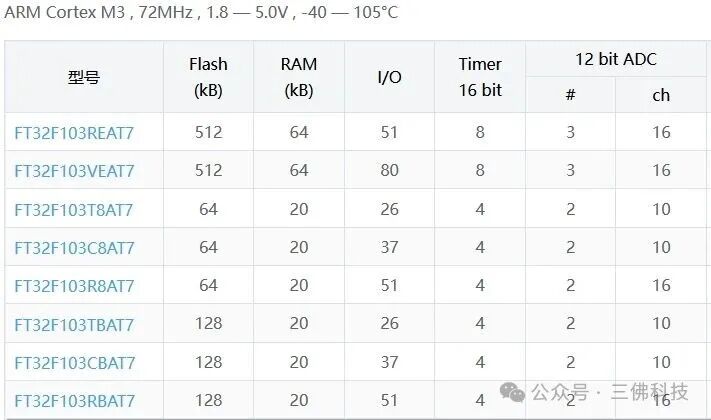
Naming Rules
• “C/R/V” corresponds to 48/64/100 pins;• The entire series includes USB 2.0 FS Device, allowing for plug-and-play HID;• Maximum Flash of 256 KB, capable of running µC/OS-III without difficulty.
M0 vs M3: Understand the Differences at a Glance
| Dimension | M0 Series | M3 Series |
|---|---|---|
| Clock Frequency | 48 MHz | 72 MHz |
| DMIPS | 45 | 90 |
| Flash | 16–64 KB | 16–256 KB |
| RAM | 4–8 KB | 6–48 KB |
| USB | No | All series include |
| Touch | Optional | No |
| Power Supply | 2.0–5.5 V | 2.0–3.6 V |
| Features | Low power, touch | Performance, connectivity |
| Typical Applications | Small appliances, toys | Industrial HMI, USB devices |
Practical Selection Steps
Check power supply: • Direct lithium battery 4.2 V → M0 (tolerates 5.5 V) is the safest choice; • If there is already a 3.3 V LDO on the board, M3 can also be used. Check interfaces: • If USB is needed → go directly for M3; • If 20+ touch channels are required → choose M0-T series. Check packaging: • Space constraints → QFN32 (M0 G series); • Ample pins → LQFP64 (M3 R series).
Minimum System 4-Piece Set (Universal Template)
• 0.1 µF + 4.7 µF decoupling, placed close to VDD/VSS;• 32.768 kHz crystal oscillator (RTC/low-power wake-up);• NRST 10 kΩ pull-up + 0.1 µF pull-down (for easy plug-and-play debugging);• SWDIO/SWCLK leave 2×2.54 pin headers, FMD-Link for easy programming.
Summary in One Sentence
• Tight budget, many touch inputs, direct battery supply — blindly choose M0;• Need USB, RAM, and computing power — go straight for M3.Keep this table handy, so you won’t have to flip through 100 pages of datasheets next time you select a model.