
Once upon a time, there were jokes about forgetting how to drive a manual transmission vehicle; perhaps in the not-so-distant future, we will hear similar remarks: I wouldn’t dare touch a car without ADAS.
Almost every driver and passenger can feel the tremendous changes that have occurred in automobiles in recent years, from the once-optional rear parking sensors to the central control screens that allow for a comprehensive view of the vehicle’s position. From side parking that blocks community traffic to automatic parking that fits in one go. From monochrome LCD radios and CDs to the new entertainment facilities that one wishes to engage with after parking. Among these changes, none have evolved faster than Chinese automobiles, with domestic electric vehicles already being defined as the “new three items” in international trade.

Domestic cars are achieving a comprehensive leap in user experience, becoming easier to drive, safer, and more affordable. This transformation is supported by advancements in vehicle electrification, networking, and intelligence. Recently, Qualcomm’s latest technical white paper, “Snapdragon Ride: Solutions to Promote ADAS Adoption Among Chinese Automakers and Consumers,” revealed two key data points:
Over 20 automakers have announced the launch or are developing models with ADAS features based on the Snapdragon Ride platform. This includes global automakers such as BMW Group, General Motors, Renault Group, Stellantis Group, and Volkswagen Group (including its subsidiary CARIAD), as well as several Chinese automakers like BAIC Group, Beijing Hyundai, Chery, FAW Group, Leap Motor, SAIC General, and SAIC Volkswagen. The Snapdragon Ride platform will play a key role in shaping the future of mobility.
With its cutting-edge technology and chip products, Qualcomm is driving automotive innovation globally and has become the leading supplier of system-on-chip solutions in the cockpit, vehicle communication, and cockpit-vehicle integration fields. This advanced position makes Qualcomm the preferred partner for Chinese automakers, helping them create smarter and safer vehicles for the local market, ranging from flagship models to mainstream models priced between 80,000 to 100,000 yuan.
Let’s explore how Chinese cars are becoming easier to drive, more affordable, and safer through this white paper.
Easy to Drive:
Six Eyes, Voice Interaction
As tech-savvy consumers in China, accustomed to using AI assistants, smart homes, and mobile devices, they also desire the convenience of high-tech features in traditional automotive domains. This shift in consumer preference is driving automakers to fully integrate ADAS technology into their overall user experience. As one of the fastest-growing automotive technology markets, it is expected that by 2035, the penetration rate of L2 to L3 level driving assistance features in new cars will exceed 50%.
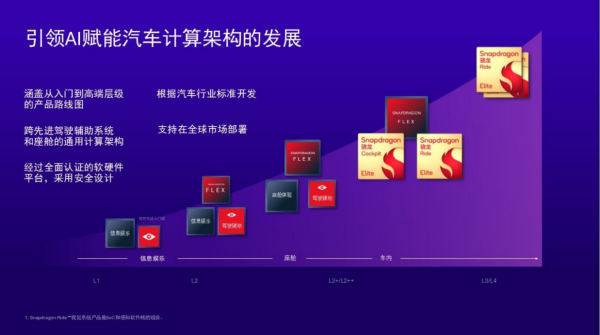
Snapdragon Ride, as an advanced platform for ADAS within the Snapdragon digital chassis, integrates high-performance computing, artificial intelligence, and sensor technology, supporting multiple levels of driving assistance.
The powerful heterogeneous computing capabilities provide performance assurance for enhancing the vehicle’s external perception capabilities. A display system capable of providing a comprehensive view of the vehicle’s position naturally requires multiple cameras and radars as the vehicle’s eyes, while the computation of visual and signal data requires compliant CPUs, GPUs, NPUs, and hardware accelerators. Snapdragon Ride supports multi-modal inputs, such as 11 cameras and 7 radars, optimized for L2 and above ADAS applications. Additionally, it employs a scalable underlying perception architecture with multiple cameras and radars, optimized for system-on-chip applications. The premium version of the Snapdragon Ride platform can support over 40 multi-modal sensors, including cameras, radars, LiDAR, and ultrasonic sensors, and can run large visual language models and end-to-end transformer networks based on specific use cases.
A large amount of sensor data can also be integrated with AI. The Snapdragon Ride platform utilizes AI for scene-based adjustments, real-time adjustments of speed, braking, and steering to respond to potential dangers, thereby enhancing driver confidence. Advanced algorithms help vehicles interact with the environment through precise control and path planning, making driving easier.
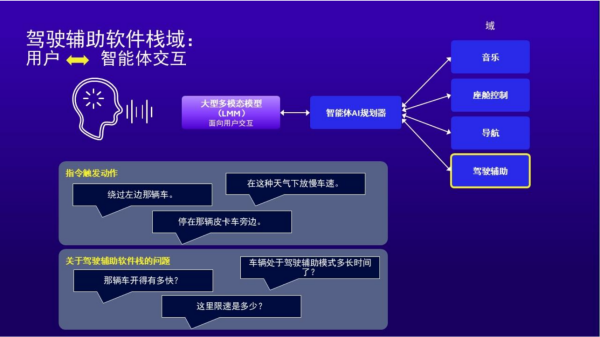
In line with the future logic that “AI is becoming the new UI,” generative AI can also enable cars to interact dynamically with drivers through natural language processing and voice generation, providing guidance and reminders in a conversational manner, and adjusting based on driver behavior and preferences.
For example, users can directly express commands like “Park next to that pickup truck” or “How long has the vehicle been in assisted driving mode?” These commands or questions are not simple orders but contain complex language with situational understanding and driving intent, allowing the intelligent agent to coordinate multiple systems within the vehicle and ultimately make intelligent decisions.
Behind the upgrade in driving experience, savvy consumers also expect vehicles to be as affordable as domestic flagship smartphones, offering strong performance and the best experience while maintaining a “persuasive price after overnight discussions with executives.”
Affordable:
Better Costs, Faster Innovation
Just as Snapdragon has lowered the R&D barriers and costs for OEM manufacturers in the smartphone sector, shortening time-to-market while allowing them to leverage their technological capabilities in their areas of innovation, the Snapdragon digital chassis provides a complete set of system-on-chip, software, tools, and connectivity services to help local automakers develop smarter and safer vehicles. These solutions help customers seamlessly integrate advanced ADAS features, shorten development cycles, and accelerate time to market.
The Snapdragon Ride platform, as part of the Snapdragon digital chassis, incorporates ASIL D-level microcontrollers within the system-on-chip, reducing costs while maintaining high safety standards.
Snapdragon Ride Flex not only integrates cockpit infotainment and ADAS functions into a centralized computing architecture driven by a single SoC but also offers excellent cost-effectiveness by replacing high-power, resource-intensive peripherals and components, effectively reducing the overall bill of materials and providing more energy-efficient solutions.
The Qualcomm ADAS white paper specifically states that Chinese automakers need solutions that balance cost-effectiveness with rapid development cycles. Snapdragon Ride Flex is designed to meet this demand, helping automakers quickly introduce innovative technologies and maintain a competitive edge in a rapidly changing market landscape. Additionally, with a complete set of advanced tools and resources, automakers can quickly commercialize new solutions, significantly reducing the product launch cycle from years to months.
Mapless ADAS features can better cope with the high-density and complex urban road conditions in China, relying on the “mapless” capability that does not depend on high-definition maps to handle complex urban driving scenarios, allowing automakers and tier-one suppliers to avoid long-term binding contracts for map updates with other ADAS suppliers throughout the vehicle lifecycle.
In terms of implementing generative AI capabilities, Qualcomm’s AI engine Direct SDK toolchain supports mainstream frameworks, focusing on efficiency, and helps developers easily create advanced neural network applications. Meanwhile, the Snapdragon Ride platform also provides real data and simulation testing tools to build a controllable testing environment, supporting rigorous testing, validation, and iterative optimization. Integration and deployment tools also simplify the process of merging new systems with existing automotive technologies, supporting key communication protocols such as CAN, LIN, and Ethernet.

The realization of rich functionalities is also attributed to the powerful and synergistic ecosystem of the Snapdragon Ride platform. This ecosystem brings together multiple partners, including Zhaoyu Technology, Momenta, Yuanrong Qixing, Desay SV, Coboda, Cheliantianxia, Changxing Zhijia, and Hangsheng. The expertise and solutions of these partners further expand the capabilities of Snapdragon Ride, enhancing abilities such as object detection, pedestrian recognition, real-time decision-making, and enabling information exchange through standard APIs with AI agents, supporting functions including highway and urban navigation assistance, parking assistance, and compliance management.
Safety:
World Standards, Comprehensive Protection
Although some have compared the electronic iteration of automobiles to equipping a smartphone with four wheels, unlike consumer electronics, the primary focus is not on performance scores or entertainment but on safety. ADAS (Advanced Driver Assistance Systems) inherently aims to enhance safety through an integrated automotive electronic system that incorporates multiple safety features to reduce traffic accidents caused by human error. The Snapdragon Ride platform, as an open and scalable platform for ADAS, adheres to world-class standards, making this system safer and more reliable.
The Snapdragon Ride platform includes a globally validated safety stack, serving as a “safety barrier.” This design complies with global standards and differentiates itself from other ADAS solutions, reducing deployment risks and addressing scalability challenges across regions. It is reported that Chinese automakers can rely on the high quality and reliable safety features of this global ADAS solution, combined with locally developed driving strategy software stacks, to meet the development needs and pace of China.

Since 2016, the Snapdragon Ride platform has been validated in over 60 countries and regions worldwide and continues to undergo research and optimization. With extensive experience, the platform has collected over 6 million kilometers of vehicle and traffic data, generating synthetic data covering diverse scenarios and edge cases, with a total test mileage exceeding 482 million kilometers (300 million miles). The platform also employs fifth-generation visual perception and high-performance software-defined controllers to ensure stable system operation and reliable performance.
In terms of safety, the Snapdragon Ride platform features several advanced enhanced safety characteristics, including redundancy and fault-tolerant mechanisms, real-time monitoring and diagnostic capabilities, secure boot processes, and secure firmware updates. For instance, safety redundancy and fault protection mechanisms ensure normal system operation under critical conditions, while monitoring and diagnostic functions support the system in timely detecting and addressing anomalies. Additionally, secure boot processes and secure firmware update mechanisms strengthen cybersecurity measures. The white paper states that these features are specifically designed to comply with international safety standards such as ISO 26262 and IEC61508, which are of significant importance to the Chinese automotive ecosystem.
The Snapdragon Ride platform also enhances safety assurance through encrypted communication, secure data processing, and robust threat detection. It employs a multi-layered security architecture, including hardware-based isolation, encryption technologies, and regular software updates to mitigate risks and enhance system integrity.
Moreover, with the assistance of generative AI, it can predict unsafe operations. By combining with large visual models, it can predict potential unsafe actions such as sudden lane changes or emergency braking based on historical behavior patterns, allowing ADAS to anticipate and take proactive measures to reduce risks.
The integration of ADAS and cockpit domains can also bring new possibilities for enhancing safety through AI. During long-distance driving, generative AI can create personalized content, such as audiobooks or music playlists. This content not only aligns with the driver’s preferences but can also be adjusted based on the driver’s attention state to help maintain focus and alertness.
At the same time, the intelligent interaction capabilities brought by generative AI reveal the technical answers to why domestic cars are becoming increasingly easier to drive.
By thoroughly reading Qualcomm’s ADAS white paper, it is evident that behind the transformation of Chinese cars into being easier to drive, more affordable, and safer, the Snapdragon Ride platform is leveraging cutting-edge technology and responding to the unique needs of the Chinese ecosystem to provide attractive solutions for automakers and consumers, leading the revolution in smart vehicles in China.
