Exciting! In-Depth Analysis of the GSV1127E Chip: A Multi-Interface HD Conversion Marvel Empowering Automotive and Audio-Video New Scenarios
In today’s digital wave sweeping across various industries, the demand for high-definition interface conversion is surging, especially in automotive electronics and video conferencing, where stability, efficiency, and integration of multi-format signal conversion are increasingly required. The GSV1127E chip launched by GSHL Microelectronics, with its powerful multi-interface conversion capabilities, rich functional configuration, and excellent performance, has become an ideal solution to meet these demands. Today, we will delve into the core highlights and practical value of this chip.
1. Core Positioning of the Chip: A One-Stop Multi-Interface Conversion Solution
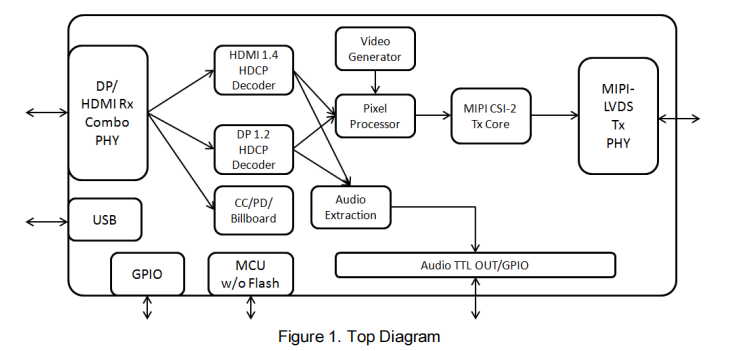
The GSV1127E is a high-performance, low-power signal conversion chip focused on converting signals from Type-C/DisplayPort 1.2/HDMI 1.4 to MIPI CSI-2/LVDS, while also integrating audio extraction functionality and an embedded MCU, providing users with a cost-effective and rapid market entry solution. It adopts a QFN76 package, and due to its compact size, it meets the needs of miniaturized devices in automotive electronics and video conferencing scenarios, and it has passed automotive-grade certification processes, ensuring excellent environmental adaptability.
2. Hardcore Performance Parameters: Stable and Efficient, Adapting to Multi-Scenario Needs
1. Interface Speed and Compatibility Maximized
- The DisplayPort receiver supports rates up to 21.6Gbps (HBR2, 4 channels), compatible with various modes such as HBR and RBR, flexibly supporting 1/2/4 channel main link configurations;
- The HDMI receiver can achieve rates of up to 9Gbps (TMDS, 3G/3 channels), compliant with HDMI 1.4b standards, suitable for mainstream HD video transmission needs;
- Integrated USB Type-C alternate mode receiver, compatible with USB Type-C 1.1/1.0 and USB PD 3.0 specifications, supporting Billboard USB 2.0 functionality, easily achieving multi-protocol adaptation for Type-C interfaces.
2. Flexible and Powerful Video Processing Capabilities
With a built-in pixel processor, it supports color space conversion, 420-444/422 format conversion, deinterlacing, and downscaling functions, automatically adapting to the bandwidth capabilities of downstream devices. When the video stream bandwidth exceeds the downstream capacity, it automatically adapts through downscaling. It also supports HDR and dynamic/static metadata, as well as various 3D formats, meeting the diverse needs of HD video playback.
3. Comprehensive Audio Extraction Functionality
Supports audio extraction from DisplayPort/HDMI/Type-C interfaces, compatible with various audio formats such as I2S, SPDIF, HBR, DSD, and TDM, with a sampling frequency range of 32KHz-768KHz. It can automatically detect and mute fill zero sample data in LPCM channels, ensuring audio output quality.
4. Excellent Environmental Adaptability and Reliability
Operating temperature range covers -40℃ to 85℃, with a maximum junction temperature of 125℃. The Type-C interface pins have 8kV HBM electrostatic protection capability, meeting the stability requirements for operation in harsh environments such as automotive electronics. Power consumption performance is excellent; for example, at a resolution of 4K@30Hz, in DP-4 channel 1.62Gbps mode, power consumption across various domains is kept at a low level, balancing high performance with low power consumption.
3. Core Functional Highlights: More Than Just Conversion, Understanding Scene Needs
1. Dual-Core Application Modes, Precisely Matching Different Scenarios
- Type-C Alt-Mode Input to MIPI Output: Configures the Type-C interface as a DisplayPort 1.2 input, converting it to MIPI signal output through internal processing, and can also switch to LVDS output (supporting up to 4K30 timing), suitable for front-end interconnection scenarios from Type-C to SoC MIPI panels;
- HDMI Input to MIPI Output: After HDMI 1.4 signal input, it processes through color space conversion, deinterlacing, etc., converting to MIPI compatible output timing, also supporting LVDS output switching, meeting the connection needs between HDMI devices and MIPI panels.
2. Embedded MCU and System Control Functionality
The built-in MCU supports external MCU mode, allowing external control via the I2C interface, and with external Flash, it can achieve customized functional development; it integrates a PD 3.0 controller, which, in conjunction with an external PMIC, can charge external devices through the Type-C interface, expanding device power supply capabilities; it is equipped with a temperature sensor monitoring circuit and Mailbox functionality, facilitating external MCU access to chip operating status, enhancing system controllability.
3. Rich Pin Configuration and Expansion Capabilities
The QFN76 package provides diverse pin functionalities, supporting control interfaces such as UART/Timer/GPIO, with some pins being reusable as GPIO for expansion control. For example, GPIO can be multiplexed through MIPI-B or AUD1/AUD2 buses to achieve precise control over external PMIC, Vconn, and Vbus, meeting the needs for customized device development.
4. Key Electrical and Packaging Information: Facilitating Rapid Integration Development
1. Electrical Characteristics and Timing Specifications
Power supply supports multiple voltage domains, with the recommended voltage for digital power DVDD12 being 1.2V (1.12V-1.26V), and the recommended voltage for IO power VDDIO/VDD33 being 3.3V (3.0V-3.6V); the maximum frequency for the I2C bus is 400KHz, and the SPI bus frequency ranges from 12.5MHz to 25MHz, complying with mainstream control interface timing standards, facilitating compatibility with external devices.
2. Packaging and Ordering Information
Utilizing a QFN76 package, the compact packaging size is suitable for high-density PCB layouts; the ordering model is GSV1127E, with a temperature range covering -40℃ to 85℃, packaged in trays to meet mass production needs.
5. Applicable Scenarios and Value Realization
With its multi-interface conversion capabilities, automotive-grade reliability, and flexible functional configuration, the GSV1127E is widely applicable in two core scenarios:
- Automotive Electronics: Adapting to in-vehicle display systems, in-car entertainment devices, etc., achieving stable conversion and transmission of high-definition signals across different interfaces, meeting the stringent requirements of automotive environments;
- Video Conferencing Equipment: Supporting connections between conference terminals and various display devices, achieving efficient processing and transmission of HD audio and video signals, enhancing the conference experience.
Compared to similar products, the GSV1127E reduces the need for external components through integrated design, lowering system costs, while the embedded MCU and flexible pin configuration accelerate product customization development, helping enterprises shorten time-to-market and enhance market competitiveness.
6. Version Iteration and Disclaimer
The chip specification is currently at version v0.5, having undergone multiple iterations and optimizations, including updates to I2C/SPI timing information, expansion of the 1.2V power supply range, and addition of VESA LVDS pin descriptions, continuously enhancing product usability and accuracy. It should be noted that relevant technical materials are provided “as is”; GSHL Microelectronics does not guarantee the absolute accuracy and completeness of the materials, and users should verify and test based on actual application scenarios.
The GSV1127E chip, with its comprehensive interface compatibility, powerful audio and video processing capabilities, and excellent environmental adaptability, provides an efficient and reliable solution for high-definition signal conversion. Whether in automotive electronics or video conferencing scenarios, it can leverage its customization capabilities and cost-effectiveness to drive product innovation and upgrades.