Lib: flair
Sentiment Analysis (SA), also known as Opinion Mining (OM), is a core task in the field of artificial intelligence. Current mainstream sentiment analysis methods can be divided into three categories: rule-based methods (VADER (GitHub 4.6k stars): a sentiment analysis tool based on dictionaries and rules; Content Analysis | LIWC2015 Dictionary-Chinese: quantifying text sentiment and psychological characteristics), transformer-based models (Python Sentiment Analysis | Practical Zero-Shot Learning Model Based on BART-large-MNLI), and methods based on large language models (LLMs-based approaches).
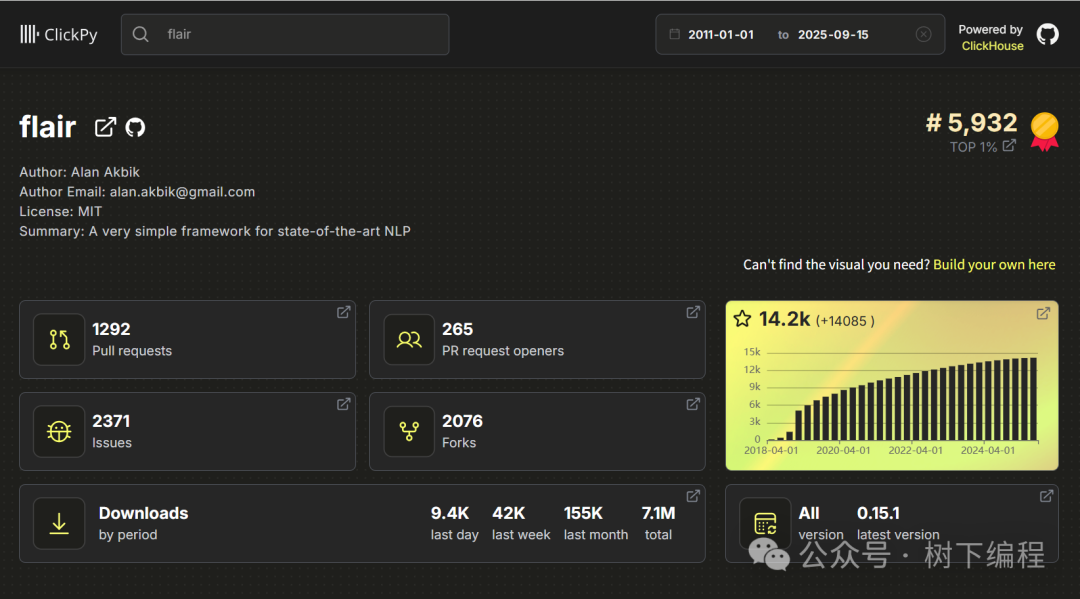
Today, the author will introduce the usage of a cutting-edge Python sentiment analysis tool, flair (Bredice et al., 2025), which ranks in the top 1% of Python libraries globally, with a daily download rate of up to 9.4k (as shown in the figure below). The tool addresses two major pain points: the inability to customize the download and loading model path, and the dependency on accessing Hugging Face’s base models. With this tool, true offline operation for English sentiment analysis can be achieved, ensuring business data security while enabling an efficient and autonomous analysis process.
To learn more about natural language processing knowledge and practical skills in Python, feel free to follow “Programming Under the Tree”, thank you for your support and sharing
 .
.
Bredice, M., Formisano, A. V., Kullafi, S., & Palma, P. (2025). Access to credit and fintech: A lexicon-based sentiment analysis application on Twitter data. Research in International Business and Finance, 77, 102875. https://doi.org/10.1016/j.ribaf.2025.102875
https://pypi.org/project/flair/
1. Sentiment Analysis Based on Flair
The following uses Python to call the sentiment analysis model (sentiment-en-mix-distillbert_4.pt, download link: https://nlp.informatik.hu-berlin.de/resources/models/sentiment-curated-distilbert/sentiment-en-mix-distillbert_4.pt) to perform sentiment analysis on the given English text.
# -*- coding: utf-8 -*-
"""
Created on Mon Sep 15 16:43:23 2025

@author: Petercusin
"""

# pip install flair
from flair.models import TextClassifier
from flair.data import Sentence

# Define your local model path
model_path = r"D:\Software\flair-models\sentiment-en-mix-distillbert_4.pt"

# Load the model from the local path
classifier = TextClassifier.load(model_path)

# Use the model for prediction
sentence = Sentence('The food was great!')
classifier.predict(sentence)

# Print sentence with predicted labels
print('Sentence above is: ', sentence.labels)

 Running result:
In [2]:%runfile 'D:/Users/PgsFile/Python_Flair情感分析2.py'--wdir
Sentence above is:['Sentence[5]: "The food was great!"'/'POSITIVE'(0.9961)]
According to the official introduction, flair provides a transformer-based models method for sentiment analysis. We look forward to more text testing and evaluation, and welcome comments for discussion
 .
.
Our standard sentiment analysis model uses distilBERT embeddings and was trained over a mix of corpora, notably the Amazon review corpus, and can thus handle a variety of domains and language.
https://flairnlp.github.io/docs/tutorial-basics/tagging-sentiment