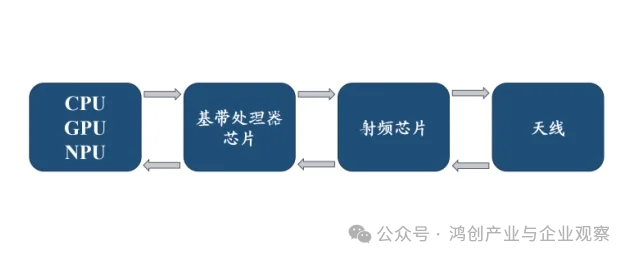
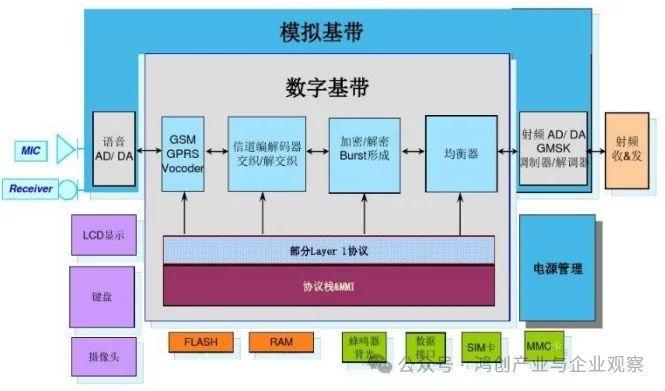
🟠A baseband chip is an important device that connects the central processing unit (CPU) and the radio frequency (RF) chip, responsible for processing information. After processing by the CPU, the information is modulated into a digital signal by the baseband chip, then transmitted through the RF chip, and finally emitted by the antenna. The signals captured by the antenna are first processed by the RF chip and then transmitted to the baseband chip for conversion into digital signals and demodulation, ultimately processed by the CPU. Baseband chips are specifically designed to handle baseband signals and are the core of various terminals and devices for implementing cellular mobile communication. Their performance directly affects the quality of phone calls, data transmission speed, and network connectivity. 🟢The baseband chip mainly consists of a CPU processor, channel encoder, digital signal processor, modem, and interface module. The CPU processor is responsible for controlling and managing tasks; the channel encoder performs channel coding and encryption of service and control information; the digital signal processor is responsible for signal equalization and voice encoding/decoding; the modem converts digital signals into baseband signals; the interface module includes analog interfaces, digital interfaces, and human-machine interfaces.
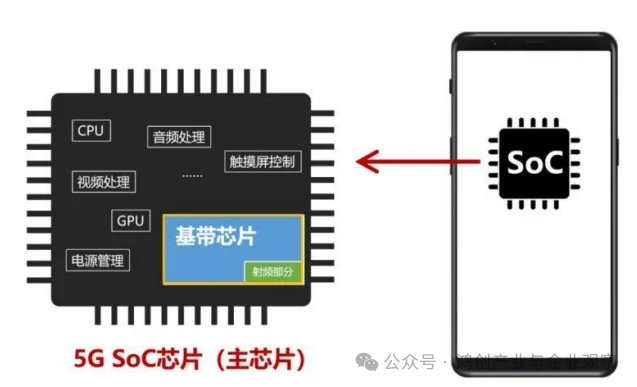
 🔴Currently, mainstream baseband chips mainly come in two forms: integrated (SoC) and discrete (Fusion). (1) Integrated: The baseband chip (BP) is integrated with the processor (AP) on the same chip, which can reduce chip area and power consumption, and bundling with the AP can enhance chip value. (2) Discrete: The baseband chip (BP) and processor (AP) are independently packaged as two chips, with the baseband chip in a discrete form. Integrated solutions significantly outperform discrete ones in power consumption control and signal stability. Temporary discrete solutions often arise during communication standard upgrades and new technology iterations. With the improvement of 5G communication technology, integrated baseband solutions remain the main trend in technological development.
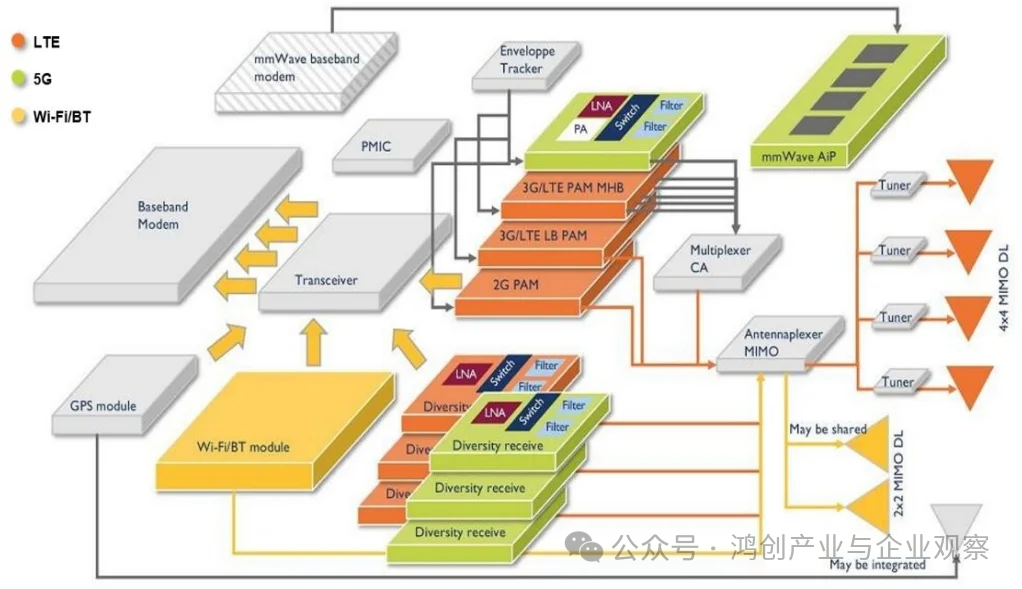
 🔵The core barriers of baseband chips are high, and communication protocols have exploded in growth with technological iterations, from early 2G/3G to 4G/5G. Each generation of communication protocols introduces entirely new technical standards, with different channel structures, modulation coding methods, and link control mechanisms. They must also maintain long-term backward compatibility with various standards while supporting multi-mode, multi-band, and carrier aggregation to ensure the normal operation of billions of existing terminal devices globally, further increasing architectural complexity. The design must also ensure the robustness and compatibility of massive codebases exceeding tens of millions, overcoming the design complexity brought by full compatibility across dozens of frequency bands. Successful passage of testing and certification by hundreds of global operators is required, along with meeting the extreme demands of mobile terminals for power consumption, area, and integration. Leading manufacturers establish technological authority through protocol-setting dominance, large patent portfolios, and product stability, and terminal manufacturers tend to prefer market-validated solutions.
 🟣Important technologies in baseband chip design include: (1) All-standard cellular baseband chip technology; (2) Ultra-low power SoC chip design technology; (3) Baseband RF integration technology; (4) Ultra-large-scale mixed-signal chip design technology; (5) High-performance ISP design technology and graphics processing and display technology; (6) Dynamic reconfigurable neural network technology engine NPU design technology, etc.
 Reference materials: Dongwu Securities, etc.