C++ Computer Syntax
C++ is a high-level programming language widely used in computer programming, and its syntax covers various aspects from basic elements to complex programming structures. Below is a systematic overview of C++ syntax:
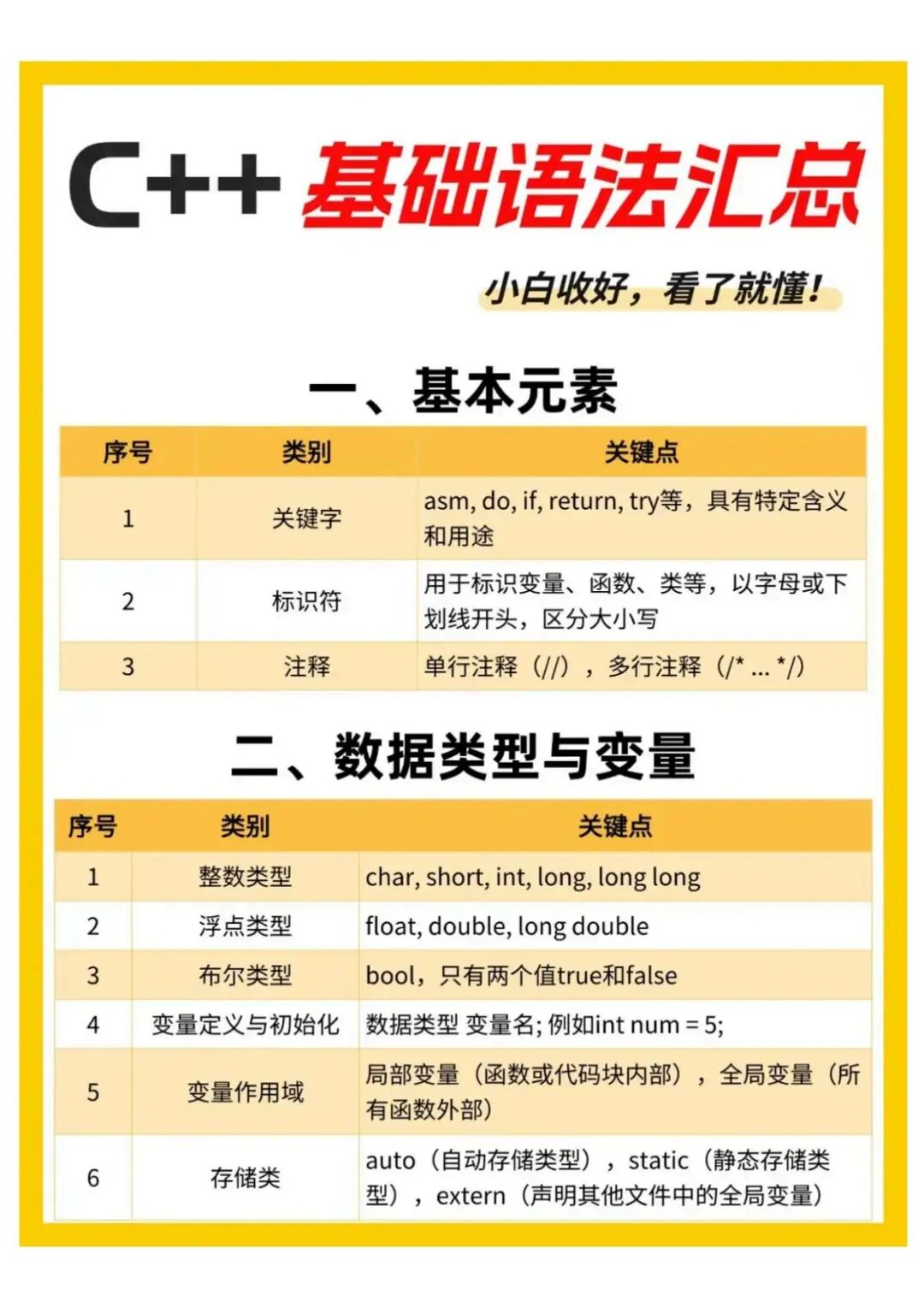
1. Basic Elements
- Keywords: such as
<span>asm</span>,<span>do</span>,<span>if</span>,<span>return</span>,<span>try</span>, etc., which have specific meanings and uses. - Identifiers: used to identify variables, functions, classes, etc., starting with a letter or underscore, and are case-sensitive.
- Comments: single-line comments
<span>//</span>, multi-line comments<span>/*...*/</span>.
2. Data Types and Variables
- Data Types:
- Integer Types:
<span>char</span>,<span>short</span>,<span>int</span>,<span>long</span>,<span>long long</span>. - Floating Point Types:
<span>float</span>,<span>double</span>,<span>long double</span>. - Boolean Type:
<span>bool</span>, with values<span>true</span>or<span>false</span>.
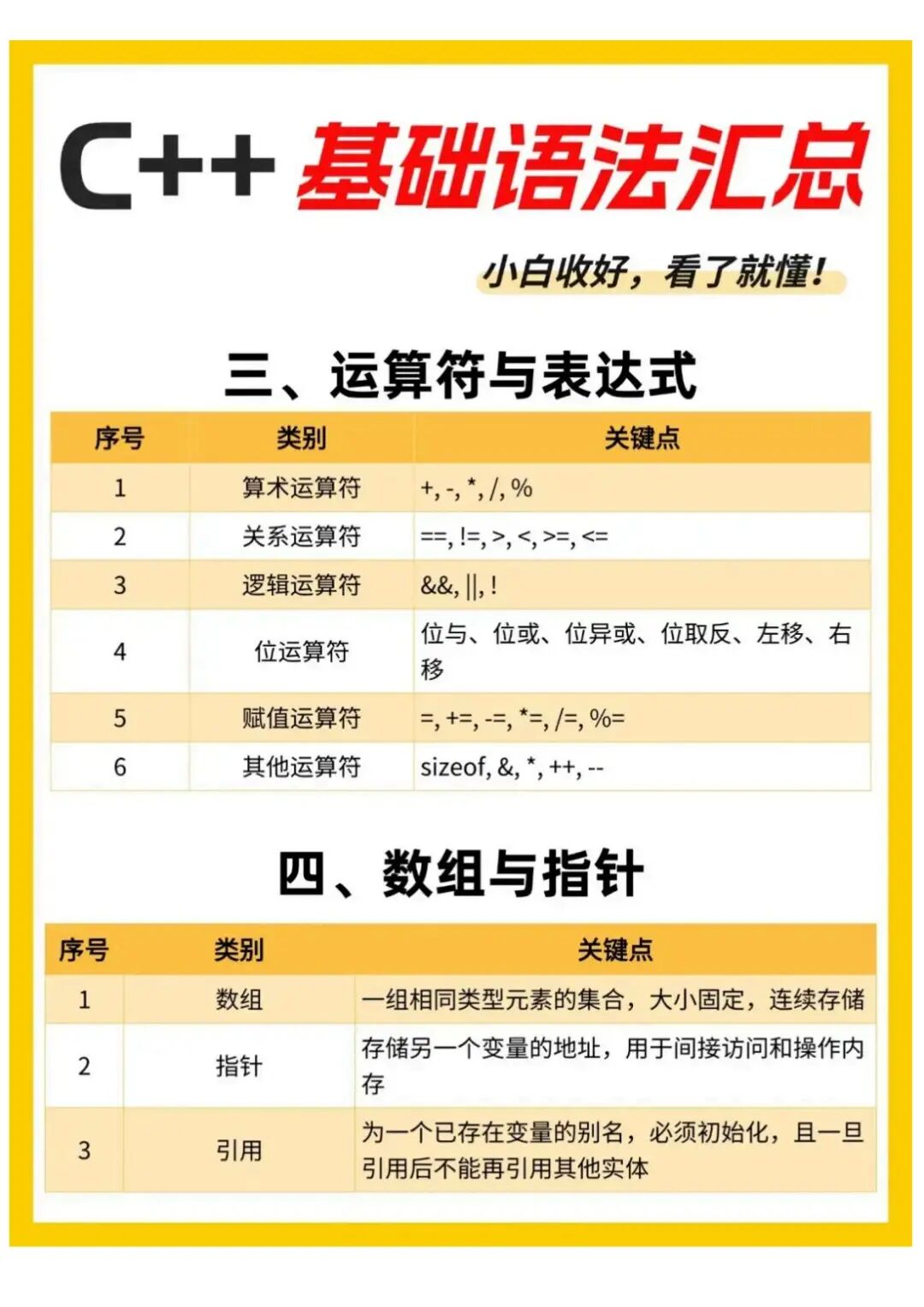
<span>data_type variable_name;</span>, for example, <span>int num = 5;</span>.<span>auto</span> (automatic storage type), <span>static</span> (static storage type), <span>extern</span> (declares global variables in other files).3. Operators and Expressions
- Arithmetic Operators:
<span>+</span>,<span>-</span>,<span>*</span>,<span>/</span>,<span>%</span>. - Relational Operators:
<span>==</span>,<span>!=</span>,<span>></span>,<span><</span>,<span>>=</span>,<span><=</span>. - Logical Operators:
<span>&&</span>,<span>||</span>,<span>!</span>. - Bitwise Operators: bitwise AND, bitwise OR, bitwise XOR, bitwise NOT, left shift, right shift.
- Assignment Operators:
<span>=</span>,<span>+=</span>,<span>-=</span>,<span>*=</span>,<span>/=</span>,<span>%=</span>. - Other Operators:
<span>sizeof</span>,<span>&</span>,<span>*</span>,<span>++</span>,<span>--</span>.
4. Arrays and Pointers
- Arrays: a collection of elements of the same type, with a fixed size and contiguous storage.
- Pointers: store the address of another variable, used for indirect access and manipulation of memory.
- References: an alias for an existing variable, must be initialized, and cannot be changed to reference another entity once set.
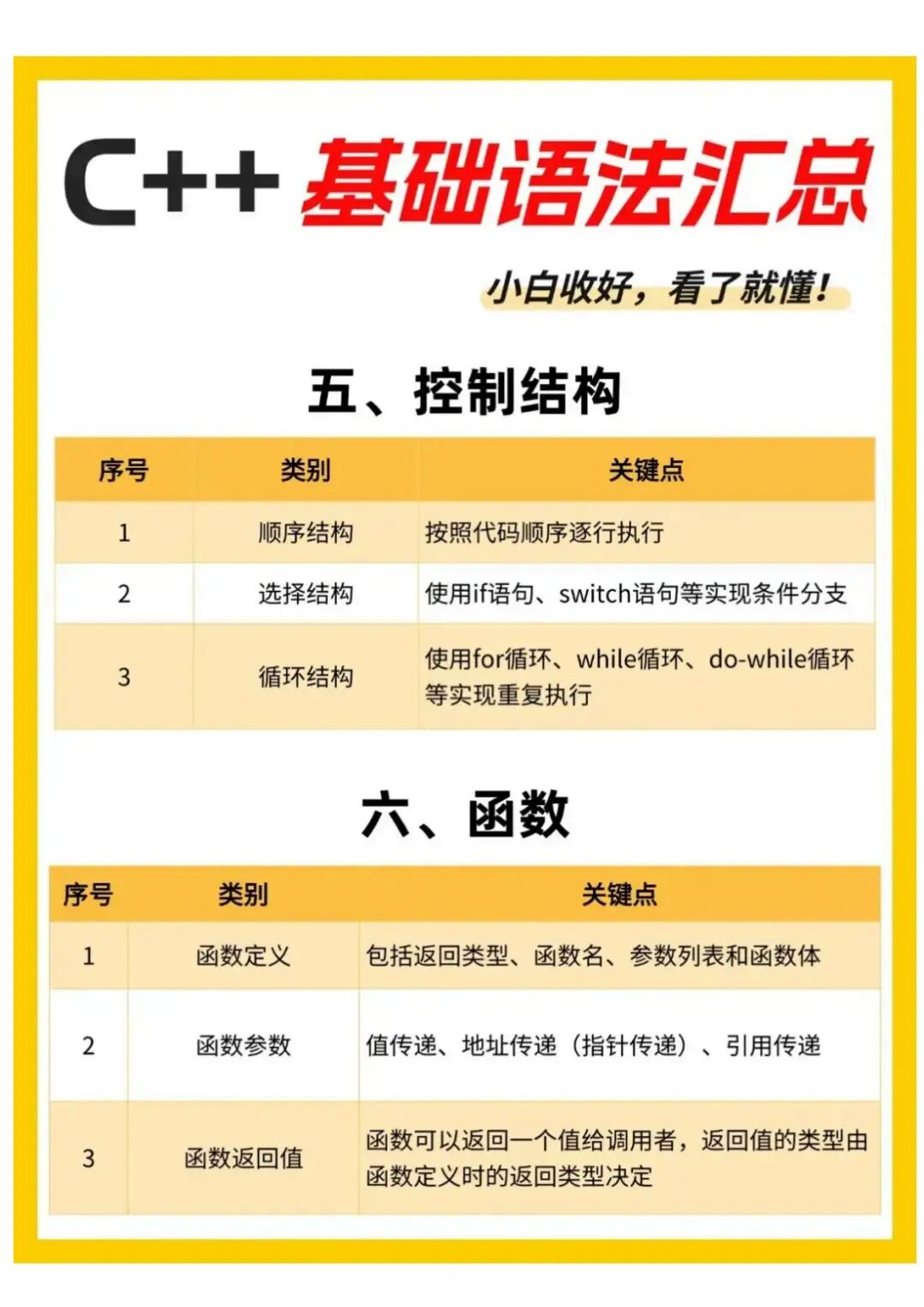
5. Control Structures
- Sequential Structure: executed line by line in the order of the code.
- Selection Structure: implements conditional branching using
<span>if</span>statements,<span>switch</span>statements, etc. - Loop Structure: implements repeated execution using
<span>for</span>loops,<span>while</span>loops,<span>do-while</span>loops, etc.
6. Functions
- Function Definition: includes return type, function name, parameter list, and function body.
- Function Parameters: pass by value, pass by address (pointer passing), pass by reference.
- Function Return Value: a function can return a value to the caller, and the return value type is determined by the return type defined in the function.
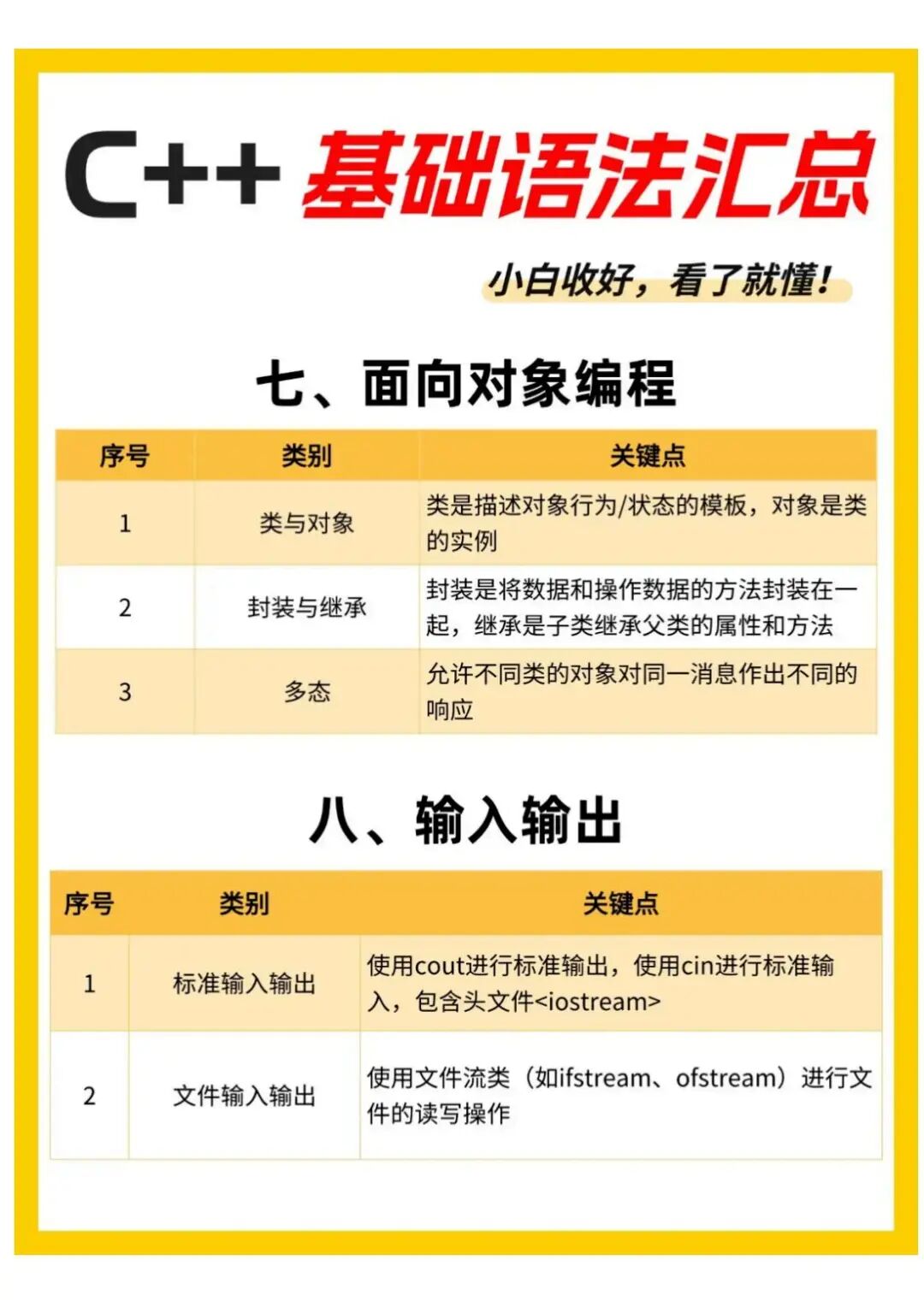
7. Object-Oriented Programming
- Classes and Objects: a class is a template that describes the behavior/state of objects, and an object is an instance of a class.
- Encapsulation and Inheritance: encapsulation is the bundling of data and methods that operate on the data, inheritance is when a subclass inherits properties and methods from a superclass.
- Polymorphism: allows objects of different classes to respond differently to the same message.
8. Input and Output
- Standard Input and Output: use
<span>cout</span>for standard output, and use<span>cin</span>for standard input, including the header file<span><iostream></span>. - File Input and Output: use file stream classes (such as
<span>ifstream</span>,<span>ofstream</span>) for reading and writing files.
The above is the core content of C++ syntax, which should be flexibly applied in actual programming according to specific scenarios.