|
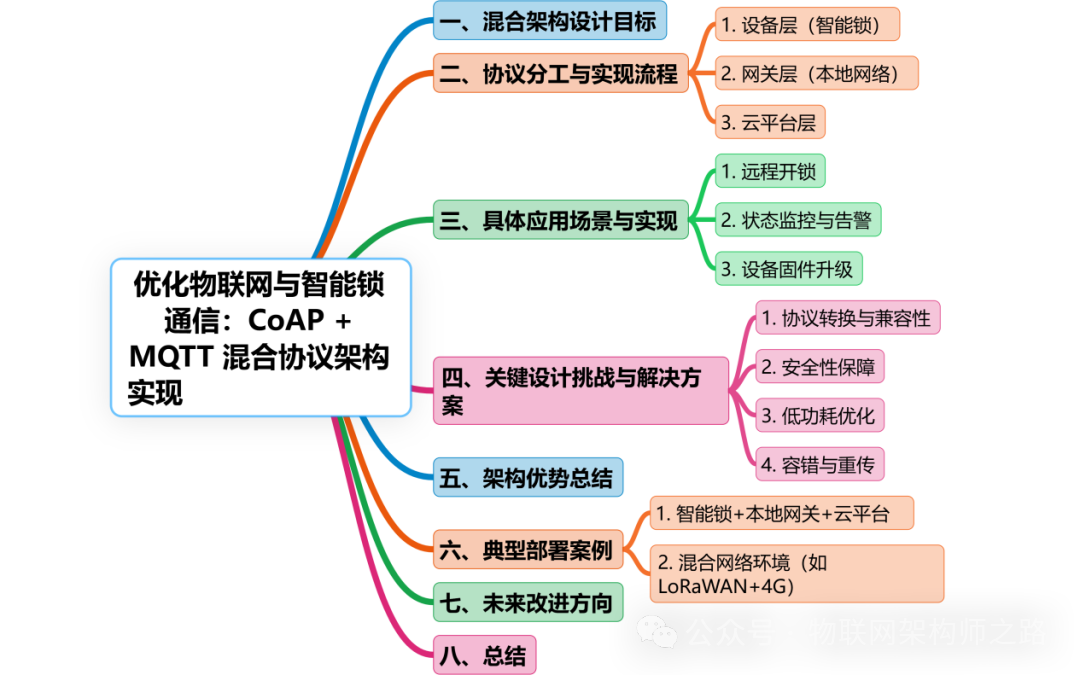
In the context of the Internet of Things (IoT) and smart locks, the CoAP + MQTT hybrid architecture can combine the advantages of both protocols to meet the requirements of low power consumption, low latency, high reliability, and cloud integration for devices. |
The following is a detailed analysis of the implementation ideas, design points, and specific application cases of this hybrid architecture:
1. Design Goals of the Hybrid Architecture
1. Core Requirements of Smart Locks:
○Low Latency Control: Remote unlocking commands must respond quickly (in milliseconds).
○High Reliability: Critical commands (such as unlocking and alarms) must not be lost.
○Low Power Consumption: Support battery power, reducing communication overhead.
○Cloud Integration: Device status must be synchronized to the cloud platform (such as user management and historical records).
2. Protocol Division of Labor:
○CoAP: Used for local communication (device to gateway/mobile), meeting low latency and low power consumption requirements.
○MQTT: Used for cloud communication (gateway to cloud platform), ensuring data reliability and large-scale device management.
2. Protocol Division of Labor and Implementation Process
1. Device Layer (Smart Lock)
•Protocol Selection: CoAP (based on UDP)
○Advantages:
▪Low Overhead: Header is only 4 bytes, suitable for resource-constrained lock devices.
▪Fast Response: No TCP handshake delay, unlocking commands can arrive in seconds.
▪Observation Mode: Supports proactive push of lock status changes (such as low battery, abnormal alarms).
○Implementation Example:
|
Plain Text The smart lock interacts with the local gateway via CoAP’s GET/POST methods: – GET /lock/state → Query lock status (open/closed/abnormal). – POST /lock/unlock → Send unlocking command (with user authentication). |
○Security Mechanisms:
▪DTLS Encryption: Protects command transmission (such as fingerprint/password verification).
▪Resource Permission Control: Only authorized devices can operate specific resources (such as administrator accounts).
2. Gateway Layer (Local Network)
•Protocol Conversion: CoAP ↔ MQTT
○Functionality:
▪Convert CoAP commands to MQTT messages and upload them to the cloud platform.
▪Convert cloud MQTT commands to CoAP requests and send them to the lock device.
○Implementation Method:
▪Bidirectional Proxy Mode:
|
Plain Text 1. Smart Lock → CoAP → Gateway (Local Network). 2. Gateway → MQTT → Cloud Platform (Remote Management). |
▪Data Format Conversion:
•CoAP’s JSON resource (such as{“state”: “locked”, “battery”: 20%}) → MQTT’s JSON payload.
•MQTT’s command (such as{“action”: “unlock”, “user_id”: “12345”}) → CoAP’s POST request.
○Library Selection:
▪CoAP Library: Californium (Java) or libcoap (C).
▪MQTT Library: Eclipse Paho (supports embedded systems).
3. Cloud Platform Layer
•Protocol Selection: MQTT (based on TCP)
○Advantages:
▪High Reliability: QoS 1/2 ensures commands are not lost (such as remote unlocking).
▪Large-Scale Device Management: Supports subscription/publishing for millions of devices.
▪Persistent Sessions: Caches commands when devices are offline (such as temporary network disconnection).
○Implementation Example:
|
Plain Text User APP → MQTT → Cloud Platform → MQTT → Gateway → CoAP → Smart Lock. |
▪Topic Design:
•Publishing Topic: /devices/{device_id}/command (receives unlocking commands).
•Subscription Topic: /devices/{device_id}/status (receives lock status updates).
3. Specific Application Scenarios and Implementations
1. Remote Unlocking
•Process:
a. The user sends an unlocking command via the mobile APP → MQTT → Cloud Platform.
b. The cloud platform forwards the command to the local gateway (MQTT).
c. The gateway sends a POST /lock/unlock request to the smart lock via CoAP.
d. The lock performs the unlocking operation and confirms success via CoAP’s ACK.
•Reliability Assurance:
○MQTT Layer: Uses QoS 1 to ensure the command reaches the gateway.
○CoAP Layer: Uses CON (Confirmable) messages, the gateway retransmits unacknowledged requests.
2. Status Monitoring and Alarms
•Process:
a. The smart lock registers status changes (such as low battery) via CoAP’s observation mode.
b. When the battery falls below a threshold, the lock proactively pushes /lock/status resource to the gateway.
c. The gateway uploads the alarm information to the cloud platform via MQTT.
d. The cloud platform triggers push notifications (such as SMS/APP notifications to users).
•Advantages:
○Low Latency Alarms: CoAP observation mode avoids polling, reducing network overhead.
○Cloud Persistence: MQTT stores alarm records for subsequent analysis.
3. Device Firmware Upgrade
•Process:
a. The cloud platform issues upgrade commands to the gateway via MQTT.
b. The gateway transmits firmware to the lock device via CoAP using blockwise transfer.
c. After the lock device completes the upgrade, it notifies the gateway of the result via CoAP.
•CoAP Advantages:
○Blockwise Transfer: Suitable for low bandwidth environments (such as LoRaWAN).
○Low Power Consumption: No need to maintain a TCP connection, reducing device energy consumption.
4. Key Design Challenges and Solutions
1. Protocol Conversion and Compatibility
•Problem: CoAP’s RESTful resources need to be mapped to MQTT’s Topics.
•Solution:
○Mapping Resources to Topics:
|
Plain Text CoAP resource path → MQTT topic: /lock/{id}/state → /devices/{id}/state /lock/{id}/command → /devices/{id}/command |
○Unified Data Format: Use JSON format to ensure cross-protocol parsing compatibility.
2. Security Assurance
•End-to-End Encryption:
○CoAP Layer: DTLS encrypts local communication.
○MQTT Layer: TLS encrypts cloud communication.
○Identity Authentication:
▪Device Authentication: CoAP uses PSK (Pre-Shared Key) or X.509 certificates.
▪User Authentication: MQTT combines OAuth 2.0 or JWT to verify user permissions.
3. Low Power Optimization
•Smart Lock Sleep Mechanism:
○CoAP Caching: The gateway caches the lock status, reducing frequent queries.
○MQTT Last Will: Automatically notifies the cloud when the device disconnects, avoiding invalid commands.
4. Fault Tolerance and Retransmission
•CoAP Retransmission Strategy: Set reasonable retransmission counts (e.g., 3 times) and timeout periods (e.g., 2 seconds).
•MQTT QoS 2: Use QoS 2 for critical commands (such as unlocking) to ensure “exactly once” delivery.
5. Summary of Architectural Advantages
|
Advantages |
CoAP Contribution |
MQTT Contribution |
|
Low Latency Control |
No TCP handshake, unlocking commands respond in seconds. |
Depends on gateway conversion, but local CoAP directly controls. |
|
Low Power Consumption |
Lightweight header and connectionless features. |
Cloud platform reduces direct connections for devices via gateway. |
|
Reliability |
Observation mode reduces polling, CON message retransmission. |
QoS 1/2 ensures cloud commands are not lost. |
|
Scalability |
Gateway can be expanded to support more CoAP devices. |
Cloud platform supports management of millions of MQTT devices. |
6. Typical Deployment Cases
1. Smart Lock + Local Gateway + Cloud Platform
•Hardware Requirements:
○Smart Lock: STM32 microcontroller (supports CoAP).
○Gateway: Raspberry Pi (running CoAP/MQTT proxy).
○Cloud Platform: Alibaba Cloud IoT platform (supports MQTT protocol).
•Implementation Steps:
a. The lock device registers resources (such as /lock/state) to the gateway via CoAP.
b. The user APP subscribes to /devices/lock1/status via MQTT to obtain lock status.
c. In emergencies, the cloud sends an unlock command to the gateway via MQTT, which forwards the CoAP request to the lock.
2. Hybrid Network Environment (e.g., LoRaWAN + 4G)
•Scenario: Smart locks in remote areas (LoRaWAN transmits CoAP).
•Architecture:
○ The lock connects to the local server via a LoRaWAN gateway (CoAP over UDP).
○ The local server uploads data to the cloud via 4G by converting it to MQTT.
•Advantages:
○Wide Area Coverage: LoRaWAN solves communication issues in remote areas.
○Low Power Consumption: CoAP’s lightweight design extends lock battery life.
7. Future Improvement Directions
1. Protocol Fusion:
○ Explore CoAP over QUIC (a reliable transport protocol based on UDP) to enhance packet loss resistance.
2. Edge Intelligence:
○ The gateway processes some commands (such as local user authentication) directly via CoAP, reducing cloud load.
3. AI Optimization:
○ Utilize CoAP’s low latency characteristics combined with edge AI for real-time detection of abnormal behaviors (such as brute force attack alarms).
8. Conclusion
The CoAP + MQTT hybrid architecture achieves:
• Local fast response (low latency and low power consumption of CoAP).
• Reliable cloud management (high reliability and large-scale device support of MQTT).
• Flexible scalability: Adapting to different network environments (such as LoRaWAN, Wi-Fi) through gateways.