What is the Embedded Engineering Roadmap?
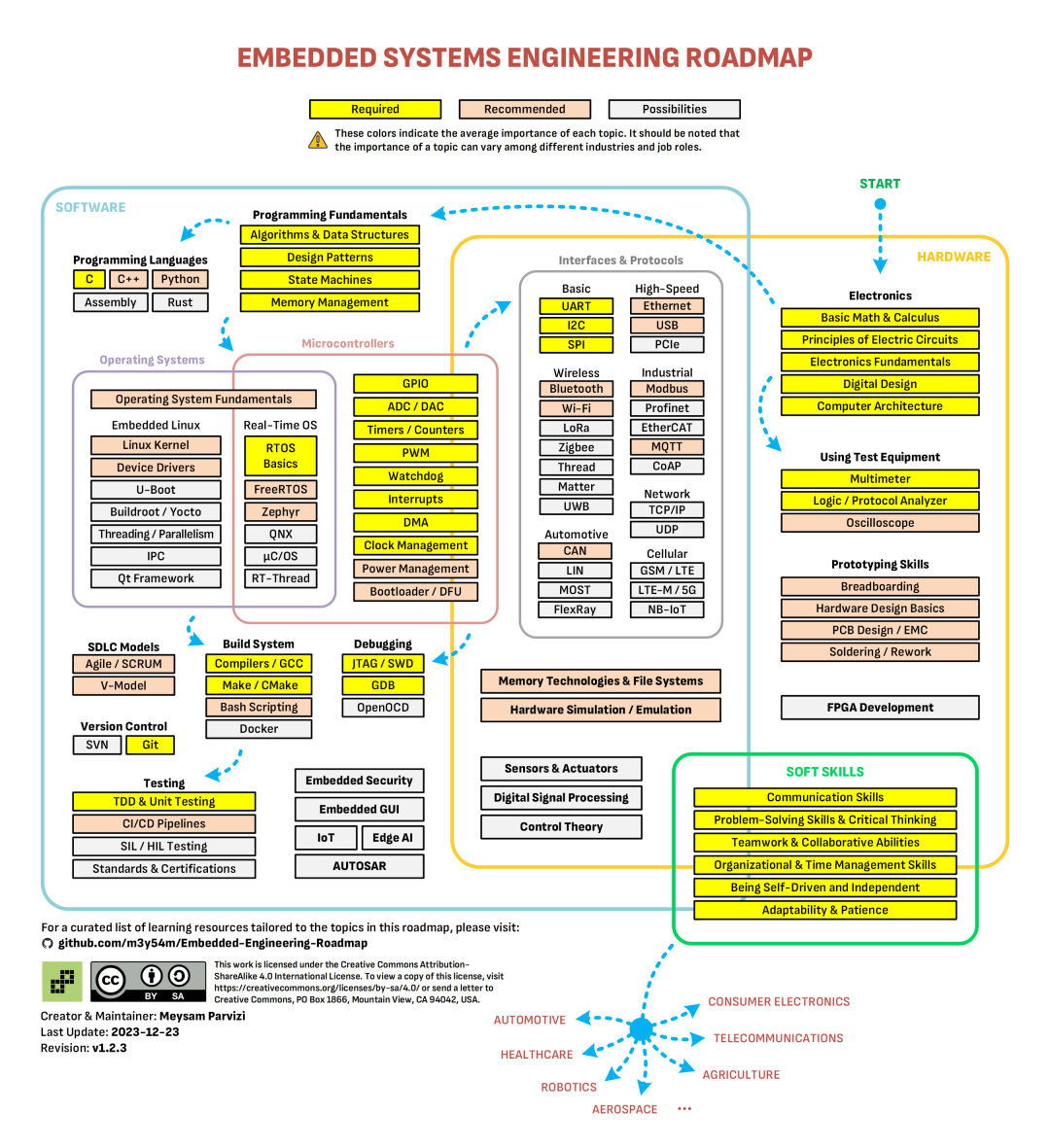
In simple terms, it is an open-source learning roadmap designed to provide a “one-stop” skill checklist for those interested in embedded development, whether they are newcomers or seasoned professionals.
- • Comprehensive Perspective: It integrates three major areas: hardware, software, and soft skills, helping you see the complete path from “writing a blinking LED” to “developing an in-vehicle real-time system.”
- • Resource Tagging: Each knowledge point is accompanied by icons like 📘, 🎞️, 📝, and indicates whether it is suitable for beginners 👶 or essential for experts 💎, saving you time in resource selection.
What Pain Points Does It Address?
| Pain Point | Traditional Approach | Roadmap Solution |
| Fragmented Information | Searching through blogs, videos, and books often leads to dead ends. | All mainstream resources are unified in one diagram, allowing direct access. |
| Lack of Systematic Learning and Jumping Levels | Only learning C language or only focusing on MCUs, neglecting hardware/soft skills. | Three major areas (Software / Hardware / Soft Skills) are advanced simultaneously, layer by layer. |
| Not Knowing Where to Start | Overwhelmed by tutorials, stuck at the basics. | Recommended paths for beginners: “Entry → Intermediate → Expert” stages. |
| Slow Updates, Outdated Technology | Old textbooks and blogs that are no longer updated. | Community-driven, timely updates on new technologies like ARM Cortex-M, RISC-V, Edge-AI on GitHub. |
| Lack of Practical Projects | Only theoretical knowledge with few hands-on opportunities. | Each module is paired with small project links (ESP32, STM32, Arduino, etc.) to learn by doing. |
Installation & Usage Guide
Prerequisites: As long as you can use a mouse and type on a keyboard, you can get started. It’s completely free.
- 1. Clone the Repository (recommended using Git)
git clone https://github.com/m3y54m/Embedded-Engineering-Roadmap.git cd Embedded-Engineering-Roadmap - 2. Open the Roadmap
- •
<span>roadmap.png</span>(Visio version) can be viewed by double-clicking. - •
<span>roadmap.md</span>(Markdown version) can be opened in editors like VS Code or Typora, supporting search.
- • Entry: Start with “Basic Programming → C Language → Arduino.”
- • Intermediate: Switch to “Microcontrollers → STM32 / ESP32 → RTOS.”
- • Expert: Choose “Security → AUTOSAR → Edge-AI.”
- • Resource icons have links next to them, click to watch videos, download documents, or read blogs directly.
- • Each resource has a star rating (👶 / 💎), start with 👶 and gradually upgrade to 💎.
- • The bottom of the roadmap lists “Project Recommendations” → choose any (e.g., “ESP32 Wi-Fi OTA”) and follow the project documentation step by step.
Pros and Cons Quick Review
| Pros | Description |
| Comprehensive Coverage | Software, hardware, and soft skills presented all at once, avoiding being “just a coder” or “just a circuit designer.” |
| Resource Quality Tagging | 👶 / 💎 allows you to quickly assess the depth of learning suitable for you. |
| Practical Orientation | Each section has corresponding projects, enabling you to deliver work after learning. |
| Free and Open Source | No barriers, suitable for students, individual developers, and corporate training for newcomers. |
| Cons | Description |
| Large Amount of Information | First-time users may be overwhelmed by a plethora of technical terms and need to set clear goals first. |
| Lack of Chinese Resources | Some high-quality resources (especially the latest papers) are only available in English, requiring Chinese learners to translate them themselves. |
| Reliance on External Links | Some videos/documents are hosted on platforms (YouTube, GitHub), and occasionally links may break, requiring replacements. |
| No Interactive Experiment Environment | Only provides a list of resources; actual hands-on work still requires setting up hardware or using third-party simulation platforms. |
Conclusion: Why You Must Add It to Your Learning Arsenal?
- • Time and Effort Saving: No more wasting hours searching for textbooks, videos, or blogs.
- • Systematic Learning: Pieces of knowledge are pieced together into a clear growth path, allowing for a comprehensive understanding of “embedded full stack” after completion.
- • Practical Driven: Each stage has corresponding projects, combining academic and practical approaches, making your resume more compelling.
- • Continuous Iteration: The community is active, and the roadmap will be updated with new technologies in the industry, keeping you at the forefront of technology.
If you really want to go from zero to your first “Hello World” to mastering in-vehicle real-time systems, the Embedded Engineering Roadmap is your most reliable “learning partner.” Don’t hesitate any longer, clone it now, open the Markdown, and pick a small project to get started—success is right in front of you.
Project Address: https://github.com/m3y54m/Embedded-Engineering-Roadmap