
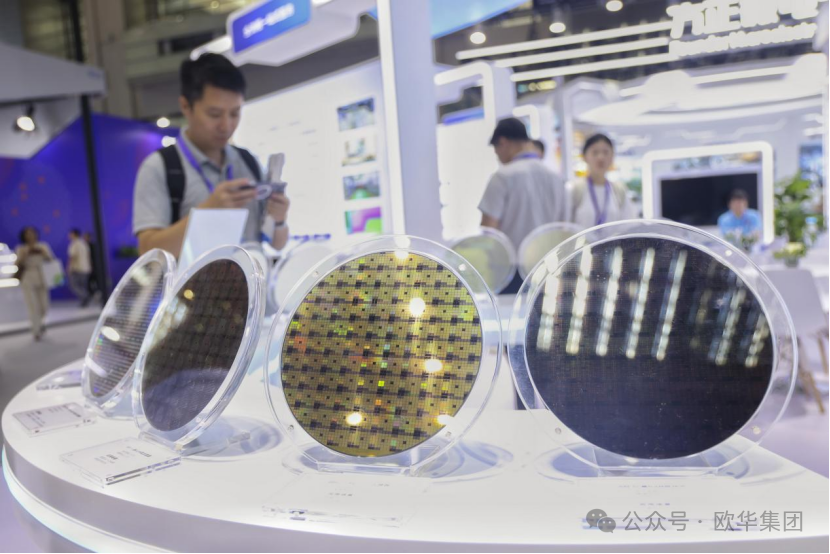
On October 15, the second Bay Area Semiconductor Industry Ecological Expo opened in Shenzhen. The photo shows the Shenzhen Pinghu Laboratory booth. Southern Daily reporter Zhu Hongbo photographed.
On October 15, the second Bay Area Semiconductor Industry Ecological Expo (hereinafter referred to as the “Bay Chip Expo”) opened in Shenzhen. More than 600 leading enterprises and well-known institutions from over 20 countries participated, showcasing new technologies and products.
Among them, Shenzhen semiconductor equipment manufacturer Xinkailai’s subsidiary presented several new products. Shenzhen Wanliyan Technology Co., Ltd. (hereinafter referred to as “Wanliyan”) launched its self-developed next-generation ultra-high-speed real-time oscilloscope at the Bay Chip Expo.
“The next-generation ultra-high-speed real-time oscilloscope we released this time can be mainly applied in chip, communication networks, smart networks, and even in scientific research,” said Liu Sang, General Manager of Wanliyan. This oscilloscope has a bandwidth exceeding 90GHz, ranking second globally in key indicators, and this technology can support the R&D of processes at 7nm and below.
Generally speaking, high-end oscilloscopes at the international leading level have bandwidths of over 60GHz, with the highest reaching 110GHz. Previously, domestic manufacturers’ oscilloscopes had maximum bandwidths between 8GHz and 18GHz. From the source of the electronics industry to all aspects of product application, oscilloscopes are closely related to people’s lives.
“For example, AI chips at 7nm typically require a real-time oscilloscope with a bandwidth of about 60GHz, while more advanced process nodes may require real-time oscilloscopes around 90GHz,” Liu Sang said.
Xinkailai’s other subsidiary, Wuhan Qiyunfang Technology Co., Ltd. (hereinafter referred to as “Qiyunfang”), also released two domestically developed electronic engineering EDA (schematic and PCB) design software with completely independent intellectual property rights to the industry for the first time, filling the gap in domestic high-end electronic design industrial software technology.
Electronic engineering EDA design software is the cornerstone of electronic product design. The reporter learned on-site that Qiyunfang’s electronic engineering EDA design software has reached first-class industry standards in important indicators of electronic circuit design, with product performance improved by 30% compared to industry benchmarks. The software supports multi-user parallel collaborative design, online review anytime and anywhere, reduces hardware development cycles by 40%, and increases the success rate of intelligent assisted design by 30%, comprehensively enhancing work efficiency and quality.
Currently, Guangdong is beginning to establish a “3+N” layout for the semiconductor and integrated circuit industry. “The Guangdong-Hong Kong-Macao Greater Bay Area, based on a solid electronic industrial foundation, is actively promoting the collaborative development of the semiconductor and integrated circuit industries. From IP design, chip R&D to system application, a complete industrial chain partnership has formed, creating an innovative ecosystem that deeply integrates production, education, research, and application, accelerating our product innovation,” Liu Sang said. (“Today’s Guangdong” Overseas Chinese Journal International Contribution Center Xu Ningning Cui Can)