Remember to star our public account ⭐️ to receive timely updates.
Background and Core Overview of Strategic Cooperation
On September 17, 2025, Luxshare Precision and the American edge AI chip company PIMIC reached a strategic cooperation agreement. The two parties will integrate PIMIC’sJetstreme™ compute-in-memory architecture with Luxshare Precision’s wearable platform to develop a new generation of smart devices, including wireless earbuds, AI/AR glasses, and AIoT devices. The core breakthrough of this cooperation is to achievelocalized AI processing, allowing devices to perform complex tasks without relying on the cloud, enhancing performance while extending battery life by 50%, and supporting more compact product designs.
PIMIC CEO Subi Krishnamurthy pointed out that the cooperation will promote the realization of “AI-first wearable devices,” while Ronald Yuan, Senior Director of the Technology Committee at Luxshare Precision, emphasized that the joint technology will be quickly applied to acoustic solutions, strengthening the product advantages of “ultra-low power consumption and compact layout.” This collaborative model of “hardware platform + core chip” marks the transformation of wearable devices from “passive data collection” to “active intelligent services.”
Core Objectives of the Cooperation
- Technology Integration: Deep integration of compute-in-memory architecture with wearable hardware
- Product Innovation: Smaller size and localized AI processing smart devices
- Experience Upgrade: Balancing high performance with long battery life, freeing from cloud dependency
Breakthroughs in Edge AI Technology and Integration Pathways
Advantages of PIMIC Chip Technology
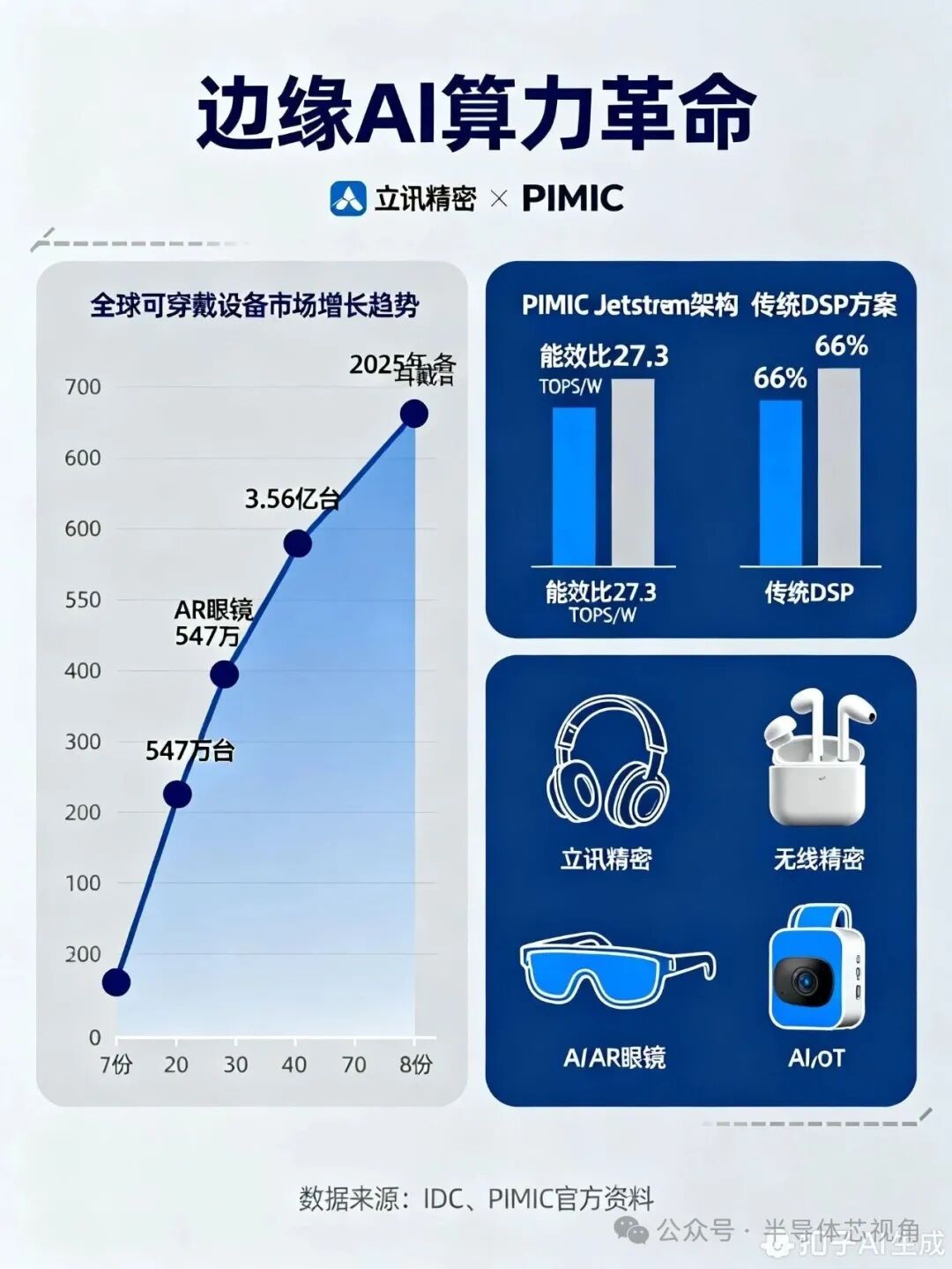
PIMIC’s Jetstreme™ architecture adoptscompute-in-memory design, achieving an energy efficiency ratio of 27.3 TOPS/W through TSMC’s 22nm ultra-low leakage process, reducing power consumption by 66% compared to traditional solutions. Its dynamic model update technology supports devices to upgrade algorithms via OTA throughout their lifecycle, and the energy consumption for model reconfiguration is extremely low, solving the triangular contradiction of “computing power – power consumption – volume” in edge devices.
The commercially available Clarity NC100 chip has validated the technical feasibility: in a single microphone noise reduction scenario, it only requires 150 microamps of current to suppress wind noise and industrial background noise, improving performance by 10 times compared to traditional DSP solutions, providing crucial support for upgrading the voice interaction experience of wearable devices.
Technology Integration and Product Direction
Luxshare Precision will deeply adapt its lightweight design capabilities to PIMIC chips:
- Wireless Earbuds: Integrating the NC100 chip to achieve single microphone noise reduction, reducing size by 30%, and improving call clarity by 40%;
- AR Glasses: Enhancing environmental perception accuracy through sensor fusion technology, with localized processing latency as low as 1ms, supporting real-time virtual-physical interaction;
- Health Monitoring Devices: The ring computing architecture shortens blood glucose detection intervals to 5 seconds, reducing the low blood sugar warning missed report rate from 12.3% to 3.8%.
Luxshare Precision’s mechanical layout experience and PIMIC chip’s miniaturization characteristics create synergy, enabling devices to maintain a “non-intrusive wearing” experience while achieving real-time heart rate anomaly alerts (response delay < 0.5 seconds) and dialect voice command recognition (accuracy rate 92.3%) among other complex functions.
Market Landscape and Growth Opportunities for Wearable Devices
Global Market Status
According to IDC, the global wearable device market is expected to reach 556 million units by 2025, withear-worn devices leading with a growth rate of 8.9%, expected to ship 356 million units; although the base for AR glasses is relatively low, benefiting from breakthroughs in edge AI technology, shipments are expected to reach 5.47 million units. The Chinese market is performing outstandingly, with wrist-worn device shipments expected to reach 61.16 million units in 2024 (a year-on-year growth of 19.3%), accounting for 32% of the global share, becoming a core growth driver.
Impact of Cooperation on the Market
The technology integration between Luxshare Precision and PIMIC will reshape the competitive landscape:
- Performance Leap: Localized AI processing increases device-side inference speed by 113%, solving latency issues caused by cloud dependency;
- Cost Optimization: Vertical integration reduces hardware costs by 15%, helping mid-to-high-end products to penetrate the mainstream price range of 1000 – 1500 yuan;
- Scenario Expansion: Health monitoring devices, through real-time data analysis, are expected to enter the medical-grade market, with related product revenue share expected to increase to 25% by 2026.
The success of Meta Rayban AI glasses has validated the growth potential driven by technology—its sales surged from 100,000 units to 270,000 units within nine months of its launch in May 2024. Luxshare Precision, leveraging its manufacturing advantages and technology integration capabilities, is expected to replicate this growth path in the open-ear headphone (80% market share in China) and AR glasses sectors.
Industry Chain Restructuring and Future Outlook
This cooperation will restructure the industry chain from three aspects:
- Upstream Chips: The PIMIC architecture challenges Qualcomm and MediaTek’s monopoly, promoting diversification in edge AI chip competition, with the localization rate of wearable chips expected to increase to 45% by 2025;
- Midstream Manufacturing: Luxshare Precision’s flexible production lines will compress the R&D cycle from 12 months to 8 months, with a 15% improvement in mass production yield;
- Downstream Applications: Devices are transitioning from “data tools” to “health managers,” for example, dynamic ECG monitoring systems have achieved real-time alerts for arrhythmias, pushing the value share of medical health scenarios from 18% to 35%.
Despite risks related to technology stability (dynamic model updates) and resource allocation, both parties still plan to launch the first AI headphones in Q1 2026 and gradually expand to AR glasses and medical devices. IDC predicts that by 2027, the penetration rate of wearable devices using edge AI technology will exceed 68%, and through this cooperation, Luxshare Precision is expected to increase its global market share from 7% to 12%, establishing itself as a leader in the “hardware + AI” ecosystem.
Core Value SummaryThe cooperation between Luxshare Precision and PIMIC not only represents a technological complement between companies but also marks the entry of wearable devices into the “localized intelligence” era. Through the synergy of compute-in-memory architecture and manufacturing capabilities, both parties are redefining industry rules—driving wearable devices from consumer electronics to cross-border upgrades in medical health and industrial internet with a “low power consumption – high performance – small volume” technological closed loop.
We are deep observers penetrating the technological fog with chips as our anchor. Focusing on hardcore analysis of chip technology, tracking global capacity and policy dynamics, and collecting real-world stories from engineers. We deconstruct industries with technical details and connect ecosystems with warmth—understanding the industrial codes of every chip, remember to follow us!