
At this year’s IOTE Shenzhen exhibition LoRaWAN forum, Seeed Studio partner Jiang Yu delivered an exciting presentation. He not only introduced the latest explorations of the integration of LoRaWAN and edge AI but also showcased real-world case studies from the Giant Panda Protection Base, allowing attendees to intuitively experience the disruptive changes brought about by the combination of AI and low-power wide-area IoT technology for the first time.
🌍 Seeed’s Positioning and Ecosystem:
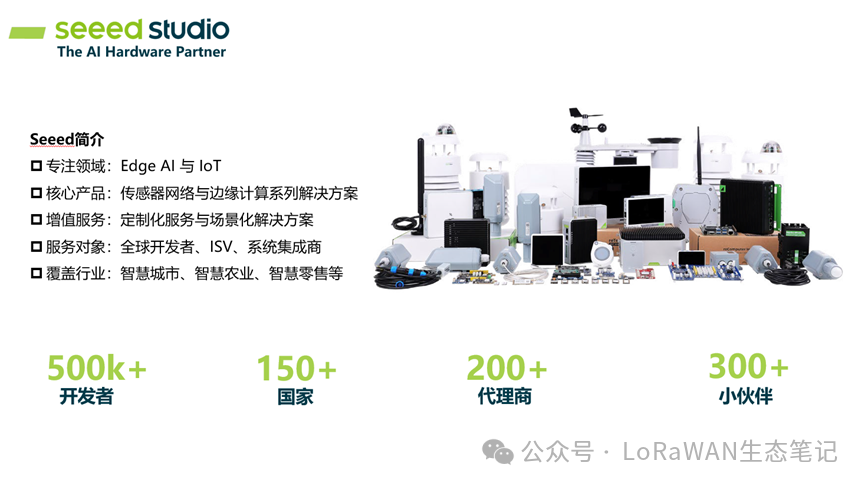
Seeed is a hardware platform company aimed at global developers and system integrators:
-
Focusing on Edge AI and IoT;
-
Providing a series of solutions for sensor networks and edge computing;
-
Covering industries such as smart cities, smart agriculture, and smart retail;
-
Having over 500,000 developers, covering 150+ countries, and 200+ channel partners.
As an “AI hardware partner,” Seeed’s mission is to:make AI + IoT easier to implement.
🐼 Case One: LoRaWAN + AI in Panda Protection
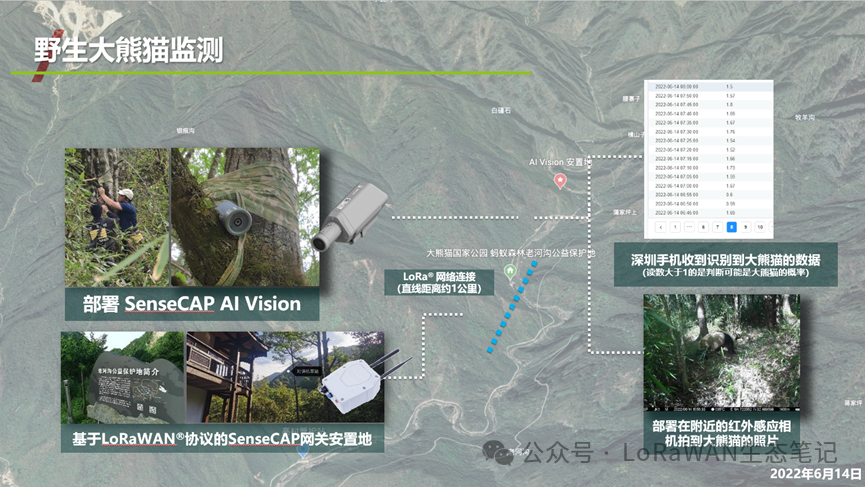 At the Giant Panda Protection Base in Sichuan, researchers face several typical challenges:
-
No constant power supply; devices can only rely on batteries;
-
Insufficient light, limiting solar energy utilization;
-
No cellular network coverage, unable to rely on 4G/5G;
-
Need for over 90% recognition accuracy, but the training threshold for AI models is high.
Seeed’s solution is:
-
Deploying SenseCAP AI Vision cameras, performing target recognition directly at the edge;
-
Transmitting recognition results via LoRaWAN network (over 5 kilometers in straight-line distance);
-
Receiving real-time alerts of “panda detected” on the mobile phones of the research team in Shenzhen;
-
Nearby infrared cameras capturing clear images for cross-validation.
However, AI models do not always perform smoothly in practical applications. A key challenge is the huge discrepancy between training data and real-world scenarios. In the lab, we often train models using photos of giant pandas from zoos or publicly available online, which are usually well-lit, well-composed, and clearly focused. But in the wild, images captured by cameras are drastically different:
-
Variable lighting conditions: cloudy days, nights, and rainy or snowy weather can affect image quality;
-
Angles and obstructions: wild pandas may be partially obscured by branches or grass, significantly increasing recognition difficulty;
-
Camera differences: different models and settings can lead to significant differences in image resolution and color performance;
-
Complex postures: wild animals move naturally and uncontrollably, differing greatly from the standard postures in the training set.
These discrepancies can directly lead to a decrease in model accuracy in real environments. To bridge this gap, researchers often need to collect a large number of field samples for retraining, which significantly increases costs and time. Additionally, due to the sensitive information involved in data collection in protected areas, some images cannot be shared externally, further complicating model optimization.
For this reason, Seeed made a significant investment in the initial implementation of the solution, sending a large number of personnel to the site to collaborate with local managers in extensive data collection efforts, barely meeting the accuracy requirements.
This case proves that even in remote, power-less, and network-less extreme environments, AI + LoRaWAN can still operate stably. However, the AI training project faces challenges such as data acquisition difficulties and high coupling with the project itself. As part of the solution, it is essential to lower the training threshold to empower end customers to conduct training, thereby truly realizing the implementation of AI in various scenarios.
This experience prompted them to develop a low-threshold AI training tool – Sensecraft AI. This platform not only provides dozens of pre-trained common models but also offers a web-based training tool, allowing customers to complete the entire process from data collection to model training and deployment to the edge with zero background knowledge by simply plugging in a USB. In just a few minutes, you can have your own model, turning the camera into a unique sensor.
Through this tool, they began empowering end customers to train their own models and achieve implementation:
🏭 Case Two: Unmanned Inspection and Smart Applications
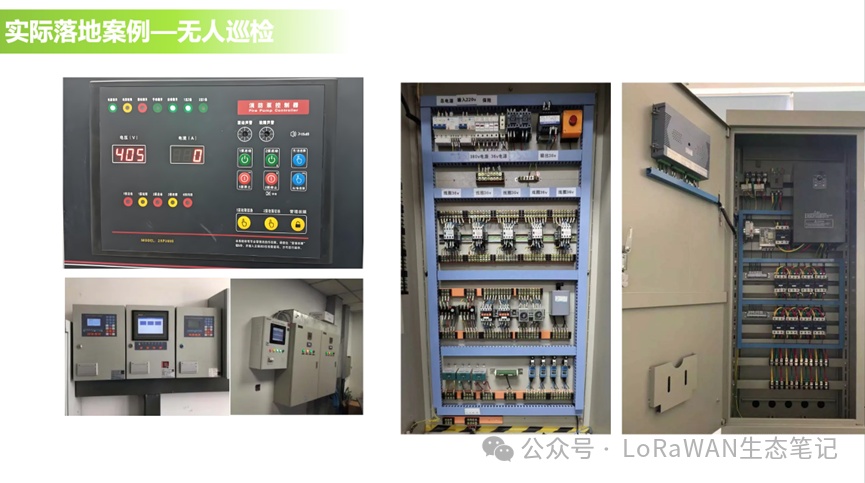 In addition to ecological protection, Seeed is also exploring more applications:
-
Factory equipment monitoring: sensors + AI, identifying equipment failures in advance to reduce downtime losses;
-
Urban infrastructure: cameras + edge computing, reducing manual inspection frequency;
-
Environmental monitoring: LoRaWAN ensures long-distance low-power backhaul.
These scenarios share common features:
-
AI runs locally, transmitting only results rather than all data;
-
LoRaWAN low-power wide-area coverage, ensuring connectivity even without operator networks;
-
Privacy protection, avoiding large-scale uploads of original images.
🔑 Why is LoRaWAN the Best Choice?
For many, AI applications imply big data, high-definition video, and cloud computing, seemingly far from a protocol like LoRaWAN that deals with “small data volumes.” However, the reality is quite the opposite:the combination of LoRaWAN and AI is indeed the best partnership.
-
Power consumption advantages: traditional video streams consume massive power and bandwidth if uploaded directly. However, LoRaWAN only needs to transmit the results of AI computations, significantly reducing energy consumption.
-
Long-distance coverage: in protected areas, mountainous regions, and factories without 4G/5G coverage, LoRaWAN can still transmit reliably.
-
Low cost: no need to build cellular base stations, LoRaWAN gateways can cover large areas.
-
Flexible scalability: AI models can iterate quickly on-site, while data transmission remains simple and efficient.
For this reason, in scenarios like the panda protection area, only LoRaWAN can meet the requirements of low power + long distance + no network environment.
🚀 Seeed’s Unique Contribution: Convenient AI Solutions
Jiang Yu particularly emphasized a major highlight of Seeed in his presentation:convenience.
They have created an extremely simplified AI video learning solution:
-
Plug and play: just plug in the camera via USB;
-
Quick access: connect to the website provided by Seeed;
-
Local training: model learning can be completed in minutes;
-
Direct application: makers or engineers can immediately deploy it.
This means that users do not need a deep AI background to quickly get started with AI applications.Whether developers, students, or corporate engineers, they can experience the charm of “AI + LoRaWAN” with low barriers.
At the same time, Seeed provides a complete set of hardware (camera + LoRaWAN module + AI software platform), allowing users to combine them directly, greatly reducing the difficulty of project implementation.
Watch the video👇 :
🔊 More Possibilities of AI + Multimodal Sensing
In addition to exploring AI + vision, Seeed is also actively expanding the integration of AI with vibration, audio, and other multimodal sensors. By combining acoustic recognition and vibration pattern analysis with the LoRaWAN network, more practical applications that address customer pain points can be created:
-
Equipment status monitoring: identifying the operational status of motors, pumps, fans, etc., through vibration data to detect signs of failure in advance, reducing downtime losses.
-
Abnormal sound detection: in factory or urban environments, AI can identify abnormal events such as explosions, gas leaks, and unusual noises in real-time through audio streams, triggering alerts immediately.
-
Multisensor fusion: when visual recognition is combined with vibration and audio, the system can not only “see” anomalies but also “hear” and “feel” the equipment status, leading to more accurate judgments.
This series of products combined with LoRaWAN means that even in network-less, low-power environments, the results of multimodal AI can still be quickly transmitted to the cloud or control center. In the future, LoRaWAN + AI + Multisensors will form an increasingly powerful application ecosystem, covering various needs from industrial operations, urban governance to environmental protection.
At Seeed’s booth, they also showcased related audio and vibration AI solutions (demonstration video attached at the end), allowing developers and corporate clients to intuitively feel the infinite possibilities of the integration of LoRaWAN + AI.
Watch the video👇 :
🌟 Summary: The Infinite Possibilities of AI Empowering LoRaWAN
Through Seeed’s practice, we see:
-
In ecological protection, AI + LoRaWAN safeguards endangered species;
-
In industrial operations, smart inspections reduce costs and improve efficiency;
-
In smart cities, promoting more widespread AIoT applications.
LoRaWAN has already demonstrated strong vitality at the connectivity level, and when combined with AI, its potential is further amplified.
👉 In the future, with the participation of more manufacturers and ecosystem development, we will usher in a new era of deep integration of AI + LoRaWAN.
👉 In the next article, we will share highlights from another heavyweight guest’s speech, stay tuned.
THE END
This public account is officially authorized by the LoRa Alliance and is the only official WeChat account of the alliance in China. Here, we will release the alliance’s official information, latest standard progress, application cases, and market dynamics in real-time. Follow us to directly obtain the most authoritative LoRaWAN ecosystem information.
 LoRaWAN
Scan to follow and join the ecosystem