
Currently, in the large screen display industry, LED screens and LCD splicing screens have become the dominant technologies. For example, splicing screens are commonly used in indoor security monitoring, while LED screens are more suitable for outdoor advertising. However, in certain scenarios such as conference rooms, exhibition halls, big data processing, and media integration applications, both LED and splicing screens have their applicability. Therefore, it is particularly important to understand their respective working principles and the differences in their advantages and disadvantages when making a selection. This knowledge can help us make the best choice based on actual needs, considering the application environment and purpose. Let’s explore the differences and pros and cons of both technologies.
1. Light Emission – Different Display Technology Principles
-
LED screens generally use light-emitting diodes (LEDs) as pixel points that emit light directly, offering vibrant colors and high brightness. They consist of numerous LED pixel points, each emitting light (RGB three-color LEDs), with color mixing controlled by brightness. Characteristics: no backlight module, direct light emission, high contrast, and vivid colors. They are particularly suitable for outdoor or bright environments.
-
LCD splicing screens, on the other hand, are based on liquid crystal panels and rely on a backlight source (usually LED or CCFL) to illuminate the liquid crystal layer. The backlight source (LED backlight) shines through the liquid crystal molecules to control the light’s on/off state, requiring filters to generate colors. The light is controlled by the deflection of liquid crystal molecules, resulting in softer colors. Its characteristics include reliance on backlight, with display effects limited by the uniformity of the liquid crystal layer and backlight, typically resulting in lower contrast.
2. Comparison of Display Effects:
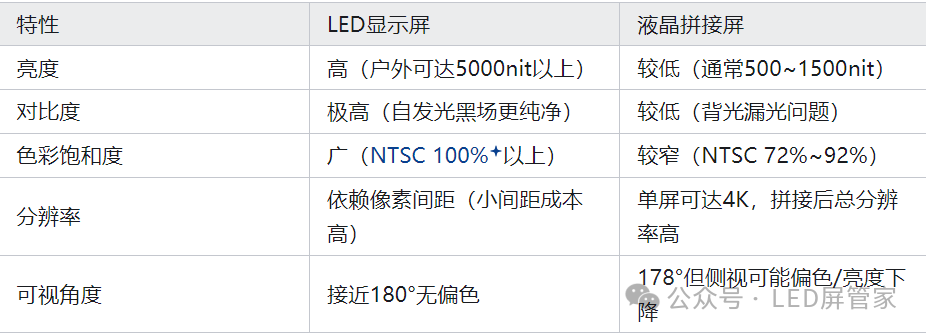
From the table above, in terms of picture quality, contrast, and brightness, LED screens have higher contrast, with purer blacks (especially OLED screens can turn off individual pixels), and better dynamic performance. In contrast, LCD splicing screens rely on backlight, resulting in weaker black performance, although high-end IPS panels offer wide viewing angles and accurate colors.
3. Comparison of Physical Structures:
-
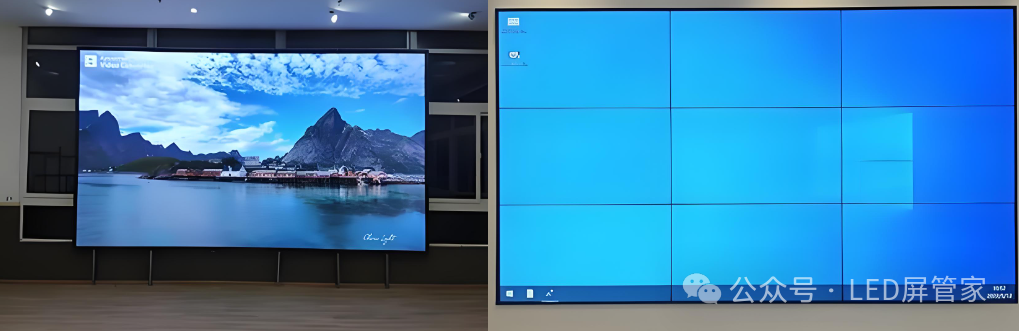
LED displays are composed of multiple LED modules with no physical borders (seam < 0.5mm to seamless), and can be curved (e.g., arc screens, irregular screens), adapting to irregular installations.
-
LCD splicing screens, however, have borders on each panel (seam typically 0.88mm to 5.5mm), and when multiple screens are spliced, there are visible seams (affecting overall integrity). They are generally fixed hard structure screens, usually flat, making them difficult to bend.
4. Comparison of Lifespan and Maintenance:
-
LED displays generally have a lifespan of about 50,000 to 100,000 hours, but there is an issue of LED attenuation, which may cause brightness/color difference problems. During routine maintenance, modular replacement is convenient and quick, but the cost of maintenance for small pitch displays is high.
-
LCD splicing screens have a backlight lifespan of about 30,000 to 60,000 hours (the entire panel needs to be replaced after attenuation), and routine maintenance only requires single panel replacement, which is more convenient and cost-effective.
5. Comparison of Power Consumption and Cost:
-
In terms of energy consumption: LED screen power consumption varies greatly with brightness (outdoor high-brightness screens consume more), while LCD screens have more stable energy efficiency.
-
Regarding pricing: small pitch LED costs > LCD splicing screens (for the same size), but large-size LEDs may be more economical. LED screens are generally more energy-efficient, have a longer lifespan, and are suitable for long-term use. In contrast, the backlight module of LCD splicing screens may degrade over time, but the technology is mature and costs are lower.
6. Comparison of Applicable Scenarios:
-
Applicable scenarios for LED screens include: high brightness and long-distance visibility, commonly used for outdoor advertising, stage performances (high brightness resistant to light), and super large screens (such as in stadiums and shopping malls). They are ideal for scenarios requiring seamless display (such as command centers and virtual shooting studios).
-
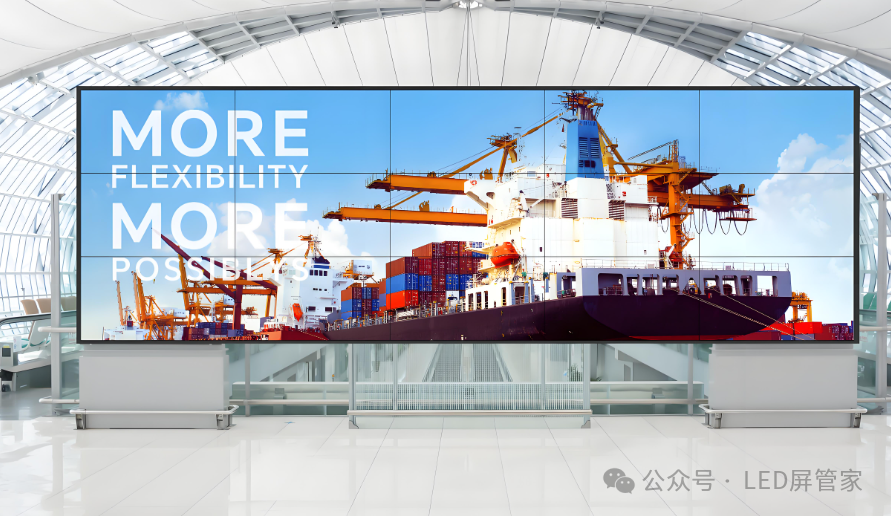
Applicable scenarios for LCD splicing screens include indoor monitoring centers (multi-screen display), conference rooms, and exhibition halls (requiring high-resolution detail display). They are suitable for scenarios with limited budgets and no outdoor use.
In summary, LED screens offer seamless, high brightness, making them the first choice for outdoor displays; splicing screens provide delicate colors and multi-screen interaction, making them superior for indoor monitoring. The main drawback of LED screens is their relatively low color saturation, especially when displaying dark or deep colors, which may not achieve the level of detail of LCD screens. LCD splicing screens perform excellently in many aspects, but their cost is relatively high, and they still have seams. Although professional products have optimized seam widths to a minimum of 0.88mm, in practical applications, especially in meetings and data displays, seams can still affect visual effects. Additionally, splicing screens contain electronic components, so they do not have waterproof capabilities and are only suitable for indoor environments.
If you find this useful, please bookmark and share it with more friends around you.To learn more about LED display technology, please click the following to follow our WeChat public account: LED Screen Manager