For any chip, its technical manual (referred to as a specification by local companies, hereinafter referred to as documentation) plays a crucial role in the initial promotion of the product and subsequent technical support, significantly contributing to the establishment of a rigorous image for the chip manufacturer and improving the efficiency of technical support. The consistency of documentation is an essential element of high-quality documentation for any company. This article discusses the consistency of documentation using a technical document for a dedicated mobile power supply chip as an example.1. Consistency in Description Content and Product PositioningThe main control chip of a mobile power supply typically provides a pin to connect to an external NTC thermistor. When the temperature changes, the resistance value of the NTC thermistor changes accordingly. The main control chip detects the voltage at this pin (usually named NTC or TH) to achieve temperature detection, as shown in the figure below.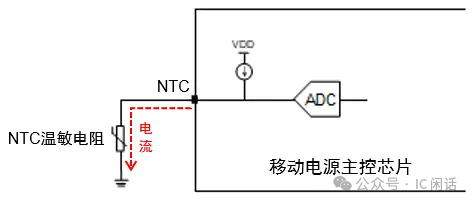 So, how should this detection function be described in the technical documentation? Let’s compare the following two different description methods.
 If the documentation describes the “chip” as the subject (the technical documentation of the chip), then the title of option-1 aligns with the product positioning (the chip), because the chip provides the detection function for the NTC pin voltage, which is a function of the chip itself.If the documentation describes the “mobile power supply solution” as the subject (the technical documentation of the solution), then the title of option-2 aligns with the product positioning of “mobile power supply.” The chip detects the voltage at the NTC pin, and whether this voltage is used to represent the battery temperature or the liquid level height is determined by the specific application solution, not by the chip’s own function. The mobile power supply solution based on the main control chip utilizes the chip’s NTC detection function to achieve battery temperature detection, thus option-2’s description aligns with the target of “mobile power supply detecting battery temperature.”2. Consistency in Context Content and Product FunctionIn the documentation for the mobile power supply chip used in this example, the following description is provided:Built-in switch power MOS, path MOS, single inductor achieves charging and discharging functions, requiring only one inductor to realize both step-down and step-up functions.However, in other parts of the documentation, contradictory descriptions appear, as shown below:The chip only requires a small number of passive components such as MOS transistors, inductors, capacitors, and resistors to achieve a complete fast-charging mobile power supply solution.Comment:Since the chip has built-in power MOS and path MOS, there is no need for external MOS transistors when developing the mobile power supply solution. Therefore, the subsequent description contradicts the product function and needs to remove “MOS transistors” to ensure consistency between the description content and product function. It should be corrected to the following statement:The chip only requires a small number of passive components such as inductors, capacitors, and resistors to achieve a complete fast-charging mobile power supply solution.3. Consistency between Paragraph Content and Paragraph TitlesFor example, in the original document, the paragraph title is “VSYS Capacitor Position,” and the first paragraph’s content elaborates on this theme, discussing the considerations for the capacitor connected to the VSYS pin during PCB layout. Therefore, the content of the first paragraph is consistent with the paragraph theme.However, the content of the second paragraph shifts to explain the filtering capacitor considerations for other pins (BAT pin, VCC pin), thus the content of the second paragraph is inconsistent with the paragraph title. To resolve this issue, it is necessary to establish a separate title for the second paragraph that aligns with its content, as follows.4. Consistency in the Representation Methods of the Same ContentThe names or symbols used to refer to the same object appearing in different locations in the documentation must use the same vocabulary to maintain consistency. For example:
 Using both IIC and I2C in the same paragraph to refer to the same In-Integrated Circuit is inconsistent, even though both are conventional abbreviations. For high-quality technical documentation, it is necessary to consistently use one of the representations (IIC or I2C) throughout the document.Consistency in documentation is reflected at all levels. When developing documentation, in addition to the aspects mentioned above, consistency management should be strengthened in the following details, especially when the documentation is large and developed by multiple collaborators.■ Consistency between Illustration Titles and Illustration ContentFor illustrations with similar content within the same document, attention should be paid to modifying the corresponding illustration content according to different titles to avoid the issue of “copy + paste” methods improving document creation efficiency but resulting in flaws. For example, in the document reviewed this time, the title of the illustration is “Chip Driving Digital Tube Display Application,” but the illustration used shows an LED display, causing inconsistency.■ Consistency between Illustration Numbers and Actual OrderIllustration numbers in the document are sequentially numbered. When the document is large and developed by multiple collaborators, after compiling a complete document, there may be inconsistencies between the illustration numbers and the actual sequence of the figures. Using copy/paste methods is also a source of such errors.■ Consistency in Letter CaseThe font of letters in the document must be consistent throughout, especially avoiding the use of Songti font, and it is recommended to use Arial or Times New Roman fonts for letters and numbers. For the size of the text (font size), the rule of maintaining the same font size consistency for the same level of text should be followed throughout.Conclusion:For a company’s technical documentation, not only must the various components within the same document adhere to their respective consistency rules, but different documents within the company must also follow consistency rules. For example, the same functional unit should use consistent titles and descriptions across different documents. Consistent documentation not only enhances the company’s image but also facilitates the rapid replication of document content. For companies experiencing rapid product iterations, document consistency can significantly improve the efficiency of document creation.