
In response to global AI chip supply and policy changes, the self-sufficiency rate of domestic computing power chips has rapidly increased in recent years. Huawei has for the first time clearly disclosed the planning of the Ascend series AI chips, while Alibaba and Baidu are also accelerating the adoption of self-developed chips for training AI models.
Huawei Ascend Timeline Released
At the Huawei Full Connection Conference, Huawei took the lead in releasing a strong signal for domestic substitution, officially disclosing the latest roadmap for the Ascend (Ascend) chips, clarifying the product iteration rhythm for the coming years:
2025 Q1: Ascend 910C
2026 Q1: Ascend 950PR=Ascend 950 Die + HIBL 1.0
2026 Q4: Ascend 950DT=Ascend 950 Die + HIZQ 2.0
2026 Q4: Ascend 960
2028 Q4: Ascend 970
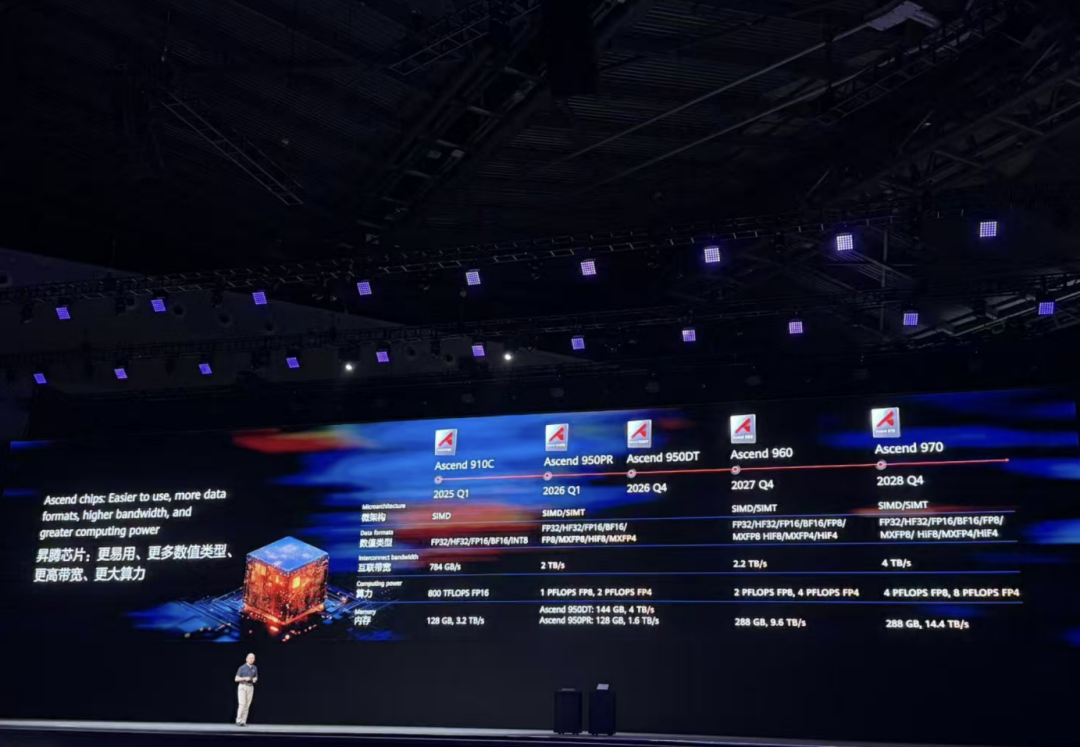
At the conference, Huawei also interpreted the upcoming950 architecture:
1. New support for low-precision data formats:
1, FP8/MXFP8/HIF8: 1 PFLOPS
2, MXFP4: 2 PFLOPS
2. Enhanced vector computing power
1, More compute allocated for vector processing
-
Improved vector computing power ratio
2, Support for SIMD / SIMT
-
Support for SIMD/SIMI
3. More granular memory access
-
Support for finer granularity memory access: 512B 128B
3. Enhanced interconnect bandwidth 2.5 times: 2 TB/s
Additionally, Huawei emphasized that950 supports self-developed HBM. In other words, Huawei has already developed its own HBM Huawei also emphasized that the company will:
1, Adhere to the monetization of Ascend hardware;
2, Open the CANN compiler and virtual instruction set interface, with other software fully open-source,CANN based on 910B/C open-source will be completed by December 31, 2025; future open-source will be synchronized with product launches;
3, Mind series application enablement components and tools will be fully open-source, and will be completed by December 31, 2025;
4, openPangu foundational large model will be fully open-source;
Huawei also revealed that the company will build the world’s strongest node based on Ascend 950 Atlas 950 SuperPoD:
-
The node has 8192 NPU;
-
Computing power reaches 8 EFLOPS FP8;
-
Memory capacity 1152 TB;
-
Memory bandwidth reaches 16.3 PB/s
-
Total training throughput 4.91mn TPS
-
Total inference throughput 19.6mn TPS
Huawei will also build the Atlas 960 SuperPoD based on Ascend 950DT / Ascend 960. According to reports, this node has 15488 cards ( NPU), computing power reaches 30 EFLOPS FPB / 60 EFLOPS FP4, with cross-cabinet all-optical interconnect (interconnect bandwidth 34 PB/s).
Alibaba and Baidu are also accelerating self-development
In addition to Huawei, companies like Alibaba and Baidu are also actively promoting the application of self-developed chips, accelerating the process of domestic substitution. According to a report from The Information, Alibaba and Baidu have introduced self-developed chips in AI model training to partially replace NVIDIA products: Alibaba has been testing self-developed chips in small-scale model training since the beginning of this year; Baidu is attempting to use the Kunlun P800 chip to train the new version of the Wenxin large model.
In fact, Alibaba’s “chip-making ambition” has long been laid out. In 2018, Alibaba acquired Zhongtian Micro and established the “Pingtouge” semiconductor company based on this, integrating the chip business into the DAMO Academy system. Since then, Alibaba has successively launched several chip products including Lingang 800, Xuantie processors, and Yitian 710, gradually landing in cloud computing and inference acceleration scenarios. Earlier this year, Alibaba was also reported to be internally testing a new AI inference chip produced by domestic wafer foundries, aimed at filling the computing power gap in large model inference and cloud computing. This chip has reportedly entered the testing phase and can be used for a wider range of AI inference tasks while maintaining compatibility with the NVIDIA ecosystem; more notably, this chip no longer relies on TSMC, opting instead for domestic manufacturers, which has significant strategic implications.
Recently, a report on “News Broadcast” revealed key parameters of the AI-specific PPU chip developed by Alibaba’s Pingtouge. According to the image released by CCTV comparing the important parameters of domestic cards with NV cards, the Pingtouge PPU surpasses NVIDIA’s A800 in various key parameters, being roughly equivalent to NVIDIA’s H20:
-
In terms of video memory: the Pingtouge PPU is equipped with 96GB HBM2e video memory, exceeding NVIDIA’s A800’s 80GB HBM2e, and matching H20’s memory capacity
-
Inter-chip interconnect bandwidth: the Pingtouge PPU reaches 700GB/s, higher than A800’s 400GB/s
-
Interface specifications: supports PCIe 5.0×15, better than A800’s PCIe 4.0×16
-
Power consumption control: maintained at 400W, consistent with A800, lower than H20’s 550W
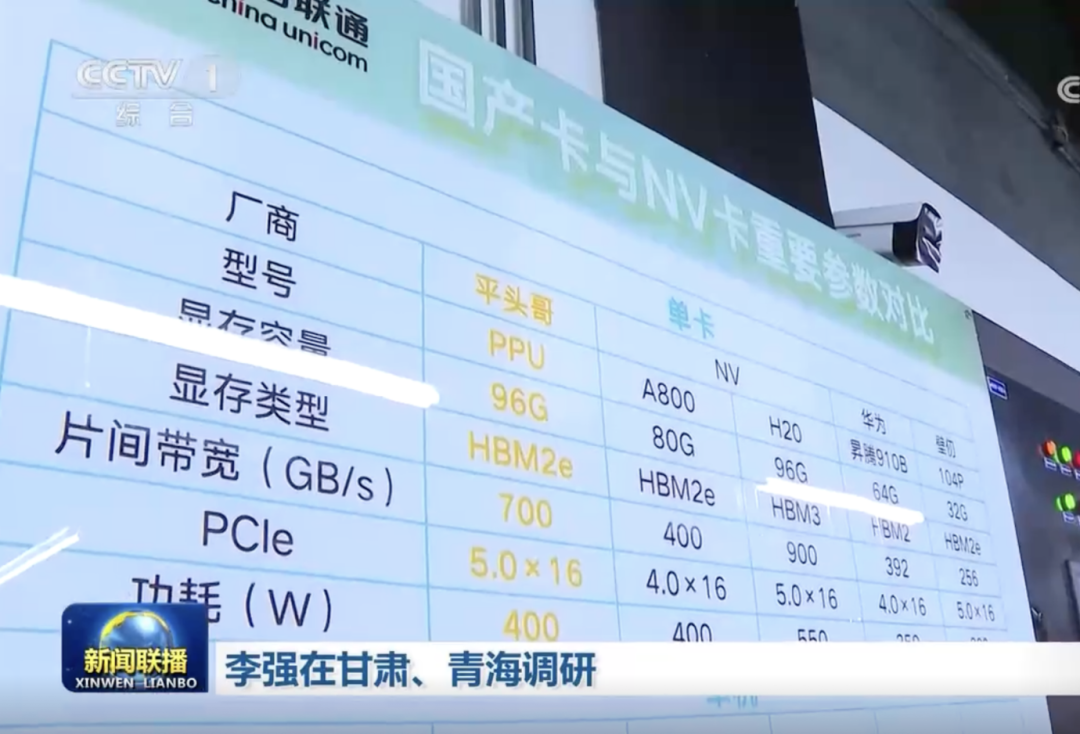
Although there is still a generational gap in memory technology ( HBM2e and HBM3), the Pingtouge PPU has demonstrated that Alibaba has the capability to compete with international giants in chip development, marking a significant breakthrough for domestic chips.
In terms of R&D investment, Alibaba has also been generous. Over the past four quarters, the company has invested over 100 billion yuan in AI infrastructure and product development; earlier this year, Alibaba further announced that it will add 380 billion yuan over the next three years for building cloud computing and AI hardware infrastructure, with chip development being one of the core investment directions.
Baidu’s layout in the chip field is also long-term. Since 2011, Baidu has established a chip R&D team; In 2018, it launched its first Kunlun chip, mainly used in autonomous driving and cloud inference scenarios; in 2021, the second-generation Kunlun chip achieved several times the computing power improvement; the latest Kunlun P800 chip has been directly used for training the Wenxin large model. Thus, Baidu has gradually formed a development pattern driven by both algorithms and computing power.
☆ END ☆ Note: This article is sourced from Electronic Engineering World, with cover and accompanying images sourced from the internet. The copyright of the images belongs to the original authors. The article is for reference, learning, and communication purposes only and does not constitute any advice, nor does it represent the position of this account. For any questions, please contact us ([email protected]).
 Click the bottom left “Read Original” to access popular tools for two yuan purchase