Recently, a research team led by Professor Hiroshi Nishihara from Tokyo University of Science announced the development of an innovative preparation technology for heterometallic coordination nanosheets (HMCONASHs). This two-dimensional material, with its scalable production and high performance, is expected to bring disruptive changes to fields such as flexible electronics and display technology, and the related results have become a focal point in the industry.
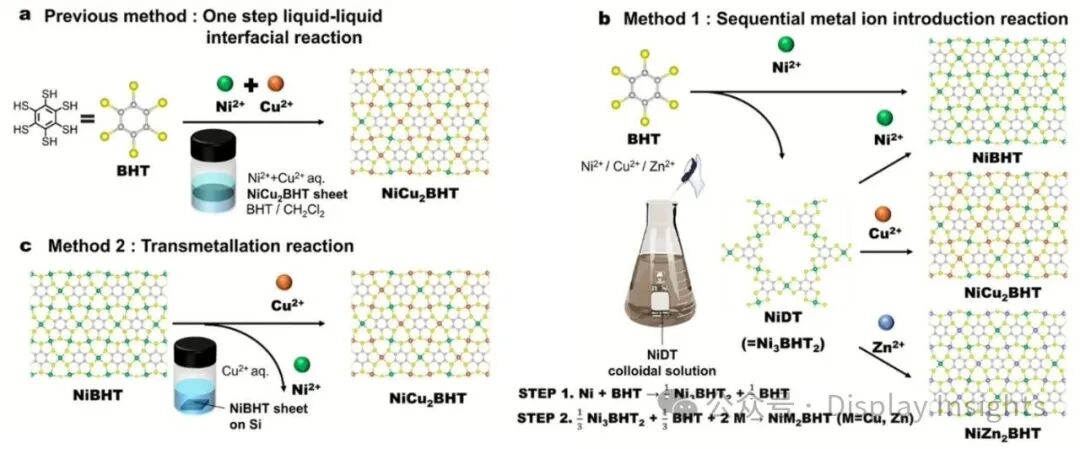
The traditional synthesis of coordination nanosheets has significant limitations, as it can only form single-metal structures and relies on complex two-phase reactions, severely restricting its application range. However, the single-phase synthesis method developed by Nishihara’s team successfully breaks this limitation. By controlling the molar ratio of nickel ions to hexanethiol (BHT), they can precisely prepare porous NiDT or non-porous NiBHT nanosheets, achieving precise control over the material’s structure and function.
More notably, the research team extended their technological breakthrough to heterometallic systems. They utilized unreacted BHT in the NiDT colloidal solution to introduce metal ions such as copper and zinc, successfully synthesizing NiCu₂BHT,NiZn₂BHT and other heterometallic nanosheets. Additionally, by employing a “metal replacement” strategy, copper ions were introduced into NiBHT , resulting in heterometallic nanosheets that outperform single-metal nanosheets in conductivity and crystallinity, providing a new pathway for material performance optimization.
In terms of production applications, this material exhibits unique advantages. Its colloidal solution can serve as a functional “dye“, which can be coated onto substrates using traditional techniques such as inkjet printing and screen printing, enabling scalable production. This characteristic not only reduces manufacturing costs but also helps create lighter, more durable flexible or foldable devices, revolutionizing the production model for electronic devices.
In the display field, the application prospects of this material are very broad. The widely used indium tin oxide (ITO) has issues such as brittleness and high cost, while heterometallic nanosheets containing copper and nickel have good conductivity, transparency, and tunable performance, making them ideal substitutes for electronic paper displays,OLED panels, and next-generation touch screens.
Moreover, heterometallic nanosheets also possess “redox-triggered multicolor electrochromism” characteristics, with a wide absorption spectrum range, showing great potential in energy-saving backlighting, dynamic color adjustment, and smart displays. Their excellent electrochemical adaptability also creates possibilities for integrating energy storage or sensing functions into display components, promoting the development of multifunctional screen technology.
Professor Nishihara stated that the ink prepared based on coordination nanosheets can now be directly applied to devices and mass-produced through printing technology. This breakthrough not only overcomes the long-standing challenges in the preparation of coordination nanosheets but also marks a key step towards the practical application of these materials in hydrogen evolution catalysts, sensing materials, and next-generation flexible electronic devices.
With the continuous growth in demand for energy-saving and smart display technologies, these printable, customizable, and high-performance heterometallic coordination nanosheets provide strong support for the development of electronic devices towards more environmentally friendly and intelligent directions, injecting new momentum into the development of related industries.
Source:M. Ito, N. Fukui, K. Takada, Z. Yu, H. Maeda, K. Mizuno, H. Nishihara, Rationally Engineered Heterometallic Metalladithiolene Coordination Nanosheets with Defined Atomic Arrangements. Small 2025, 2503227. https://doi.org/10.1002/smll.202503227
To follow this public account, please click below↓↓↓