Yesterday, while chatting with a friend, they suddenly asked me about my views on the current state of the domestic semiconductor industry. I have discussed this before; the semiconductor industry will not always be in a downturn, nor will it always be in a boom.
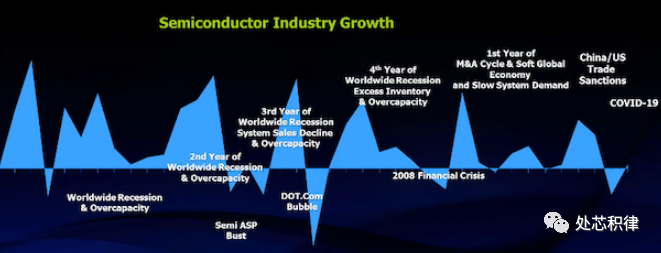
The development pattern of the entire semiconductor industry isboom, reshuffle, then boom, and then reshuffle in cyclical changes.
Next, let’s take a look atthe historical growth points of the semiconductor industry.
-
Personal Computer Revolution
From the late 1970s to the early 1980s, the popularity of personal computers drove the demand for semiconductor products such as microprocessors and memory. Intel’s x86 microprocessor architecture was widely adopted during this period.
Representative product: Desktop computers
-
Communication and Mobile Devices
From the late 1990s to the early 2000s, the proliferation of mobile phones and the rapid development of communication technology drove the demand for wireless communication chips and embedded systems. The smartening of mobile phones also led to a greater demand for high-performance chips.
Representative product: Mobile phones
-
Internet and Data Centers
From the late 2000s to the 2010s, the explosion of the internet and the rise of cloud computing led to the construction of large-scale data centers, thereby driving the demand for high-performance processors, memory, and network chips.
Representative product: Servers
-
Digital Media and Consumer Electronics
From the late 2000s to the 2010s, the dissemination of digital media content and the diversification of consumer electronic products, such as digital cameras, audio players, and gaming consoles, all drove the development of multimedia chips.
Representative products: MP3 players, counterfeit devices, etc.
-
Tablets and Smartphones
In the 2010s, the popularity of tablets and smartphones accelerated the development of high-performance, low-power processors and packaging technologies to meet the demands of these mobile devices.
Representative product: iPhone
-
Internet of Things (IoT)
From the late 2010s to the early 2020s, the rise of the IoT increased the demand for various connected devices and sensors, requiring a large number of low-power, miniaturized chips across both home and industrial sectors.
Representative products: Smart speakers, shared bicycles
What are the future growth points for the semiconductor industry? I can’t predict with certainty, but I can mention a few general directions.
-
Artificial Intelligence (AI)
Application areas: Text/short video/movie generation, drug development, and various other fields.
-
Robotics
Application areas: Domestic services, companionship, transportation, rescue, and various other fields.
-
Smart Wearables
Application areas: Personal health monitoring, memory assistance, etc.
-
New Hardware
Application areas: Social networking, gaming, and various other fields.
-
Autonomous Driving and Intelligent Transportation
Application areas: Mobility
In addition to the above, what other potential golden growth points for semiconductors can you think of? Feel free to leave comments for discussion.
Recommended Reading




Click to read the original article for IC design job consultation