► Source: Observer Network Liubai
The diplomatic turmoil initiated by Japanese Prime Minister Fumio Kishida regarding China has drawn global attention. Bloomberg noted on November 21 that China quickly implemented a series of countermeasures against Japan, including travel advisories and a suspension of seafood imports, highlighting its economic influence over Japan and reflecting Japan’s limited maneuvering space.
Analysts believe that Japan continues to employ its usual response strategy, avoiding direct retaliatory actions while keeping communication channels open, hoping that the situation will gradually ease over time. Some industry insiders suggest that Japan could collaborate with the U.S. to tighten export controls in the semiconductor sector, thereby posing a “severe challenge” to China’s related industries, but Japan must act cautiously to avoid impacting its own economy.
Reports indicate that the longer the current standoff between China and Japan lasts, the more likely Japan is to engage in close cooperation with the U.S. and like-minded partners.
Just two days ago, U.S. Ambassador to Japan Rahm Emanuel publicly supported Kishida. After meeting with Japanese Foreign Minister Toshimitsu Motegi in Tokyo, he expressed “steadfast” support for Kishida on social media, claiming that China’s actions against Japan constitute “economic coercion,” and that the related countermeasures are “unacceptable.”
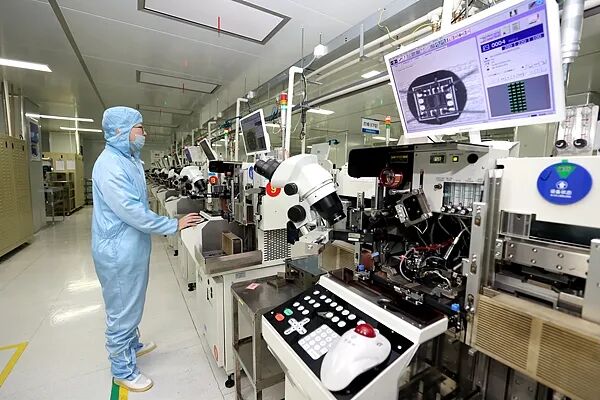
On October 15, in Suqian, Jiangsu: Workers operate smart devices to produce power chip packaging products. Visual China
The technology sector may become a key area for Japan-U.S. cooperation. Reports indicate that semiconductor manufacturing equipment is a critical category in Japan’s exports to China, accounting for over 10% of Japan’s total exports to China last year. Japan may consider tightening export controls in this area. However, if Japan takes this step, it must carefully weigh the potential impact on its own economy.
Masahiro Wakusawa, a senior technology analyst at Bloomberg Industry Research, pointed out that Japan has advantages in chip manufacturing technology, and its companies can supply key equipment and materials for both advanced and mature process chips. However, for Japanese companies that heavily rely on the Chinese market, if the government does not implement clear mandatory measures, they are likely to adopt a wait-and-see attitude towards the related control policies.
“But if they can gain support from the U.S., the situation would be entirely different. With Japan and the U.S. joining forces, they would control a significant portion of the global core chip manufacturing supply chain, which would undoubtedly pose a more severe challenge to China’s chip industry,” Wakusawa said.
Reports suggest that if China follows through on its threats of further sanctions, this dispute may escalate. China may resort to restricting rare earth exports, a strategy it employed during the territorial disputes with Japan over a decade ago. With the global dependence on China’s rare earth supplies increasing, this tactic could also impact the U.S. and Europe.
“If China tightens (rare earth) controls, Japan may seek assistance from the U.S. or procure key mineral resources through third countries,” said Jeremy Chan, a senior analyst at Eurasia Group and former U.S. diplomat.
Nevertheless, Japan remains exposed to risks. According to data from Tadanori Sasaki, a senior research director at the Japan Energy Economics Institute, Japan’s dependence on Chinese rare earths had dropped to about 60%, but has recently risen to over 70% due to the surge in demand for electric vehicles and renewable energy.
Rare earth magnets have a wide range of applications, from electric motors to consumer electronics. Earlier this year, China’s tightening of rare earth export controls triggered a potential supply shortage crisis, which was one of the reasons prompting the Trump administration to seek to ease relations with China.
China has repeatedly emphasized that its measures regarding rare earth export controls are a normal practice in improving its export control system in accordance with the law, reflecting China’s responsibility as a major power in maintaining world peace and stability. China is committed to ensuring the security and stability of global production and supply chains.
Reports indicate that although Japanese officials and companies have not disclosed specific details about their rare earth reserves, analysts believe that China is unlikely to impose a complete ban on rare earth exports to Japan. Currently, there are signs of easing in China-Japan diplomatic relations, and agreements have been reached between China and the U.S., making it unlikely for China to take actions that could lead to turmoil.
However, China still has many means to exert pressure on Japan.
Douglas Paal, director of the Asia Program at the German Marshall Fund, stated, “While it is unlikely that China will completely ban rare earth exports to Japan, it may create obstacles through administrative means such as extending license approval times and strengthening export document reviews.”
Jeremy Chan believes that if this dispute continues to escalate, Japan may seek more diplomatic support from other countries. Japan may unite with G7 allies to condemn China’s actions and push for a diplomatic resolution to the dispute. At the same time, Japan will increase direct communication with China, as it is unwilling to retaliate against China’s countermeasures.
Regarding the China-Japan diplomatic turmoil, U.S. State Department spokesperson Tommy Vietor asserted on the 20th that the U.S. commitment to Japan’s defense remains steadfast.
However, there are still doubts about the reliability of the U.S. as a security partner under the Trump administration.
On November 10, President Trump responded to this turmoil in an interview with Fox News, stating, “Many allies are not friends of the U.S.” This remark was seen as a cold shower for Kishida.
“If I were a leader of Japan, South Korea, or other countries, my confidence in the security guarantees provided by the U.S. would likely be greatly diminished,” said Joe Mazur, a senior analyst at Trivium China Consulting.
In just one month in office, Kishida has made significant blunders and has yet to retract his erroneous statements, making him a “troublemaker” in the eyes of many.
Bloomberg reported on the 17th that Kishida touched a red line for China upon taking office and is facing a significant diplomatic test, but he has no effective means to prevent China’s retaliation. Domestically, if he compromises with China, Kishida will face substantial political backlash, but China has already hinted that if the situation spirals out of control, it may escalate sanctions further and sever diplomatic, economic, and military communication channels.
At the regular press conference of the Chinese Ministry of Foreign Affairs on November 21, a reporter asked about Kishida’s statement that Japan’s idea of developing a mutually beneficial strategic relationship with China has not changed. What is China’s comment on this?
Spokesperson Mao Ning emphasized that Prime Minister Kishida’s public remarks regarding Taiwan contain erroneous statements, suggesting the possibility of military intervention in the Taiwan Strait, which has aroused public anger and condemnation in China. China firmly opposes this. If Japan genuinely wishes to develop a mutually beneficial strategic relationship with China and build a constructive and stable China-Japan relationship that meets the requirements of the new era, it should adhere to the spirit of the four political documents between China and Japan and the political commitments made, immediately retract its erroneous statements, and translate its commitments to China into concrete actions.
Source: Observer NetworkRecommended Reading