


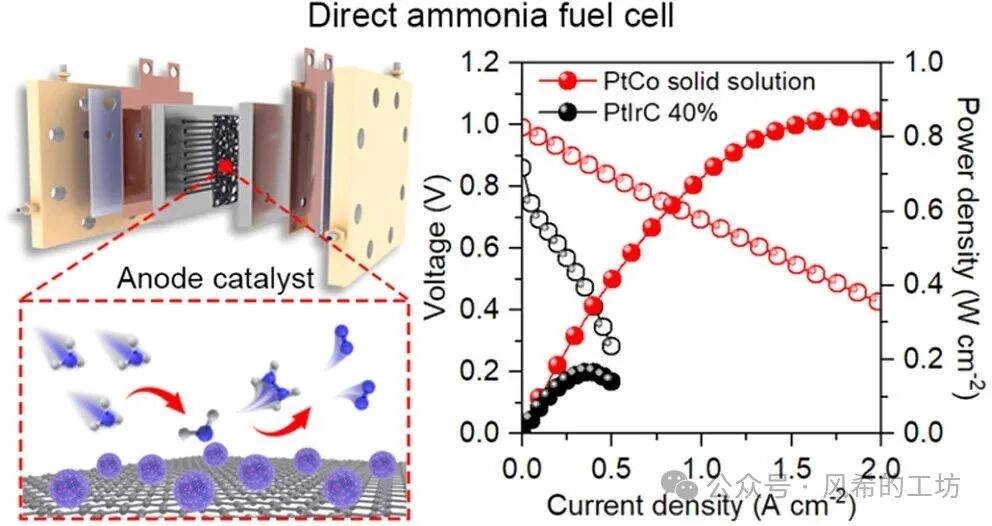
Direct ammonia fuel cells (DAFC) are a low-carbon power generation technology with high safety and energy density. However, the slow kinetics and unclear mechanisms of the anodic ammonia oxidation reaction (AOR) limit their practical application. Recently, a study published in J. Am. Chem. Soc. designed a trace cobalt-substituted platinum solid solution catalyst, which, combined with a nucleophilic attack mechanism, significantly improved AOR performance, achieving a DAFC power density breakthrough of 853.75 mW cm⁻², marking a key step towards the practical application of DAFCs.
1
Research Background

DAFCs use ammonia as fuel for low-carbon power generation, but AOR, as the core anodic reaction, faces issues such as slow kinetics and catalyst poisoning. Traditional mechanisms (e.g., G-M mechanism) require the coupling of two adsorbed intermediates, which presents significant steric hindrance. The nucleophilic attack mechanism in homogeneous catalysis may overcome these limitations, but it has not been validated in heterogeneous catalysis. Therefore, elucidating the efficient mechanism of AOR and designing matching catalysts is key to promoting the practical application of DAFCs.
2
Overview of the Full Text
This study proposes a nucleophilic attack mechanism for AOR: free NH₃ attacks the pre-oxidized *NHₓ intermediates to form N-N bonds, which is easier than the traditional mechanism. The designed Pt₀.₉₅Co₀.₀₅ solid solution catalyst (Pt₀.₉₅Co₀.₀₅-SSC) exhibits excellent performance in AOR: peak current density reaches 83.96 A g⁻¹, and performance retention is 90.61% after 5000 cycles. The assembled DAFC achieves a power density of 853.75 mW cm⁻² at 60°C, with a performance retention of 95.14% after continuous operation for 300 hours, far exceeding existing reports, validating the practical value of this catalyst.
3
Graphical Analysis
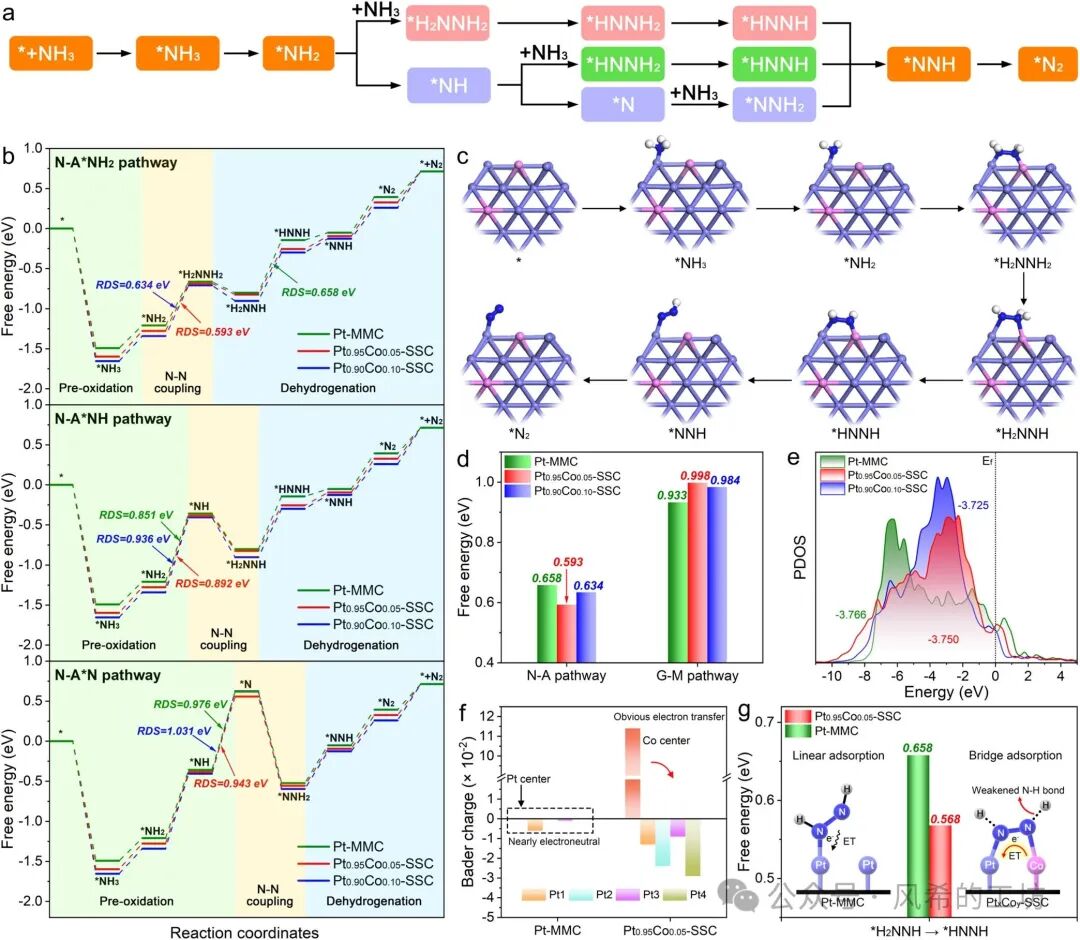
Figure 1:AOR Mechanism. Comparing the nucleophilic attack mechanism (N-ANH₂, N-ANH, N-AN) with the traditional G-M mechanism reveals that the energy barrier for free NH₃ attacking NH₂ to form N-N bonds is the lowest (0.593 eV), thermodynamically more favorable. Cobalt substitution allows the Pt-Co solid solution to form a bridging adsorption mode, weakening the N-H bond and reducing the subsequent dehydrogenation energy barrier, with Pt₀.₉₅Co₀.₀₅-SSC having the lowest rate-determining step energy barrier, theoretically validating its high activity.
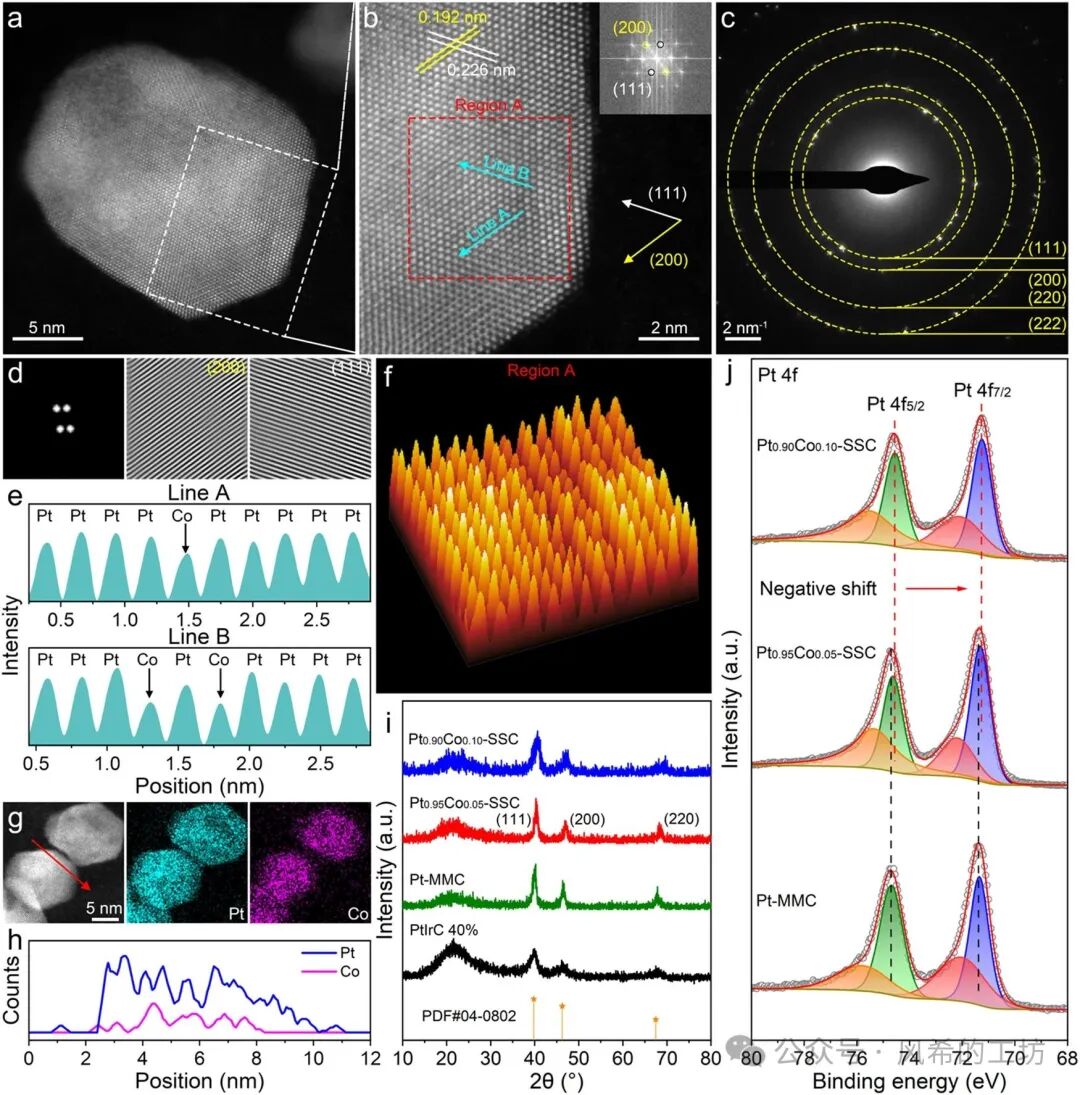
Figure 2:Structural Characterization of the Catalyst. AC-HAADF-STEM and EDS mapping confirm the uniform distribution of Pt and Co, forming a solid solution; XRD shows lattice contraction, indicating Co incorporation into the Pt lattice; XPS and XANES indicate electron transfer from Co to Pt, with the d-band center of Pt shifting upward, optimizing intermediate adsorption. These results confirm the uniform structure and electronic regulation of Pt₀.₉₅Co₀.₀₅-SSC.
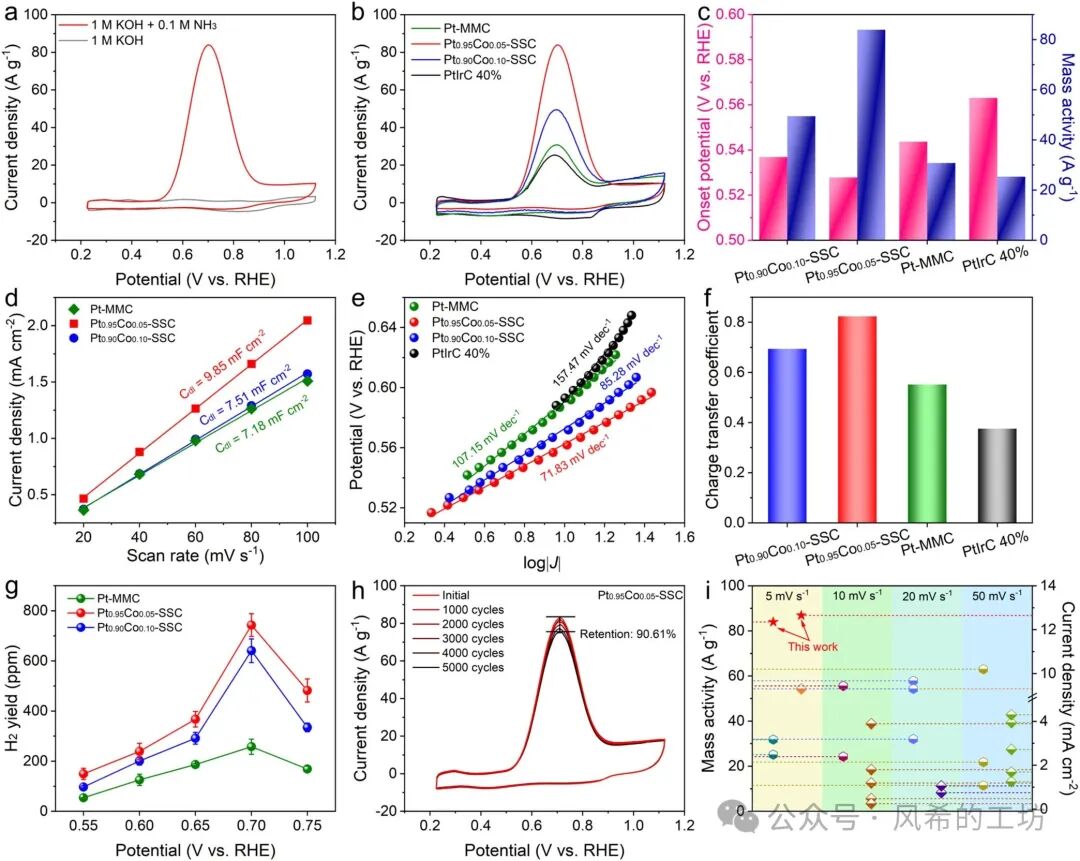
Figure 3:AOR Electrochemical Performance. CV curves show that the peak current density of Pt₀.₉₅Co₀.₀₅-SSC (83.96 A g⁻¹) is 2.7 times that of pure Pt, with the lowest onset potential (0.528 V vs RHE); the Tafel slope is minimal, and the charge transfer coefficient is highest, indicating optimal kinetics. Accelerated degradation tests show that performance retention is 90.61% after 5000 cycles, demonstrating excellent stability, superior to commercial PtIrC catalysts.
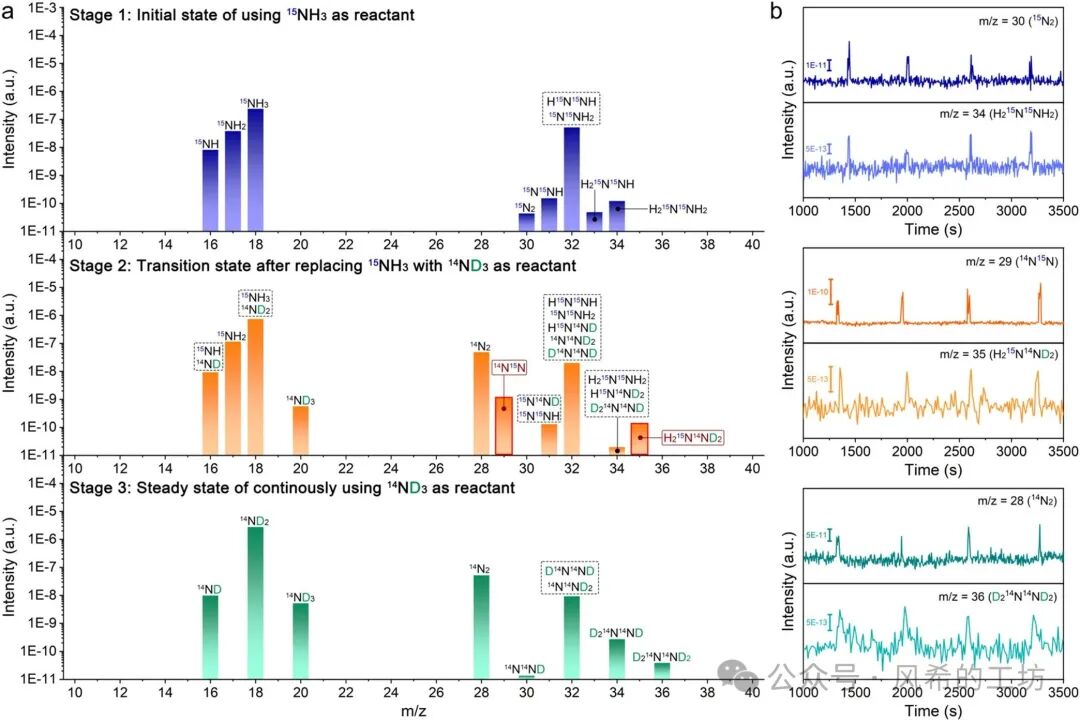
Figure 4:Isotope Labeling Experiments to Validate Mechanism. Three-stage DEMS testing: initially using ¹⁵NH₃ detected ¹⁵N₂ (m/z=30) and other intermediates; in the transition stage, switching to ¹⁴ND₃ detected ¹⁴N-¹⁵N mixed intermediates (e.g., H₂¹⁵N¹⁴ND₂, m/z=35); in the steady-state stage, only ¹⁴N species were observed. The results directly demonstrate that free NH₃ attacks the adsorbed *NH₂ to form N-N bonds, validating the nucleophilic attack mechanism.
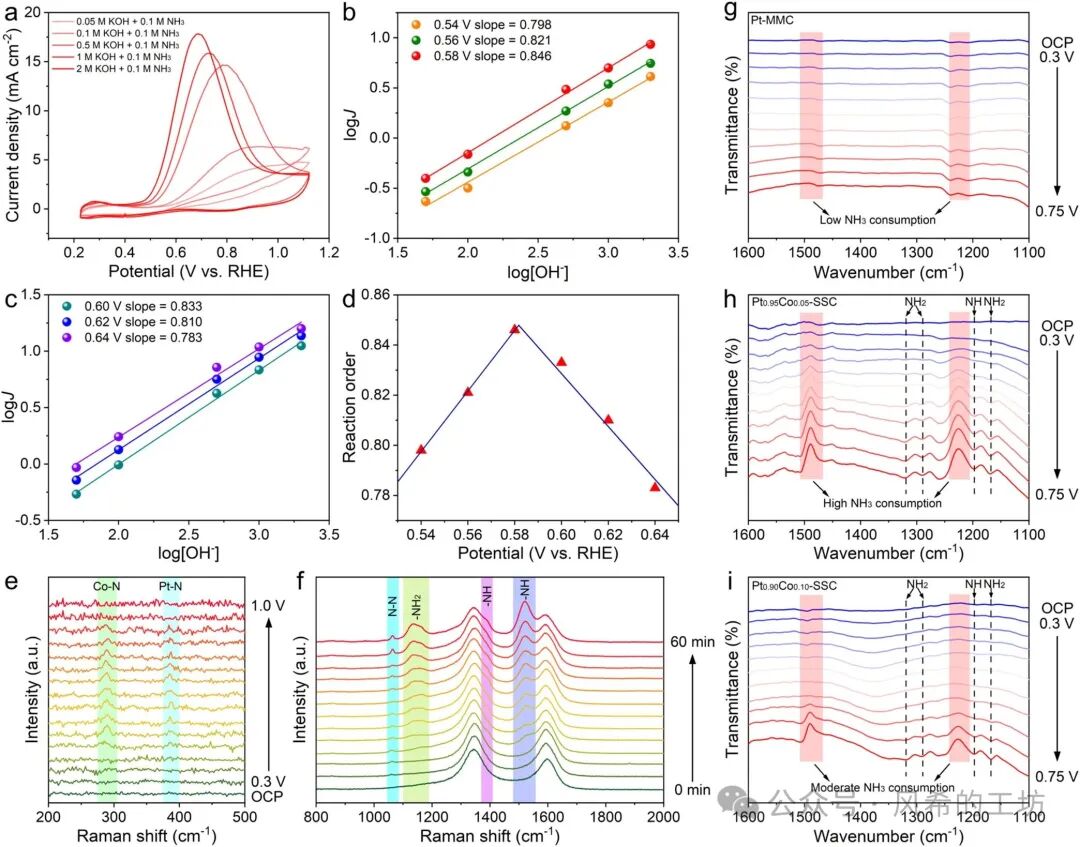
Figure 5:Reaction Mechanism. In situ Raman shows a significant Co-N vibration peak (286 cm⁻¹) on Pt₀.₉₅Co₀.₀₅-SSC, indicating bridging adsorption of intermediates; in situ FTIR detected -NH, -NH₂, and N-N stretching peaks, with NH₃ consumption occurring more rapidly. OH⁻ concentration experiments show that the reaction is first-order dependent on OH⁻, confirming its auxiliary dehydrogenation role. These results elucidate how Co weakens the N-H bond through bridging adsorption, accelerating the reaction.
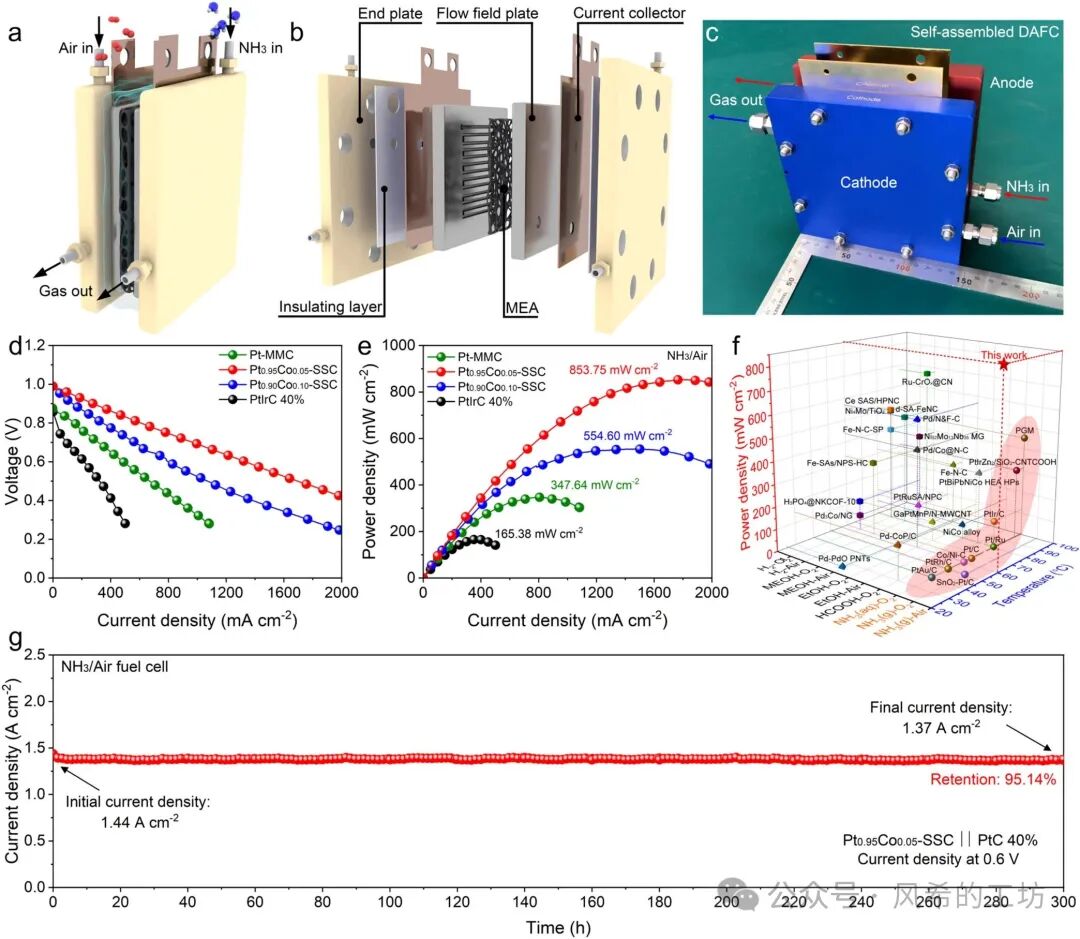
Figure 6:DAFC Performance. Polarization curves show that the open-circuit voltage of DAFC with Pt₀.₉₅Co₀.₀₅-SSC as the anode is 0.99 V, with a peak power density of 853.75 mW cm⁻², far exceeding pure Pt (347.64 mW cm⁻²) and commercial catalysts. In a 300-hour stability test, the current density retention is 95.14%, and performance surpasses existing reports of DAFCs, validating its practical application potential.
4
Conclusion and Outlook
This study proposes a nucleophilic attack mechanism for AOR, breaking through the steric hindrance limitations of traditional mechanisms, and designs a Pt₀.₉₅Co₀.₀₅ solid solution catalyst. Through Co’s electronic regulation and bridging adsorption mode, AOR activity and stability are significantly enhanced. The assembled DAFC achieves a power density of 853.75 mW cm⁻² and can stably operate for 300 hours, providing an efficient catalyst and mechanistic guidance for low-carbon power generation applications of DAFCs, pushing towards practical application.

Paper Information

Yanzheng He, Sisi Liu*, Qiyang Cheng, et al. Facilitating Anodic Ammonia Oxidation over Trace Cobalt-Substituted Solid Solution of Platinum to Boost Direct Ammonia Fuel Cell up to 853.75 mW cm–2. J. Am. Chem. Soc. 2025. https://doi.org/10.1021/jacs.5c08228.