
As urban environments rapidly evolve into digital ecosystems, the integration of smart infrastructure and interconnected devices has become central to urban planning.
Author: Michael De Nil, Co-founder and CEO of Morse Micro
The core of the transition to a digital ecosystem is the Internet of Things (IoT), where connected sensors, smart meters, and embedded controllers work together to optimize energy consumption, traffic monitoring, reduce emissions, and protect public safety.
As the scale and complexity of these systems grow, so do the demands on them. What is emerging is something larger; a shift towards IoT 2.0. The next wave goes beyond simple connectivity, prioritizing intelligence, autonomy, and real-time responsiveness in large distributed systems. Think of devices that not only report data but also analyze, decide, and act. Imagine networks that can scale seamlessly and operate without failure.

As the IoT expands, many urban planners and utility providers face connectivity bottlenecks. Traditional networks like 2.4GHz Wi-Fi, LoRaWAN, and Wi-SUN have reached their limits in range, reliability, and throughput. Cellular alternatives offer speed but come with trade-offs in cost and power consumption. What is emerging is a wireless solution that balances power, penetration, and performance, known as Wi-Fi HaLow.
Wi-Fi HaLow, also known as IEEE 802.11ah, is poised to become the cornerstone of smart metering infrastructure and a key enabler of the next generation of smart cities. More importantly, it can serve as the wireless backbone of IoT 2.0, where always-on, low-power, edge-intelligent devices can act as autonomous nodes in smarter, more adaptive urban systems.
Smart Meters: A New Role in the Smart Grid
Historically, the introduction of smart meters was aimed at automating billing and simplifying meter reading. However, their role is expanding. In modern grids, especially those supporting renewable energy sources like wind and solar, energy availability can fluctuate significantly. Smart meters are evolving to manage demand in near real-time, adjusting appliance usage and electric vehicle charging based on supply changes.
Imagine a city where thousands of homes are powered by solar panels. On cloudy days, generation may suddenly drop. In such cases, smart meters must not only notify utility companies but also help balance household energy usage by throttling electric vehicle charging, prioritizing HVAC, or drawing power from batteries.
This level of control requires meters to perform a lot of heavy lifting: local processing, real-time communication with devices, and fast, reliable backhaul. Wi-Fi HaLow helps meet these demands. In the context of IoT 2.0, smart meters become intelligent agents capable of negotiating usage with other devices, participating in dynamic pricing events, and optimizing loads locally using embedded intelligence.
Why Traditional Connections Fall Short
The dominant short-range wireless technology in today’s homes—2.4GHz Wi-Fi—was never designed for IoT. High frequencies like 2.4GHz and 5GHz quickly attenuate through walls and floors. This becomes a real issue in smart homes, as signals must be transmitted from meters, typically located outdoors, to indoor routers, gateways, or smart appliances.

In contrast, Wi-Fi HaLow operates in the sub-GHz frequency band (typically around 900MHz). The lower frequency penetrates physical barriers more effectively, providing a transmission range that is ten times that of traditional Wi-Fi. Moreover, while 2.4GHz signals may drop off after two to three walls, Wi-Fi HaLow can maintain a strong, stable connection through several walls, which is crucial for connecting meters to home energy systems like solar inverters, batteries, and smart thermostats.
This resilient remote connection enables the distributed intelligence required for IoT 2.0, where decisions happen closer to the edge rather than solely in the cloud.
LAN vs. WAN: A Smart City Perspective
One of the most important shifts that planners and utility companies need to recognize is that Wi-Fi HaLow is a local area network (LAN) solution, not a wide area network (WAN). While WAN technologies like LTE or 5G are designed to cover entire countries, Wi-Fi HaLow is best suited for creating large-scale, high-performance LANs that far exceed the coverage of traditional Wi-Fi. By design, it is a LAN solution, not a WAN.
Why this matters:
● Large-scale LANs: Wi-Fi HaLow enables businesses, municipalities, and industries to create large-scale LANs that span factories, campuses, farms, or even entire smart cities.
● Native IP and Wi-Fi interoperability: As a Wi-Fi protocol, Wi-Fi HaLow devices can seamlessly interoperate with a broader Wi-Fi ecosystem. This means devices can communicate locally, integrating seamlessly with existing infrastructure and cloud platforms.
● Smart city use cases: Imagine a citywide LAN connecting lighting, traffic signals, environmental sensors, and security cameras—all without the recurring costs of cellular WAN solutions.
In short, smart cities do not need every sensor connected via cellular WAN. Instead, they need scalable LANs that keep intelligence local, are cost-effective, and are interoperable. Wi-Fi HaLow provides the missing layer by bridging the gap between traditional Wi-Fi and many alternatives. It is not limited to a single building but can extend several kilometers. It is not limited to dozens of devices; each access point can scale to hundreds. Unlike WAN-based alternatives, it keeps intelligence local, secure, and cost-effective.
The Benefits Behind the Meter: Whole-Home Coverage Without Repeaters
One of the most overlooked benefits of Wi-Fi HaLow is that it eliminates the need for extenders, mesh repeaters, or rewiring. A single Wi-Fi HaLow access point can cover hundreds of meters through walls and interference, and under open conditions, can cover up to a kilometer. This significantly reduces deployment costs for utilities and simplifies integration for OEMs and consumers.
It also supports a shift towards distributed IoT clusters, where numerous nodes operate semi-independently in a local intelligent grid. Moreover, since each access point supports hundreds of devices, utilities can connect an entire multi-dwelling unit (MDU) or dense urban block with a single Wi-Fi HaLow gateway, simplifying infrastructure.
Real-World Field Trials and Global Momentum
In a recent global field trial coordinated by the Wireless Broadband Alliance (WBA), Wi-Fi HaLow was validated in several smart city applications, including smart metering, environmental sensors, and building automation.
These trials demonstrated Wi-Fi HaLow’s remote capabilities, stable signal performance in dense environments, and energy efficiency for battery-powered devices. These results reinforce Wi-Fi HaLow’s potential as a unified wireless layer for smart infrastructure.
Countries like Australia, Japan, the United States, and Indonesia are exploring Wi-Fi HaLow-based smart metering deployments, partly due to the technology’s performance in urban and rural conditions.
Looking Ahead: Wi-Fi HaLow in the Smart City Stack
In the near future, no single wireless technology will dominate smart cities. Instead, hybrid network architectures will emerge. IoT 2.0 will require flexible, layered, and interoperable networks, with local edge mesh networks feeding into broader urban data structures. Some technologies may continue to coexist, such as cellular (LTE and 5G) supporting high-bandwidth edge computing use cases. Additionally, LoRaWAN and Wi-SUN will continue to be used for remote and cost-sensitive applications.
However, Wi-Fi HaLow may fill an increasingly large gap, becoming the preferred technology for mid-tier IoT applications where traditional Wi-Fi cannot reach and cellular networks are overutilized.
Wi-Fi HaLow is expected to expand into:
● Electric vehicle chargers and home energy management
● Parking meters and traffic sensors
● Commercial real estate building management systems
● Agricultural monitoring in smart rural communities
● Security and surveillance systems in urban and campus settings
From Smart Meters to Smart Cities
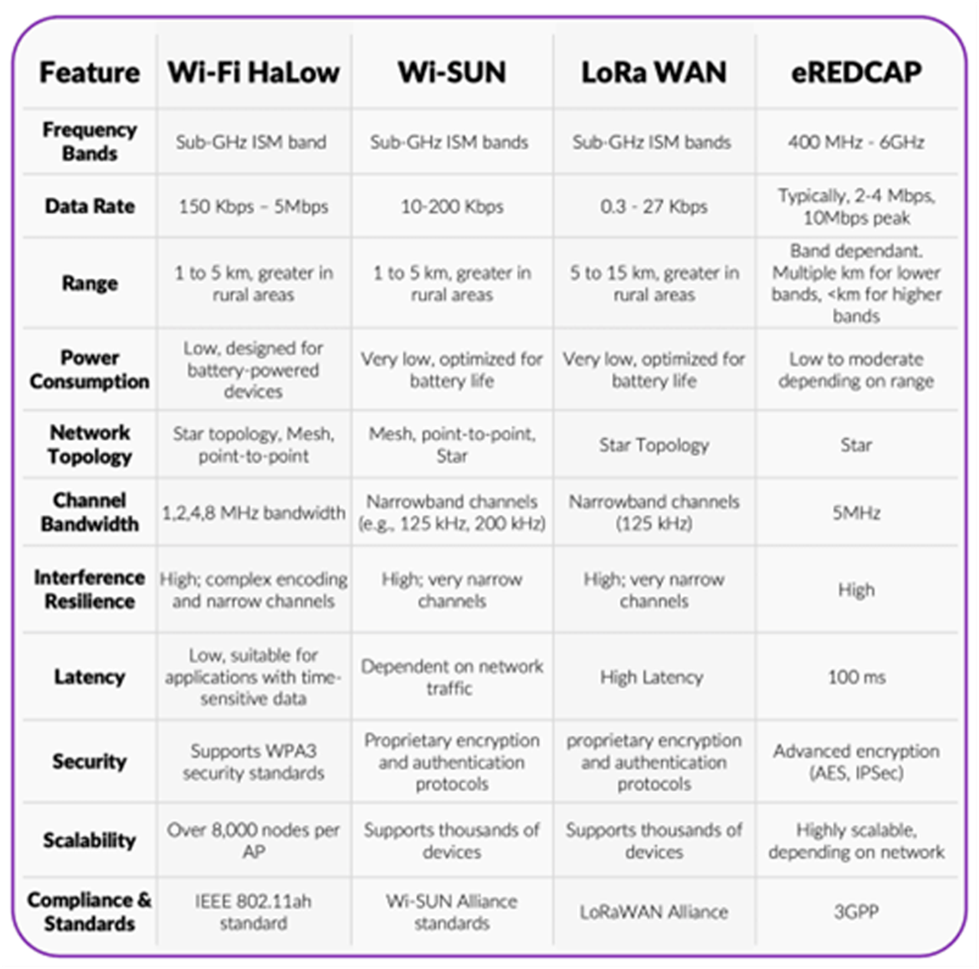
Connectivity is the backbone of every smart city, and choosing the right wireless layer is critical to success. Wi-Fi HaLow offers a compelling combination of performance, scalability, and cost-effectiveness that will prove ideal for evolving applications like smart metering that require robust, low-power, long-range links.
In addition to connectivity, IoT 2.0 also requires a new mindset—one that can achieve intelligence, adaptability, and autonomy at scale.
As cities become smarter, utilities more dynamic, and consumers more energy-conscious, Wi-Fi HaLow is poised to connect it all, quietly enabling the next wave of sustainable interconnected infrastructure.
Security is another key component when evaluating smart grid technologies. Wi-Fi HaLow adheres to the IEEE 802.11ah standard, which includes robust security protocols like WPA3. These security features provide end-to-end encryption and secure authentication, which are critical for protecting smart meters and other IoT endpoints from cyber threats. In contrast, some legacy systems may lack the ability to scale their security infrastructure to meet today’s growing cybersecurity demands.
The regulatory and certification environment is also evolving to support the large-scale deployment of Wi-Fi HaLow. With the establishment of the Wi-Fi Alliance’s Wi-Fi CERTIFIED HaLow program, interoperability between devices from different vendors is assured, giving utilities and municipalities greater confidence in integrating Wi-Fi HaLow into their smart city infrastructure. This development facilitates faster adoption and smoother integration across ecosystems, particularly in complex environments involving multiple device types and manufacturers.
For large-scale deployments, scalability is crucial. With the ability to connect hundreds of devices per access point, Wi-Fi HaLow stands out in serving dense smart grid environments. In high-density urban areas, this allows a single network to support a wide range of smart city applications, from metering and electric vehicle charging to smart lighting and traffic systems, without the need for extensive infrastructure expansion or multiple gateways.
Another often-overlooked benefit of Wi-Fi HaLow is that it operates in unlicensed spectrum. This eliminates costly carrier contracts and allows utility operators to control their own network infrastructure. Unlike LTE or 5G networks, which operate on licensed spectrum and require ongoing fees and third-party agreements, Wi-Fi HaLow networks can be owned, operated, and maintained in-house, reducing long-term costs and enabling greater deployment flexibility.
Beyond energy metering, Wi-Fi HaLow’s low power and remote connectivity open the door to a broader ecosystem of smart city services. For example, environmental monitoring stations can be deployed throughout a city without relying on power-hungry or short-range technologies. These sensors can collect and transmit data on air quality, temperature, humidity, and noise pollution, enabling municipalities to make data-driven decisions that enhance quality of life.
Looking ahead, the convergence of energy management, urban planning, and IoT innovation will require wireless solutions that are adaptive, secure, and scalable. Wi-Fi HaLow has proven to be a transformative technology in this space. With its ability to bridge the gap between constrained traditional systems and the future demands of smart cities, it is well-positioned to become the foundational wireless platform for connecting tighter, more efficient, and more sustainable urban futures.