Click the blue text to follow us



In the current era of rapid integration of the digital economy and intelligent manufacturing, warehouse logistics is quickly transitioning from a “labor-intensive” model to a “data-driven” one. The increasing complexity of order structures, higher inventory turnover requirements, and rising labor costs have made the inefficiencies, errors, and lack of visibility in traditional warehousing models increasingly apparent.
In this wave of transformation, PLC (Programmable Logic Controller) is no longer just a “device controller”; it has become the system’s “nervous center” connecting devices, data, and business logic. This article analyzes how PLC-based intelligent warehouse logistics systems can become a key driver for efficient operations in enterprises from three dimensions: architecture, technology, and value.

1. Architecture Design
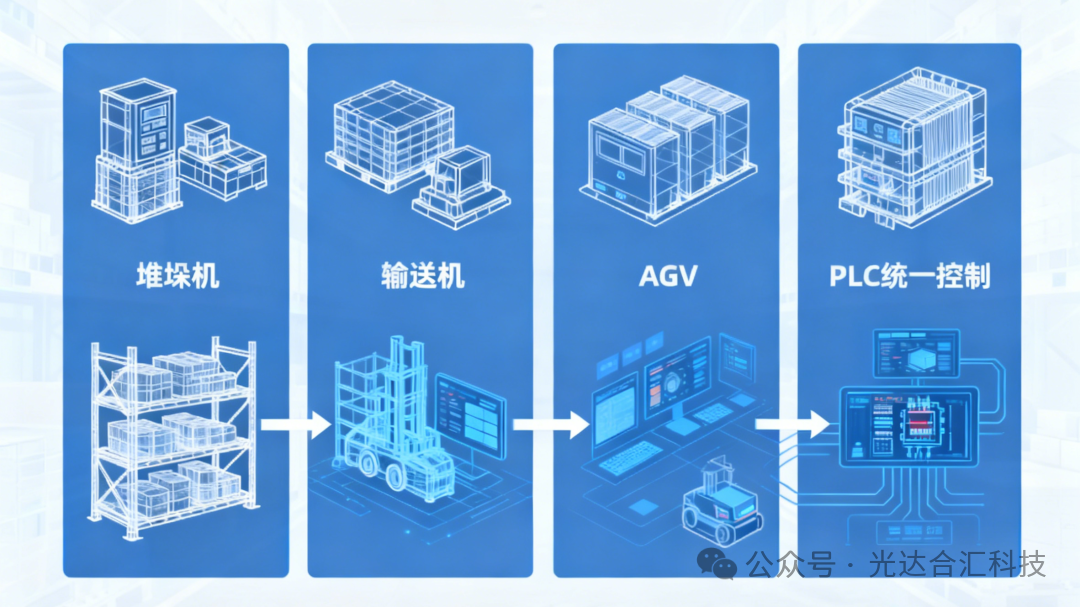
The efficient operation of an intelligent warehouse system relies on solid architectural design, and PLC is the key link that connects the device layer, control layer, and management layer.
In a typical “three-layer architecture”, the device execution layer is responsible for the actual actions of the system, including equipment such as automated storage, stackers, conveyor lines, and AGVs. PLCs combined with sensors collect position signals, speed feedback, and fault statuses in real-time, directly controlling the lifting, extending, and acceleration/deceleration of devices, ensuring that goods are stored and retrieved with millimeter-level precision. As the “brain” of the system, the control layer processes the data uploaded from the execution layer, providing action instructions based on business logic to ensure that the system maintains industrial-grade stability even at high speeds.
The top-level monitoring and management layer communicates with the PLC through a host computer, enabling task scheduling, operational monitoring, inventory analysis, and other functions. Managers can intuitively view the warehouse’s operational status on the interface and optimize strategies by modifying parameters when necessary. This layered architecture allows for precise and controllable device actions while providing the management layer with visualization and flexible tuning capabilities, forming a truly automated closed-loop system.
2. Technology Integration
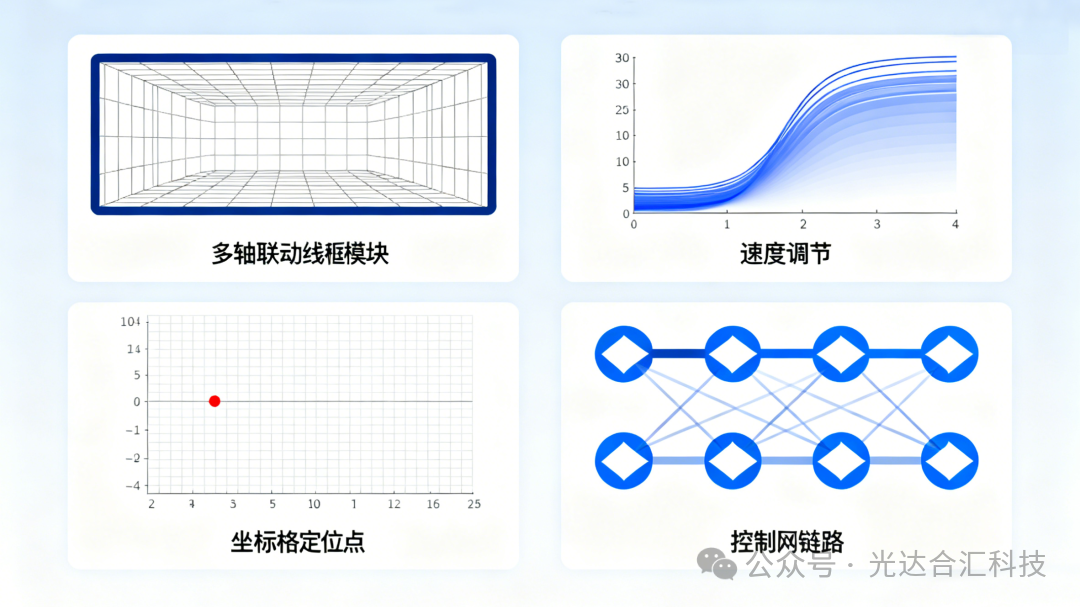
The reason PLCs can support the complex collaboration of intelligent warehouse systems is that they integrate core technologies such as motion control, communication interaction, and logic programming.
In terms of motion control, the multi-axis synchronization and high-speed response capabilities of PLCs enable seamless connections between devices such as stackers, conveyor lines, and AGVs. For example, during the transfer of goods, the PLC adjusts the device speed in real-time based on encoder and sensor data, ensuring a stable transfer process and reducing errors caused by shaking or shifting.
Data communication gives the entire warehouse system a “nervous system-like” information flow capability. PLCs achieve millisecond-level data interaction with host computers, WMS, RFID devices, and others through protocols such as Industrial Ethernet and PROFINET, ensuring that inventory status, equipment conditions, and task execution information are always updated in real-time.
Logic programming provides flexibility for the system to adapt to different scenarios. Engineers can write inbound strategies, turnover rules, and inventory logic into the PLC using ladder diagrams or structured text. When business models change, the process can be restructured simply by adjusting the program logic, without the need for large-scale modifications to hardware, significantly reducing upgrade costs.
3. Value Realization
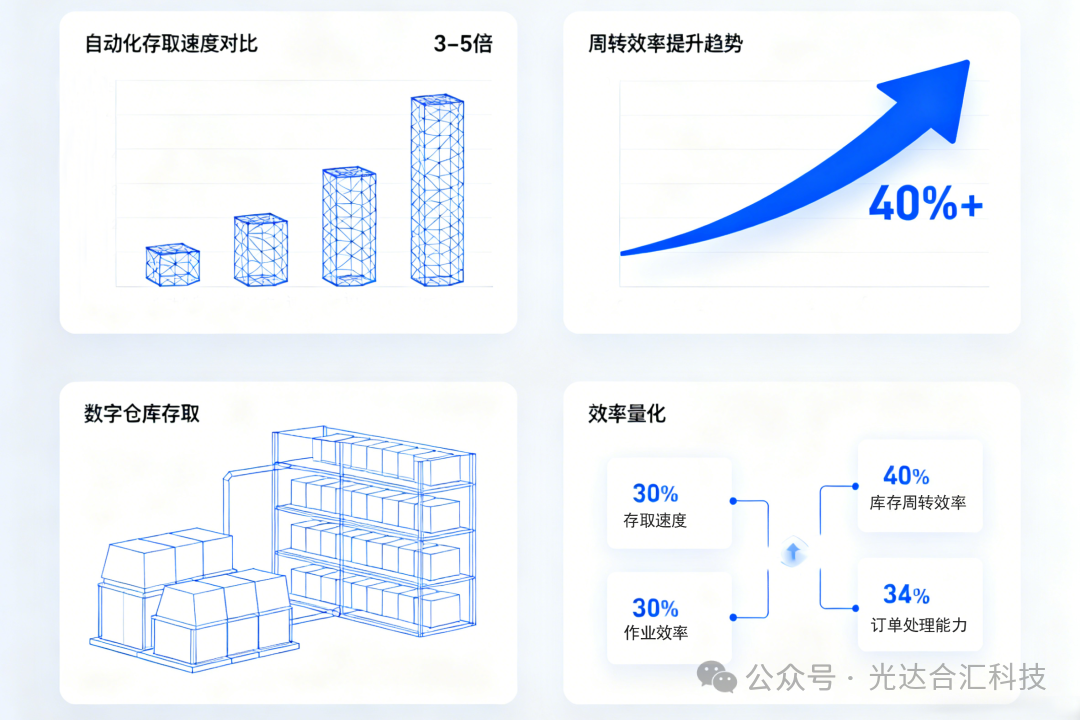
The PLC-based intelligent warehouse logistics system signifies more than just “automation”; it reflects a comprehensive enhancement in efficiency, cost, and management capabilities.
Firstly, in terms of efficiency, the high-speed control of PLCs allows devices to operate at optimal rhythms. For instance, the retrieval speed of stackers in automated mode can increase to 3-5 times that of manual operations, with overall inventory turnover efficiency improving by over 40%. The order processing capacity multiplies, enabling enterprises to easily cope with peak scenarios such as promotions and surges in orders.
In terms of cost, automation reduces the demand for repetitive labor, lowering labor and training costs. At the same time, the high stability of PLC systems allows for continuous operation 24/7 in environments with dust, vibration, and temperature fluctuations, significantly reducing downtime and maintenance costs. The precision of device actions also effectively reduces hidden losses such as damage to goods and misdelivery.
In terms of management, PLCs enable warehouses to truly achieve “data-driven operations” through real-time data collection. Managers can always grasp inventory dynamics, equipment status, and task progress, and make replenishment, scheduling, and capacity planning decisions based on trend data, avoiding the information lag and blind decision-making common in traditional models.
In summary, PLC not only shifts warehousing from “labor-intensive” to “intelligent control-driven” but also enables enterprises to obtain a measurable, traceable, and optimizable operational system.
From architecture construction, technology integration to value realization, PLC is no longer just a “controller”; it is the underlying “operating system” of intelligent warehousing. It connects devices, algorithms, data, and business logic, serving as the key support for the practical implementation of intelligent warehousing.
In the future, with further integration of PLCs with AI, digital twins, and the industrial internet, warehousing will possess autonomous scheduling capabilities, systems will achieve self-diagnosis and self-optimization, and upstream and downstream supply chains will achieve full-domain collaboration. For enterprises, those who first build an intelligent warehouse system based on PLC will gain the initiative in supply chain competition, achieving higher efficiency, lower costs, and greater resilience.


Like
Collect
Share