NANJING
NANJING
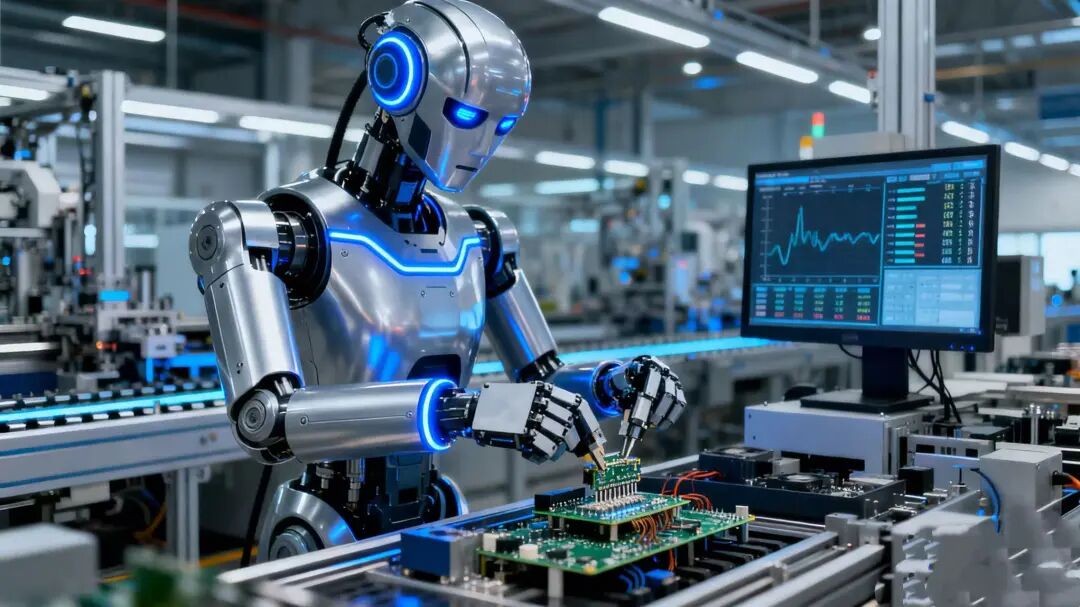
>>Image source from the internet
When robots are no longer cold mechanical executors, but can perceive the environment, make autonomous decisions, and act flexibly as “embodied intelligence”, the embodied robot industry is rapidly opening a new era of intelligent manufacturing. As a cutting-edge field that integrates information science, intelligent science, and mechanical engineering, it not only redefines the core connotation of “intelligent manufacturing” but also, driven by policies, capital, and technology, has become a new arena for global industrial competition.
NANJING
Embodied Robot
NANJING
From “Automation” to “Embodiment” Transition
Core Definition of Intelligent Manufacturing
Intelligent manufacturing is not simply about machines replacing humans, but rather centers on embodied intelligence, enabling machines to achieve a closed-loop capability of “perception-decision-execution” based on physical entities—possessing the ability to perceive open environments, act in complex scenarios, and exhibit human-like learning and reasoning intelligence. Unlike traditional industrial robots that operate on fixed processes, embodied robots, akin to having an “entity brain”, can adapt to dynamically changing environments and autonomously complete complex tasks in diverse scenarios such as industrial manufacturing, medical care, and home services, becoming the core hub connecting the digital and physical worlds.
Embodied
Robot
Evolution from Laboratory Prototypes to Large-Scale Implementation
Development History of Embodied Robots
The development of embodied robots has always revolved around dual breakthroughs in “human-likeness” and “practicality”. In the early stages, technology focused on optimizing mechanical structures and building basic perception capabilities, with robots only able to perform simple action simulations; as AI large models and sensor technologies merged, the industry entered an upgrade phase of “perception-decision”, with robotic arms and composite robots beginning to see limited applications in industrial scenarios.
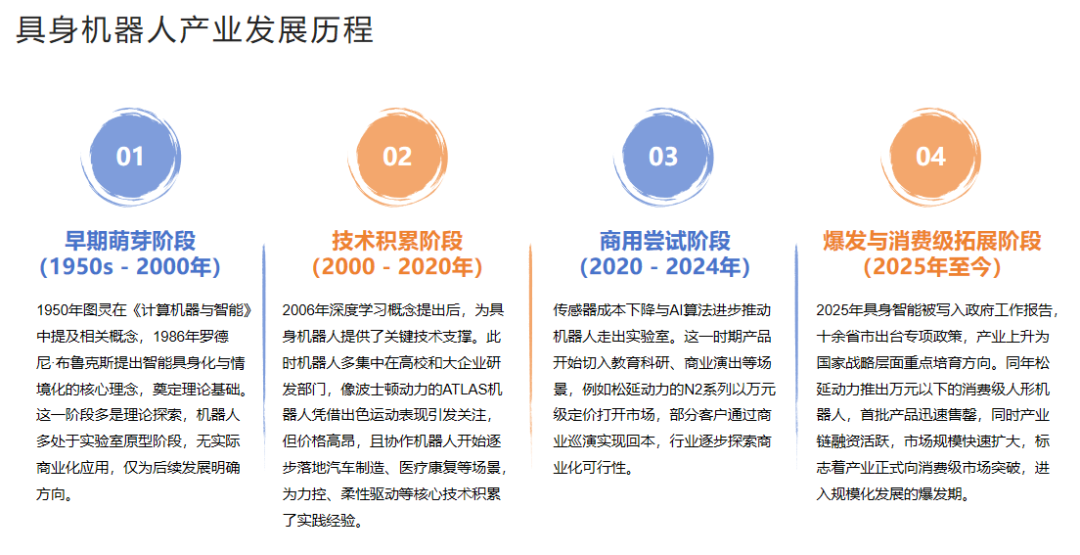
2025 will be a critical turning point, as “embodied intelligence” is first included in the government work report, with humanoid robots becoming the focal point of the industry due to their high human-likeness and strong adaptability, accelerating the transition from laboratory to commercial mass production. Today, embodied robots have achieved a leap from “single-point demonstration” to “multi-scenario penetration”, from precise assembly in industrial workshops to assisting rehabilitation in medical settings.

A trillion-dollar track is rising, with growth momentum continuously released
Market Size of Embodied Robots
The embodied robot industry is entering a period of explosive growth. Data shows that by 2025, the market size of embodied intelligence in China will reach 5.295 billion yuan, accounting for about 27% of the global share, with the humanoid robot market size reaching 8.239 billion yuan, dominating half of the global market. Third-party institutions predict that by 2027, the market size of embodied intelligence in China will soar to 12.5 trillion yuan, and by 2040, the humanoid robot industry is expected to exceed 2.2 trillion yuan, with the industrial and warehousing logistics sector expected to break 10 billion by 2030. The capital market is equally enthusiastic, with 144 financing events in the domestic industry chain in the first half of 2025, amounting to 19.5 billion yuan, with an average single financing scale of 135 million yuan, demonstrating the long-term value of the track.
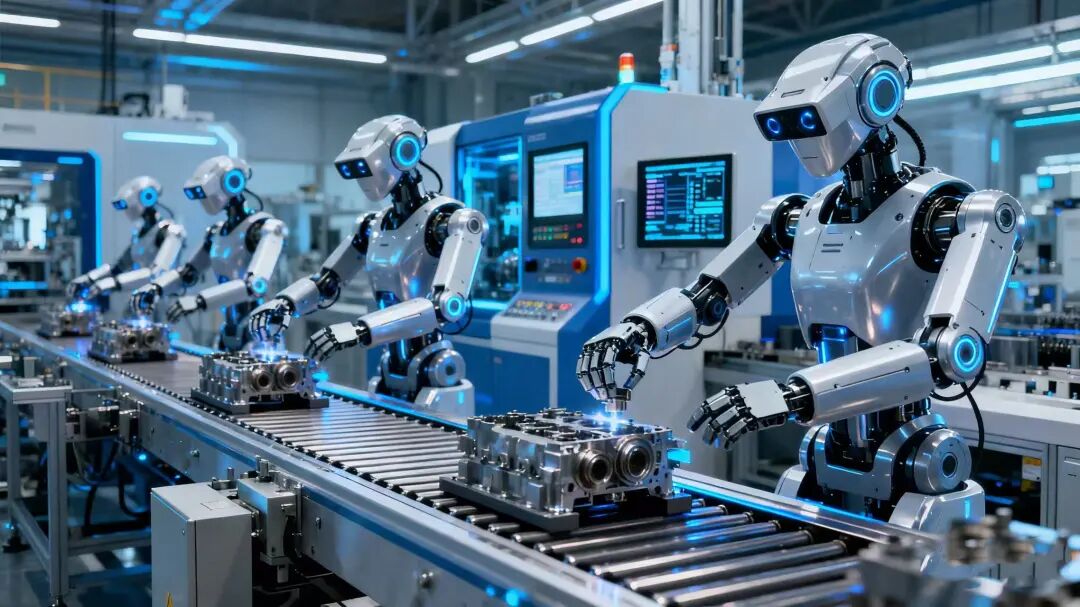
>>Image source from the internet
Embodied
Robot
National Strategy Support, Local Precision Efforts
Policy Support for Embodied Robots
2025 will be the “policy year” for the embodied robot industry, with a collaborative support system formed by top-level design and local practices. At the central level, embodied intelligence is placed alongside quantum technology and 6G as a key focus for future industry cultivation, establishing a special investment growth mechanism; the Ministry of Industry and Information Technology issued the “Guiding Opinions on the Technological Innovation and Development of Humanoid Robots and Embodied Robots”, clarifying the path for core technological breakthroughs. At the local level, multiple initiatives are underway: Beijing aims to cultivate 50 core enterprises and achieve mass production of over 10,000 units by 2027; Shenzhen targets a related industry scale of 100 billion yuan, planning to cultivate 10 enterprises with valuations of 10 billion; Shanghai has launched the “300” goal to promote the core industry scale to exceed 50 billion yuan, fully supporting high-quality industrial development.
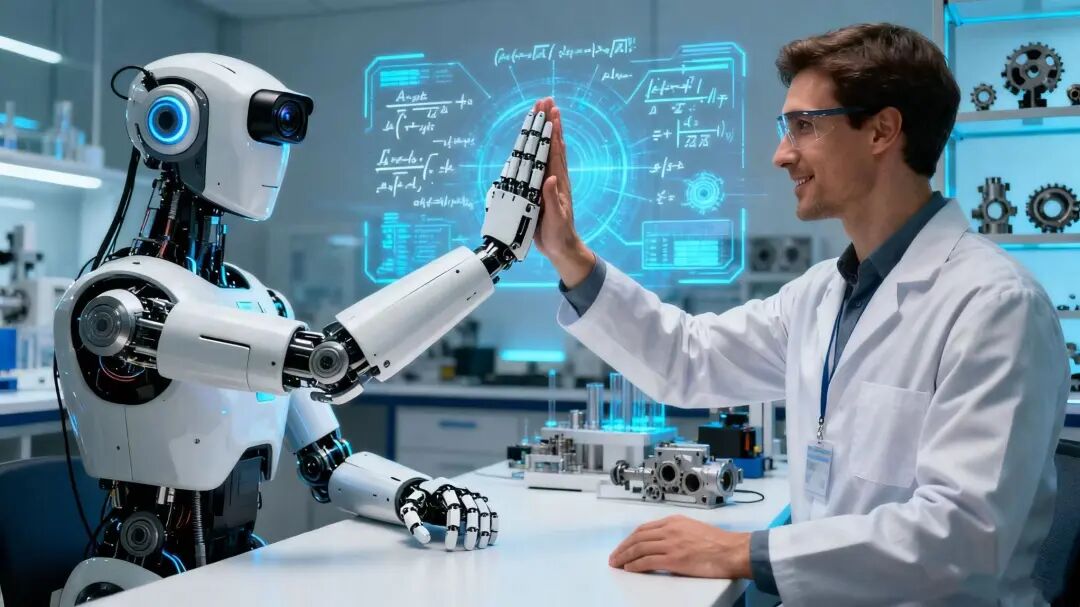
>>Image source from the internet

China Leads in Patents, Global Competition Intensifies
Domestic and International Development Patterns
Globally, the embodied robot industry presents a competitive landscape of “China leading, multiple countries catching up”. China, with its complete industrial chain and cost advantages, excels in core technology fields, with 6,618 patent applications for humanoid robots in 2023 and 3,110 valid patents, both ranking first globally, while the overseas market penetration rate of composite robots has reached 30%. Domestic enterprises are rapidly breaking through in midstream manufacturing and system integration, with multiple mass-produced products landing in industrial and service scenarios; overseas, humanoid robots like Tesla Bot focus on high-end technology research and scenario validation, maintaining certain advantages in precision components. Overall, China holds a first-mover advantage in market size, policy support, and industrial chain completeness, with the global industrial focus accelerating its shift towards China.
Embodied
Robot
Full-Chain Collaboration, Building an Industrial Ecosystem
Industrial Chain Map
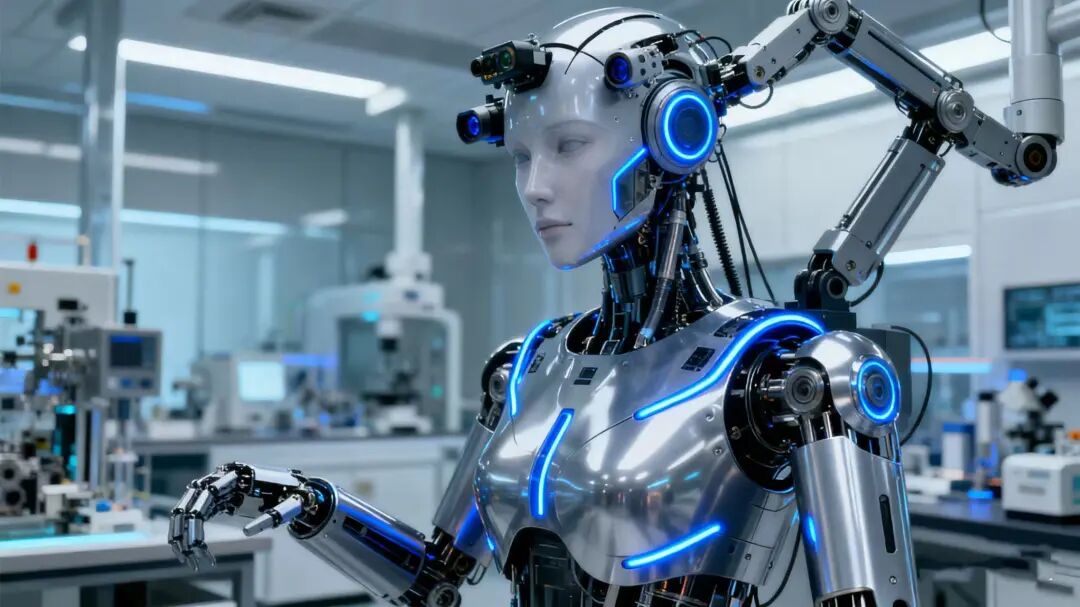
The embodied robot industrial chain presents a clear pattern of “upstream core support, midstream integrated manufacturing, downstream diversified applications”. Upstream focuses on core components and basic software, including key hardware such as visual/tactile sensors, reducers, servo motors, and AI chips, while software encompasses operating systems, control algorithms, and large models; midstream involves whole machine R&D design, body testing, and system integration, with diverse forms such as humanoid, arm-type, and composite robots meeting different scenario needs; downstream widely penetrates fields such as industrial manufacturing, medical care, home services, and high-risk operations, forming an industrial ecosystem of deep integration of “hardware-software-scenarios”. Currently, the industrial chain is upgrading towards “domestic production of components, independent software, and customized scenarios”, with collaborative effects continuously released.
>>Image source from the internet

Technological Iteration and Scene Deepening Empowering Each Other
Future Development Trends
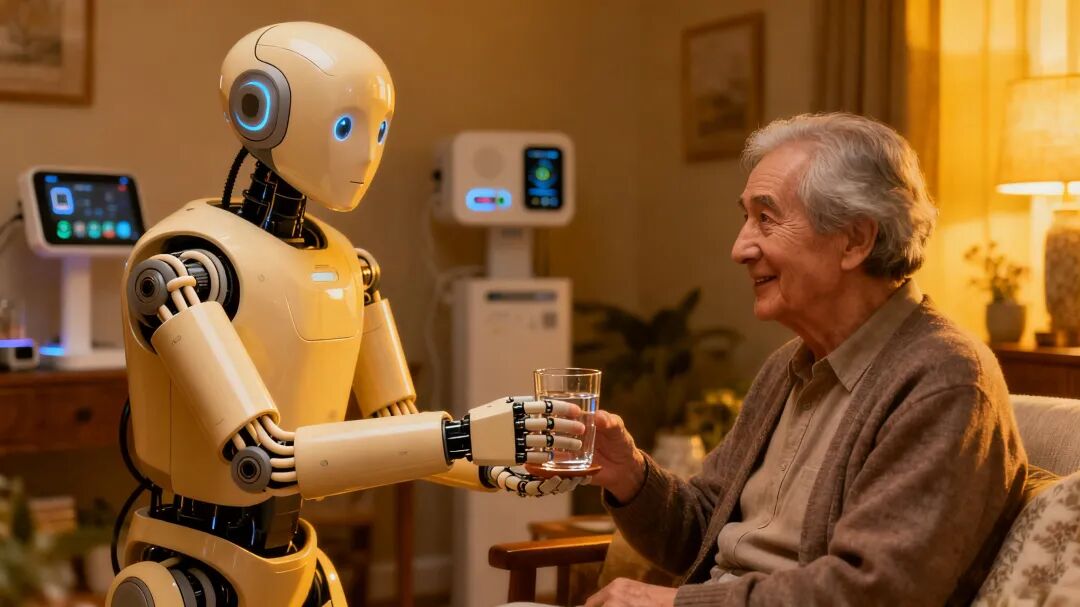
Looking ahead, the embodied robot industry will welcome a dual dividend of “technological breakthroughs + scene explosions”. On the technology front, upgrades in flexible electronic skin, integrated force control joints, and long-lasting batteries will significantly enhance robots’ environmental adaptability and operational precision; the deep coupling of large models and control algorithms will achieve a leap from “specialized intelligence” to “general intelligence”. In terms of scenarios, the industrial sector will fully penetrate into “flexible production”, surgical robots and rehabilitation robots in the medical care sector will become essential products, and household service robots are expected to enter ordinary homes, becoming new life partners. Meanwhile, as industry standards gradually unify and the localization rate of core components increases, mass production costs will continue to decline, driving the industry from “high-end customization” to “inclusive applications”, truly reshaping production and lifestyle.
>>Image source from the internet
From laboratory prototypes to a trillion-scale industrial windfall, embodied robots are not only the ultimate form of intelligent manufacturing but also the core carrier of new productive forces. Driven by policies, technology, and markets, this track connecting innovation and the future is accelerating forward, and the future is here—a new intelligent era built by embodied robots is rapidly approaching us.

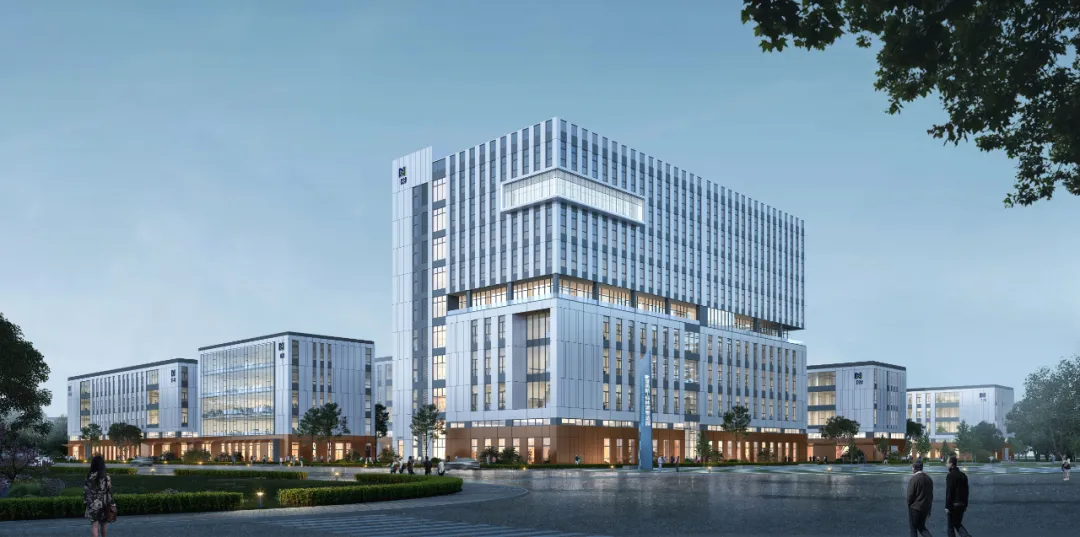
Xinjing High-tech · Xianlin Lake Intelligent Manufacturing Park
 The project covers an area of approximately 48 acres, with a total construction area of over 70,000 square meters. It is designed to high standards with standalone factories, duplex factories, and research and development buildings, as well as related supporting facilities. The project focuses on four cutting-edge industries: intelligent sensing, intelligent manufacturing, artificial intelligence, and optoelectronic technology, aiming to attract leading enterprises in the industry and actively connect upstream and downstream enterprises in the industrial chain, creating a highland of intelligent manufacturing that integrates research and development, office, pilot testing, production assembly, and exhibition reception.
Technology Builds a Golden Nest, Green Construction Shows New Trends | Xinjing High-tech Xianlin Lake Intelligent Manufacturing Park Selected as a Pilot for Intelligent Construction by the Municipal Construction Committee!
Settling in State-owned Enterprise Industrial Park, Starting a New Journey in Intelligent Manufacturing!
Park Dynamics | Xinjing High-tech · Xianlin Lake Intelligent Manufacturing Park Creates a New Position for Industrial Development in Nanjing!