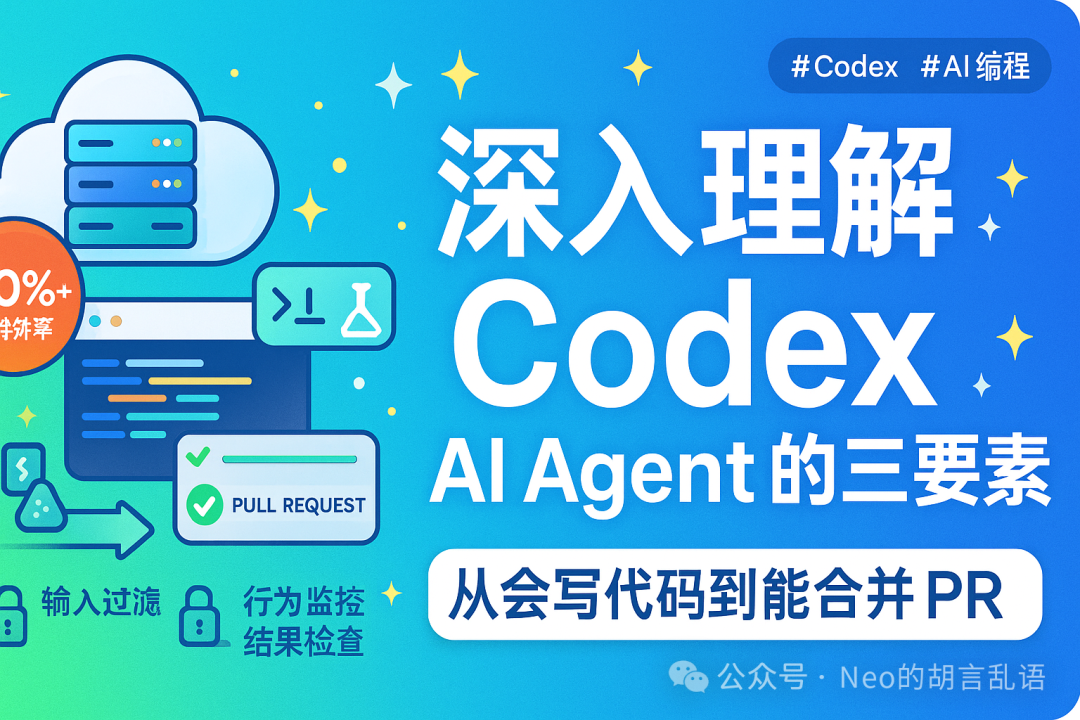
When discussing AI programming, many people’s first reaction may still be “a smarter code auto-completion tool.” However, OpenAI’s latest Codex product has long surpassed this category; it is no longer a passive “assistant” but an active “AI Agent.” This shift is not merely a conceptual game but a profound revolution in the software development paradigm.
So, what exactly allows Codex to evolve from a model into a true Agent? According to its lead, Alexander Embiricos, there are three closely interconnected and indispensable core elements. Understanding these three points is not only key to understanding Codex but also to insight into how AI is reshaping the future of software engineering.
Element One: Powerful Base Model – The Agent’s “Reasoning Brain”
The starting point is a base model with strong reasoning capabilities. This constitutes the “brain” of the Agent. The fundamental difference from ordinary code generation models is that it does not merely perform pattern matching and code filling based on context; it can truly “understand” the complex, multi-step instructions of developers.
- From “How to Write” to “What to Do” Traditional tools solve the problem of “how to write this piece of code,” while the Agent’s brain can understand high-level tasks like “I need a user login feature that supports JWT authentication and handles password error exceptions.” It can break down vague natural language requirements into specific, executable programming steps.
- Context Awareness and Planning A powerful model can maintain long-term memory of the project context, understand the dependencies between different files and modules, and plan the optimal implementation path. This is akin to a seasoned engineer who constructs an overall blueprint in their mind before starting to code.
Without this powerful reasoning brain, the Agent would merely be a shell, unable to comprehend the true intent of tasks, and subsequent actions would be impossible.
Element Two: Comprehensive Toolset – The Agent’s “Agile Hands”
If the model is the “brain,” then the toolset is the “hands” the Agent uses to interact with the real world. Software development is far more than just writing text; it is a complex process that requires deep interaction with various environments and tools. Codex’s breakthrough lies in equipping its intelligent “brain” with a fully functional “toolbox.”
This toolbox includes at least:
- Access to Code Libraries The ability to read, analyze, and even modify existing code within the project.
- Terminal Execution Capability The ability to run scripts, install dependencies, and execute commands.
- Integrated Testing Environment The ability to write and run unit tests and integration tests to verify the correctness of the generated code.
It is this toolset that elevates the Agent’s capabilities from “generating text” to “completing tasks.” Once the model conceives a solution, it can use these tools to implement, verify, and debug it. This addresses the biggest pain point of traditional AI programming tools: the generated code may look good, but developers still need to spend a lot of time integrating, testing, and fixing the new issues it introduces.
Element Three: Autonomous Operating Environment – The Agent’s “Safe Sandbox”
With a “brain” and “hands,” the Agent also needs a space where it can work safely and autonomously. Granting AI full operational permissions directly on a user’s personal computer is akin to a high-risk gamble—one small mistake by the model could lead to critical files being deleted or malicious scripts being executed.
Codex’s solution is to build a cloud-based autonomous operating environment, a “safe sandbox.”
- Isolation and Security This sandbox is completely isolated from the user’s local environment. The Agent has all the permissions and resources needed to complete tasks, but its operations are confined to this controlled environment, preventing any external damage.
- Simulation and Pre-Approval It can simulate a real production environment in the cloud, identifying issues that are difficult to expose in local testing. More importantly, the Agent completes all coding, testing, and dependency checks here before presenting a rigorously “pre-approved” high-quality code merge request (Pull Request) to humans.
These three elements work together to form a perfect closed loop: The brain (model) is responsible for thinking and planning, the hands (toolset) are responsible for execution and verification, and all of this is autonomously completed within a safe working space (sandbox).
The Evolution from Assistant to Partner
The Codex “AI Agent” model signifies a fundamental shift in the role of AI in software development—from a “code completion assistant” that requires human guidance to a “virtual engineering partner” capable of independently undertaking development tasks and collaborating with humans at a high level.
This is precisely why Codex can achieve an astonishing PR merge rate of over 80%. It delivers not just fragmented code snippets but a well-thought-out and self-validated complete solution. For developers, this means they can free up more energy from tedious implementation details to focus on higher-value tasks such as architectural design, requirement analysis, and creative thinking. The future is here, and efficient collaboration with AI Agents will become the core competency of the next generation of software engineers.
Follow the author for more interesting and informative content.