Data is a treasure, research less worries
Dig deep, look far, find patterns
Take notes, practice trading skills, summarize often

★★★★★It is not easy to create original articles, my articles do not require rewards or knowledge payments, you can learn small tips for free. If you like it, please like + collect + share + pin, Little Red Bull expresses gratitude here.★★★★★
Deepseek’s five-step stock review method is generally recognized!!
Deepseek’s bull market operation strategy and risk management
The harsh reality and survival path of retail investors in the stock market
Historical bull market sector rotation rules of A-shares
100 self-researched insights on stock trading (self + cognition + mentality, achieving a state of fearlessness and clarity)
Analysis of the computing power sector industry chain
Analysis of the chip industry chain structure and sub-segments
Analysis of the satellite industry chain structure and applications
Analysis of the automotive industry chain segmentation and development trends
Detailed analysis of the communication equipment industry chain
Analysis of the Internet of Things industry chain structure and application layers
In-depth analysis of the non-ferrous metal industry chain
Detailed analysis of the electrical equipment industry chain
Analysis of the sports industry chain segmentation and development trends
The structure of the robotics industry chain is clear, usually divided into three main links: upstream core components, midstream body manufacturing, and downstream system integration and applications. Among them, the upstream has the highest technical barriers and is the core foundation of industry development.
1. Upstream: Core Components – The “brain, nerves, and joints” of robots: This is the technical and value core of the entire industry chain, accounting for about 70% of the total cost of industrial robots. The performance of core components directly determines the performance indicators of the body.1.1. ControllerFunction: The “brain” and “cerebellum” of the robot, responsible for issuing and transmitting action commands, including motion planning, trajectory interpolation, servo control, etc.Technical core: Control algorithms, software systems.Main manufacturers:
- International: FANUC, KUKA, ABB, Yaskawa (the four major families usually produce for their own use).
- Domestic: Estun, Siasun, Inovance Technology, GSK, Canopy.
1.2. Servo SystemFunction: The “nerves and muscles” of the robot, accurately executing the position, speed, and torque commands issued by the controller, driving joint movements.Composition: Servo driver, servo motor, encoder.Key indicators: Response speed, stability, overload capacity.Main manufacturers:
- International: Panasonic, Yaskawa, Mitsubishi, Siemens.
- Domestic: Inovance Technology (leader), Estun, Hechuan Technology, Invt.
1.3. ReducerFunction: The “joints” of the robot, connecting the power source and the execution end, used to reduce speed, increase torque, ensuring precision and smoothness of movements.Types:RV Reducer: Mainly used for large load and heavy load bases, large arms, etc.Harmonic Reducer: Mainly used for light load and high precision in small and medium arms, wrists, hands, etc.Technical barriers: Extremely high, with very high requirements for materials, processing precision, and gear meshing technology.Main manufacturers:International: Nabtesco (RV leader), Harmonic Drive (harmonic leader).Domestic: RV: Double Ring Transmission, Zhongda Lide, Qinchuan Machine Tool. Harmonic: Lide Harmonic (leader), Laifu Harmonic.1.4. Other Sensors and ComponentsVision System: The “eyes” of the robot, 2D/3D vision used for recognition, positioning, and detection.Force Sensors: Perceiving force and torque, achieving precise assembly, polishing, and other compliant control.Chips: Main control chips (CPU/GPU/FPGA), MCU, etc.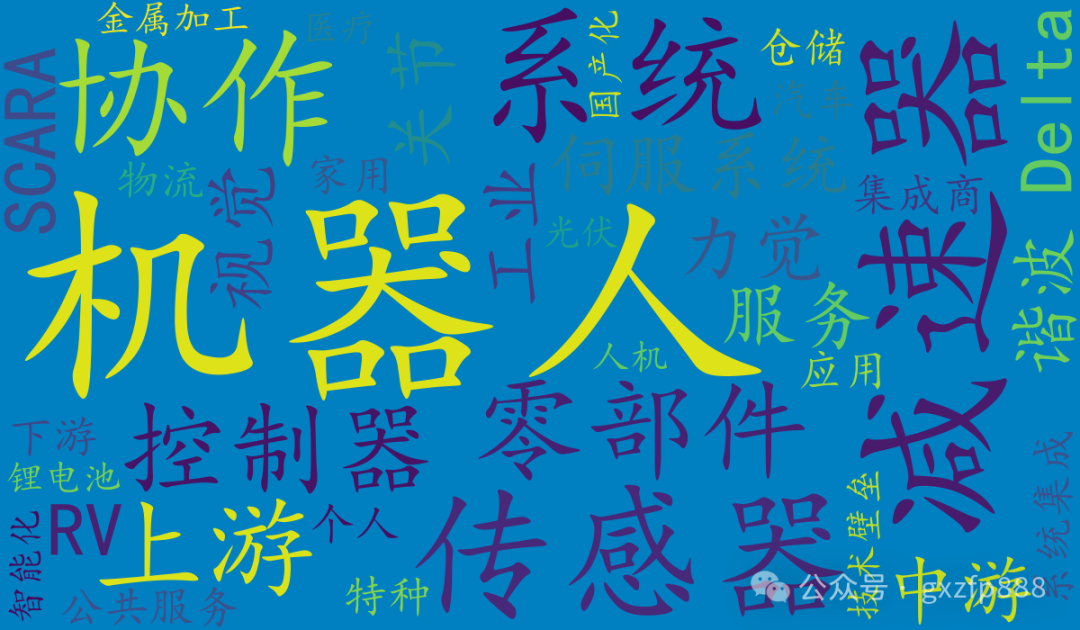 2. Midstream: Body Manufacturing – The “body” of the robot: Integrating upstream components into a complete robot product and designing the structure according to application scenarios.2.1. Industrial RobotsArticulated Robots: The most common 6-axis robots, highly flexible, widely used.SCARA Robots: Planar joint type, fast speed, suitable for planar positioning, assembly, and handling.Delta Parallel Robots: Spider-like robots, high-speed light load, mainly used for sorting and packaging.Collaborative Robots: Able to work alongside humans in shared spaces, high safety, and flexibility.Main manufacturers:
- International “Four Major Families”: FANUC, ABB, KUKA, Yaskawa.
- Other foreign: Epson, Kawasaki Heavy Industries, Nachi.
- Domestic manufacturers: Estun (leader), Siasun Robotics, Inovance Technology, New Times, JAKA Robotics (collaborative), Aobo Intelligent (collaborative).
2.2. Service RobotsPublic Service Robots: Guidance, delivery, cleaning robots (e.g., Yunji, Gaoxian Robotics).Personal/Home Robots: Vacuum robots, companion robots, educational robots (e.g., Ecovacs, Roborock, iRobot).Special Robots: Medical surgical robots, security inspection robots, underwater robots, agricultural robots, etc.3. Downstream: System Integration and Applications – The “skills and work” of robots: Integrating the robot body with other peripheral devices (such as grippers, conveyor belts, vision systems) according to the needs of specific industries and application scenarios, designing and implementing complete automation solutions. This is currently the most concentrated area for domestic manufacturers.3.1. System IntegratorsFunction: Responsible for solution design, software development, system debugging, and after-sales maintenance. They are the bridge connecting body manufacturing and end users.Characteristics: The market is highly fragmented, usually deeply engaged in one or a few specific industries.Main fields:
- Automotive Manufacturing: welding, painting, handling, assembly. (The earliest and most mature application)
- 3C Electronics: Handling, assembly, inspection, dispensing.
- Metal Processing: Loading and unloading of machine tools, cutting, grinding, polishing.
- Plastic and Chemical: Injection molding, handling, stacking.
- Food and Beverage: Packaging, stacking, sorting.
- Logistics and Warehousing: AGV/AMR (Autonomous Mobile Robots), sorting, handling. (A rapidly growing point)
- Photovoltaic, Lithium Battery: Emerging automation demand sectors.
3.2. End Application Industries:Almost all manufacturing industries and some service industries are markets for robot applications, such as:Manufacturing: Automotive, electronics, home appliances, food, pharmaceuticals, textiles, etc.Service: Catering, hotels, retail, medical, elderly care, education, logistics, security, etc.Special Industries: Nuclear power, firefighting, mining, agriculture, aerospace, national defense, etc.
Summary of Industry Chain Characteristics
| Link | Technical Barriers | Gross Margin Level | Market Concentration | Domestic Status |
|---|---|---|---|---|
| Upstream (Components) | Extremely High | High (40%-50% or more) | High (Foreign monopoly) | Striving to catch up, breakthroughs have been made in harmonic reducers (Lide) and controllers (Inovance), but high-end servos and RV reducers still rely on imports. |
| Midstream (Body) | High | Medium (20%-35%) | Relatively High (Four Major Families dominate) | Significant gap, leading domestic companies (like Estun) are accelerating catch-up, and have competitiveness in the mid-to-low-end market. |
| Downstream (Integration) | Medium/Low (Application Engineering) | Low (15%-25%) | Low (Market is extremely fragmented) | Intense competition, this is the main battlefield for domestic companies, with many players, but usually small scale, relying on engineer dividends and localized services. |
Future Development TrendsIntelligent: Deep integration of AI and robotics, reinforcement learning, visual guidance, and force control perception become standard.Modularization and Standardization: Reducing R&D and usage costs, shortening deployment cycles.Collaboration: Human-robot collaboration (HRC) becomes an important direction, safer and more flexible.Popularization: Penetrating from high-end industries like automotive and 3C into general industries (like hardware, building materials, textiles) and commercial service fields.Localization of the Industry Chain: Core components and technologies being self-controllable is a long-term inevitable trend, with huge replacement space for domestic companies.
Friendly Reminder: The stock market has risks, and investment requires caution. The content written in this article is for reference only for fans, merely expressing personal research viewpoints, and stock friends must think and analyze the stock market themselves.
-!! End, thank you for your viewing! –
——-★★Collection of Historical Articles★★—––
Stock Software Longhu List Little Red Bull Analysis System Large Capital Order System
Tongdaxin Main and Auxiliary Chart Indicator Stock Selection Tool Tongdaxin Custom Data System
Custom Data Other Stock Software Ex System Daily Closing Data
Tongdaxin Tips tdx Indicator Writing Tutorial Tdx Indicator Formula
Longhu List Tutorial Speculative Capital Profit and Loss Data Upstream and Downstream of the Industry Chain Stock Academy
Quantitative Tutorial Indicator Backtesting Python My Stock Notes