After Using Cortex-X925, All Big Cores of Dimensity 9400 Become Larger(TechInsights Analysis Report, December 6, 2024, by Chad Davis)MediaTek’s latest flagship smartphone SoC processor, Dimensity 9400, adopts the new Arm Cortex-X925 main core while maintaining a 1+3+4 CPU architecture configuration. It is manufactured using TSMC’s second-generation 3nm process and integrates 29.1 billion transistors. In addition to the Cortex-X925 (previously codenamed Blackhawk) main core, the Dimensity 9400 also features three Cortex-X4 high-performance cores and four Cortex-A720 performance cores, just like its predecessor, the Dimensity 9300. Compared to the Dimensity 9300, the Dimensity 9400 shows significant improvements in performance and efficiency, especially in key metrics for CPU, GPU, and AI. MediaTek has introduced several new AI features in the Dimensity 9400, such as an agent AI engine, high-quality on-device video generation, and low-rank adaptation (LoRA) training for large language models (LLM). It is generally expected that this flagship device level will support mmWave 5G, but this feature is noticeably absent from the current specifications.Since the company launched its first flagship 9000 series 5G version Dimensity SoC in 2021, MediaTek has proven to be a force that Qualcomm cannot ignore. Figure 1 shows most of the products in the Dimensity series, which vary in complexity and cost, while reviewing the top-tier Dimensity 9200 released by the company in Q4 2022, which introduced GPU ray tracing and mmWave to the high-end products (see MPR report November 2022, “Dimensity 9200 Continues to Drive the High-End Market”). MediaTek has some products (some not shown) that are rebranded four-digit versions of older three-digit SoCs (some of which have overflowed to over 1000 digits); for example, Figure 1 shows the Dimensity 7020 and 6080, which are rebranded versions of Dimensity 930 and 810, respectively.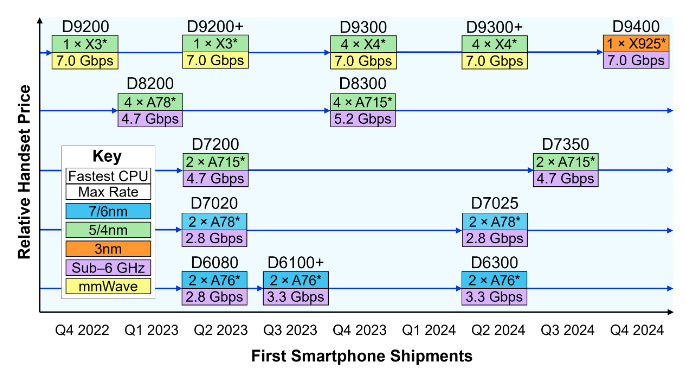 Figure 1 MediaTek Dimensity Product Line(The new Dimensity 9400 features a larger X925 main core on a 3nm process but has dropped the initial mmWave support. The “D” in the abbreviated product name stands for Dimensity. ※ It also includes low-performance CPU cores, totaling 8 cores (Translator’s note: for example, the 9400 actually includes: 1 Cortex-X925 core, 3 Cortex-X4 cores, and 4 Cortex-A720 cores).)MediaTek’s Dimensity 9400 has achieved design wins among Chinese OEMs, including the latest flagship smartphones from Oppo and Vivo, the Find X8 Pro and X200 Pro. There are rumors that due to performance issues with Samsung’s self-developed Exynos SoC, Samsung may collaborate with MediaTek for updates to its upcoming Galaxy smartphones. In the past, Samsung has used two different versions to support its Galaxy flagship products based on the region—using Samsung’s Exynos and Qualcomm’s Snapdragon, respectively. However, Samsung has previously used an all-Snapdragon product line and may do so again, especially if MediaTek’s Dimensity 9400 lacks the mmWave 5G functionality typically found in Samsung’s flagship Galaxy smartphones. Strategically, Samsung could leverage MediaTek to reduce the costs associated with using the more expensive Snapdragon in the market that only serves 5G frequencies below 6GHz.Table 1 Flagship Smartphone Processors(All three mobile SoC competitors now feature large CPU cores. Each company leads in different metrics: Apple leads in single-core CPU performance, Qualcomm leads in multi-core, and MediaTek dominates in GPU performance. (Source: Vendors, except for ※ from Nanoreview.net, † from gsmarena.com, ‡ from Notebookcheck.net, § from AI-Benchmark.com))
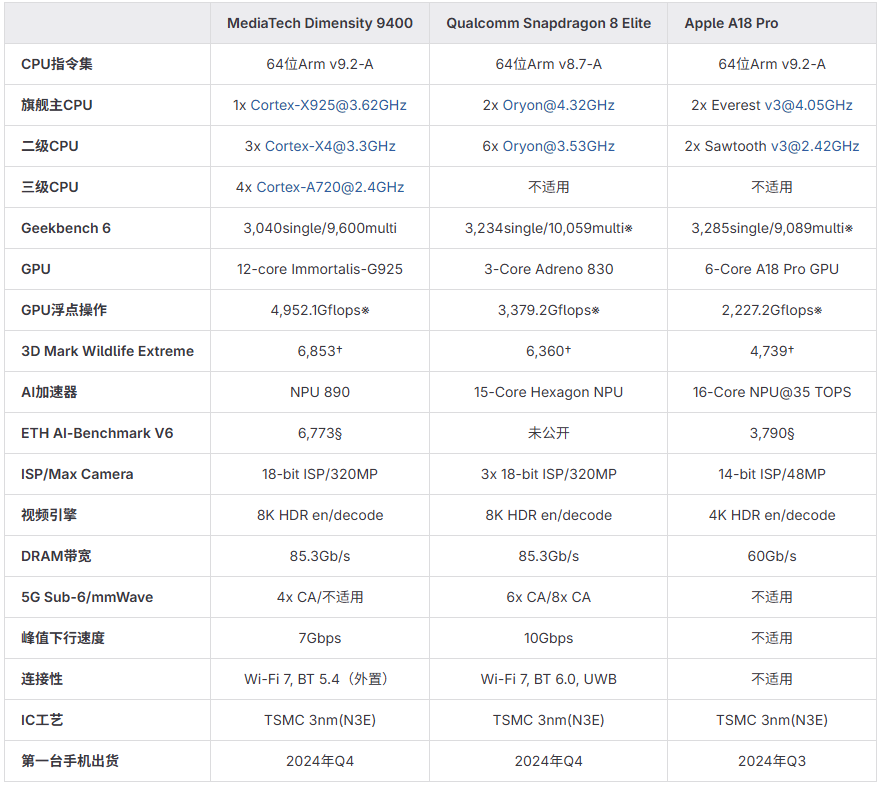 Greater with Cache ImprovementsThe latest larger main core from Arm, Cortex-X925, has a clock speed of 3.62 GHz on TSMC’s new 3nm process for the Dimensity 9400, representing a 7% peak clock speed increase compared to the mid-cycle upgrade of Dimensity 9300+, and a 12% increase compared to the actual predecessor Cortex-X4 main core of Dimensity 9300. Cortex-X925 has a 15% improvement in instructions per cycle (IPC) over the previous Cortex-X4 core, with a 35% increase in single-core performance. Compared to the previous generation, multi-core performance has improved by 28%, and energy efficiency has increased by 40%. Despite the year-on-year improvements in MediaTek’s Dimensity 9400, according to Geekbench 6 scores, Apple’s A18 Pro still leads in single-core performance by 16%, while Qualcomm’s Snapdragon 8 Elite slightly outperforms MediaTek by 5% in multi-core performance, as shown in Table 1.MediaTek has kept the configuration of the remaining “all big core” CPU cluster of Dimensity 9400 the same as that of Dimensity 9300, but with increased clock speeds: three Cortex-X4 high-performance cores at 3.3GHz (up 16%) and four Cortex-A720 performance cores at 2.4GHz (up 20%). The A7xx cores in Arm’s “big.LITTLE” scheme have the flexibility to be configured as either “big” or “LITTLE” cores. The A7xx cores are used as “LITTLE” cores in Dimensity 9300, 9300+, and 9400 to maximize energy efficiency and maintain lower clock speeds, while in most other products in MediaTek’s Dimensity 8000 to 6000 series, they are used as “big” cores, running faster and performing better, as shown in Figure 1. MediaTek continues to phase out smaller efficiency cores in the A5xx series, as this implementation was first introduced in Dimensity 9300 (see MPR report November 2023, “Dimensity 9300 with Four Cortex-X4”). Qualcomm and Apple both equip their CPUs with custom all-big cores, and all three companies utilize TSMC’s latest 3nm process.All Dimensity 9400 cores have doubled L2 cache memory, with the Cortex-X925 core having 2MB, three Cortex-X4 cores each having 1MB, and four Cortex-A720 cores each having 512KB. Additionally, the shared L3 cache has increased by 50% to 12MB, while the system cache remains unchanged at 10MB. These cache improvements should reduce DRAM memory traffic, leading to faster processing speeds and lower latency. Although the L2 cache of Dimensity 9400 has increased to 7MB, it is still less than one-third of the 24MB L2 cache of Qualcomm’s Snapdragon 8 Elite and the 20MB L2 cache of Apple’s A18 Pro. However, both Snapdragon 8 Elite and A18 Pro do not utilize L3 cache.Graphics and AI UpgradesMediaTek has invested significant effort not only in enhancing graphics performance but also in introducing several new AI features, indicating that the company is no longer lagging in this area. In fact, MediaTek is on par with its top competitors in several domains, even surpassing them. MediaTek has implemented the third generation of its Immortalis-branded GPU to achieve a 12-core Immortalis-G925, with ray tracing performance improved by 40%, peak performance increased by 41%, while power consumption has decreased by 44% compared to the Immortalis-G720 GPU in Dimensity 9300. The numbering scheme for the Immortalis-G925 GPU aligns with the Cortex-X925 main CPU core.The Immortalis-G925 GPU enhances scene depth perception through new Opacity MicroMaps (OMM), achieving more realistic effects without increasing model complexity. To showcase this new feature in ray tracing mobile games, MediaTek sponsored and developed an OMM feature test in collaboration with benchmarking company 3D Mark—though technically, this test is not a benchmark. As for actual benchmark tests, Table 1 shows that Dimensity 9400 leads in GPU floating-point operations (FLOPS), reaching 4,952.1 GigaFLOPS, which is 1.5 times higher than Qualcomm’s Snapdragon 8 Elite and more than double that of Apple’s A18 Pro. In the 3D Mark Wildlife Extreme GPU benchmark test, the GPU metrics appear closer, but they still show similar results, with Dimensity 9400 only surpassing Snapdragon 8 Elite by 500 points while easily beating A18 Pro by over 2,000 points.MediaTek’s eighth-generation Neural Processing Unit (NPU: Neural Processing Unit) 890 has several improvements over the previous generation, such as the company’s so-called “agentic AI” system designed to enhance smartphone assistants. According to MediaTek, it also features high-quality on-device video generation and LoRA training for LLMs. Generative AI has surpassed image generation on smartphones (see MPR report March 2023, “Generative AI on Smartphones”), although MPR remains skeptical about its speed and operational quality in current smartphones. Additionally, the NPU 890 has significantly improved instant performance for LLMs, with an 80% increase, and diffusion generation performance has doubled compared to the previous Dimensity 9300 NPU 790, with operational efficiency improved by 35%. The Dimensity 9400 NPU 890 claims to achieve edge multimodal AI running speeds of 50 tokens per second, more than double the 22 tokens per second of the Dimensity 9300 NPU 790.MediaTek has not released any TOPS (trillions of operations per second) data, which is a better comparative performance metric among different vendors. However, MediaTek claims that last year’s Dimensity 9300 could achieve 48 TOPS, so the performance of Dimensity 9400 should be above this level. Apple states that its NPU can reach up to 35 TOPS, while Qualcomm has not disclosed the TOPS performance of the 15-core Hexagon NPU on Snapdragon 8 Elite. AI-Benchmark tests from ETH Zurich show that Dimensity 9400’s highest benchmark score is 6,773, a 38% improvement over last year’s Dimensity 9300. Apple’s A18 Pro scored 3,790, about half of Dimensity 9400’s score. Unfortunately, ETH Zurich has not yet released AI benchmark data for Qualcomm products.Farewell to mmWaveSmartphone OEMs began adding 5G support to flagship phones in 2019, soon followed by mmWave frequency support. It is rare for smartphone SoCs to regress, but at first glance, MediaTek seems to be doing just that by omitting mmWave support from the specifications of Dimensity 9400. The Dimensity 9000 series first gained mmWave support in Dimensity 9200 and has supported it ever since, so dropping it now seems strange… or is it? Earlier this year, Apple dropped mmWave from its latest iPad series (see TechInsights “Deep Dive into the 7th Generation Apple iPad Pro 13”). However, dropping mmWave from the iPad makes sense, as mmWave is most useful in crowded places like stadiums, conference centers, and similar venues—most people do not carry iPads around.MediaTek’s Dimensity 9000 series SoCs typically find slots in Oppo and Vivo products (and others) each year, but neither brand has offered mmWave support in phones equipped with the latest flagship Dimensity SoC. The demand for mmWave support in China is not high, so MediaTek’s decision seems pragmatic. MediaTek’s Dimensity 1050 added mmWave to the mid-range Motorola Edge 2022 (see MPR report May 2022, “Dimensity Adds mmWave 5G”), which has packaged antenna (AiP) hardware, with a total cost of about $16 to implement 5G mmWave (see TechInsights “Deep Dive into the Motorola Edge 2022 mmWave XT2205-3 Smartphone”). MediaTek’s expensive antenna module has not appeared in any other 5G mmWave devices, so it is safe to say this was an experimental effort that is not worth repeating in future phones due to high costs. If MediaTek were to participate again, it might use mmWave AiP modules from third-party suppliers like Murata or USI. Qualcomm and Apple may find this beneficial for their market coverage in the flagship segment.GPU and AI Achieve Significant Leap, CPU Performance ApproachesIntroducing Arm’s latest 3nm-based Cortex-X925 main core into Dimensity 9400 is a highlight of MediaTek’s all-big core architecture, as it brings significant improvements in IPC and energy efficiency. The 1 + 3 + 4 CPU architecture consists of three Cortex-X4 and four Cortex-A720 performance cores, again discarding smaller efficiency cores—its closest competitors have done the same. With these CPU advancements, MediaTek remains slightly behind, but in some benchmark tests using custom CPUs, its performance has approached that of Qualcomm and Apple. However, on a more positive note, MediaTek’s new Immortalis-G925 GPU outperforms both Qualcomm’s Snapdragon 8 Elite and Apple’s A18 Pro in terms of performance and energy efficiency.While consumers still hope to determine who maintains the lead in competition through graphics and imaging capabilities, attention has shifted to the AI capabilities of devices. AI is embedded in various aspects of SoC performance, from graphics, imaging, connectivity, and battery life. By the end of Q2 2024, smartphones equipped with built-in AI are expected to account for about 80% of the total market share, and this number continues to grow. As early as Q2 2019, MediaTek surpassed Qualcomm with a 33% market share to become the market leader in non-AI devices. It has also been competing with Apple for second place, while Qualcomm has led in smartphones with built-in AI for most of 2022 and 2023, until MediaTek finally surpassed Apple and Qualcomm with a 34% market share in the last quarter (see TechInsights report “2Q24 Built-in AI Device Market Model”; additional subscription required). The introduction of on-device AI implementations (such as high-resolution video generation and LoRA training for LLMs) and new agent AI applications have helped MediaTek’s Dimensity 9400 catch up with competitors.Given the sluggish demand in the Chinese market, MediaTek’s practical decision to drop mmWave 5G functionality makes sense. After all, the latest smartphones equipped with the newest Dimensity 9xxx SoC from Oppo and Vivo do not support mmWave—despite previous chip iterations meeting mmWave standards. Even so, if MediaTek hopes to leverage this advantage and replace the underperforming Samsung Exynos processor in the next-generation Samsung Galaxy, it will certainly adopt international alternatives in a dual-supplier scenario, as flagship smartphones in the U.S. absolutely require mmWave functionality. MediaTek has previously supported mmWave and could easily support it again in updated Dimensity 9400 designs.Overall, MediaTek’s Dimensity 9400 has made significant progress in all aspects compared to its predecessor, but it falls short in some key CPU metrics compared to competitors. It offers the best graphics performance compared to competing devices, and MediaTek has also improved its AI performance relative to the previous generation. Qualcomm acquired Nuvia, which originally developed the Oryon CPU architecture on which Snapdragon 8 Elite is based. Qualcomm is embroiled in a licensing dispute with Arm, which was used for its previous Snapdragon 8 Gen 3 CPU design (see “McClean Bulletin: Qualcomm Fights Legal Battle with Arm”). If Arm wins, Qualcomm may have to pay higher patent royalties (increasing the cost of its devices) or, in the worst case, withdraw SoCs from the market, benefiting MediaTek. MediaTek’s Dimensity 9400 is expected to be used in the upcoming Oppo Find X8 Pro and Vivo X200 Pro, among other models and vendors, in Q4 2024.Learn More* MediaTek’s Dimensity 9300+ lands in the U.S., featured in Samsung Tab S10+. See “MediaTek’s First Footprint in North America’s High-End Mobile Space”.* Interested in a deep dive into the layout analysis of MediaTek Dimensity 9400? See “MediaTek Dimensity 9400 Layout Analysis”.* Curious about MediaTek’s overall company performance? Check out “MediaTek Company Overview”.